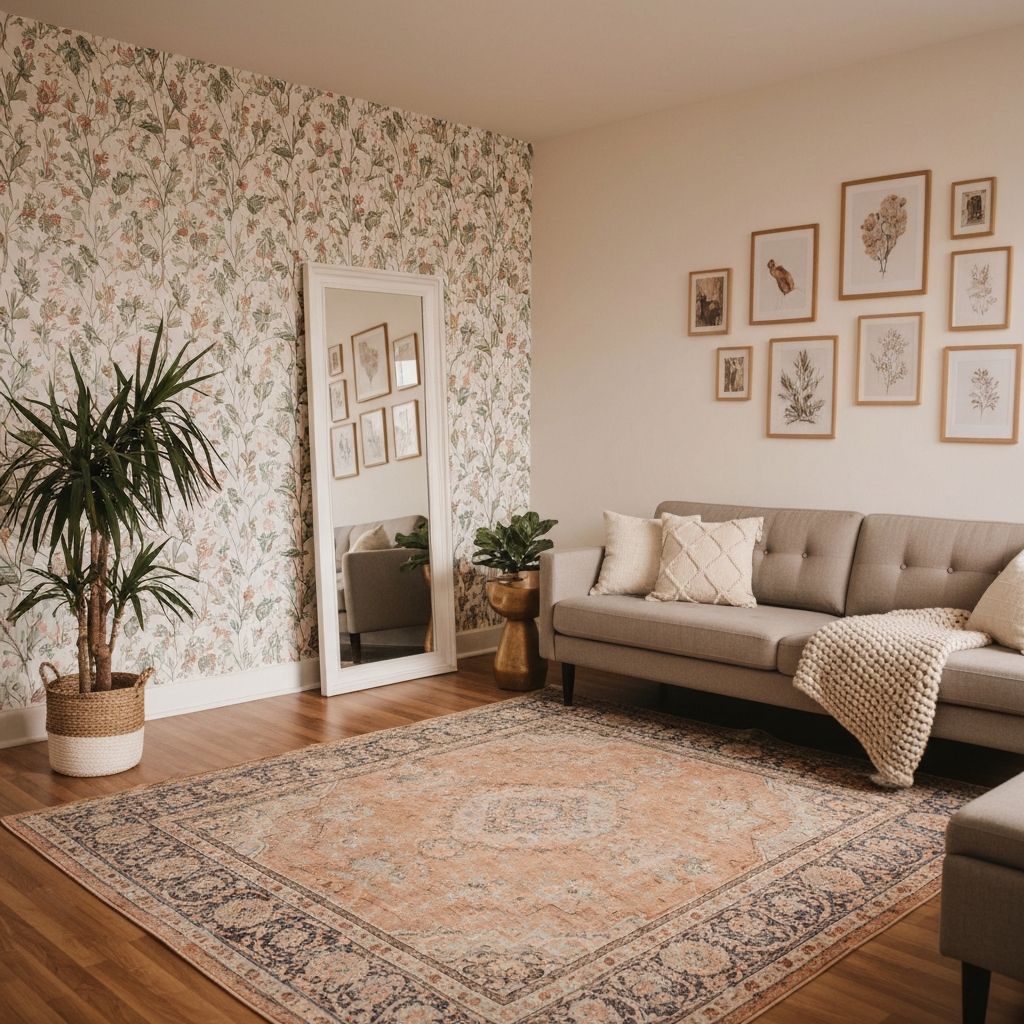
Renters hang art without damage when the system commits to one of three damage-free methods — Command picture-hanging strips for pieces under 5 lbs, adhesive Tombow or 3M hooks for pieces 5 to 15 lbs, or freestanding leaners and shelf-mounted art for anything heavier — and frames stay light (acrylic or matboard, not glass) so the limits hold. Renters either over-commit to nail holes (deposit gone) or under-commit to art altogether (apartment feels like a furnished sublet). Neither has to happen. The right system to hang any piece of art exists for almost every weight, surface, and lease — and the trade-offs between them are predictable. The biggest mistake most renters make is using the wrong adhesive product for the weight, finding it on the floor at 2 a.m. with a cracked frame, and concluding that nothing works in a rental. Match the product to the weight class and the wall type, and you can hang a real art wall in any apartment without losing a dollar of your deposit.
How do you hang pictures in a rental without damaging walls?
Use Command Strips for anything under 16 lbs, 3M velcro hanging strips for textiles and lightweight frames, picture-hanging rails for serious art walls if the lease allows minor ceiling holes, leaning art on a console or floor for unframed canvas and large pieces, and over-the-door hanging for collections in narrow spaces. Each method has a weight ceiling and a wall-type restriction; ignore those and you'll lose the art and the deposit.
The adhesive-strip method (under 16 lbs)
The default for most rental walls and most frames.
- Command Picture Hanging Strips. Velcro-style strips that hold up to 16 lbs per pair. Remove cleanly when stretched downward — never pulled outward.
- Surface matters. Works on smooth painted drywall and most painted wood. Does not work on textured walls, raw plaster, unpainted brick, or recently painted walls (wait 3 weeks after paint).
- Two strips per frame minimum. One per corner is a recipe for a tilted frame and a 4 a.m. crash.
- Press for 30 seconds. Wait an hour before hanging. The adhesive needs full cure time before bearing any weight.
- Remove by pulling straight down, slowly, parallel to the wall. Pulling outward tears paint or drywall.
What does not work with adhesive strips: anything heavier than 16 lbs (use a different method), glass frames over 16x20 (find a lighter frame), oil paintings on stretched canvas without a hook system (wrap with picture wire first), and freshly painted walls.
Textile and lightweight hangings (under 4 lbs)
For tapestries, fabric prints, paper posters in clip frames, and lightweight wood frames.
- Adhesive velcro squares (Command brand or generic 3M). Work even on slight texture.
- Adhesive S-hooks for small clip-frames or paper posters with sawtooth hangers.
- Adhesive plate hangers for ceramic plates, vintage trays, and oversized coins or medallions. The current best-selling rental decoration on Etsy is plates hung as wall art.
Picture-rail method (serious art wall, lease permitting)
This is the move for renters who plan to hang multiple pieces or rotate art regularly.
- Install a horizontal picture rail about 6" below the ceiling using minimal screws (3–4 screws across a typical wall). Total holes in the wall: ~4 small screw holes, all in one line at ceiling height.
- Hang every piece from the rail using monofilament line, S-hooks, or decorative chain.
- Adjust freely without touching the wall again. Move pieces, swap frames, change layouts entirely — all without a single new hole.
- Lease check. Some leases prohibit any wall hole; most allow small picture-hook holes that are filled at move-out. Before installing, send the landlord a 60-second message describing the install and ask written approval. Most agree because it's less damage than a single nail.
For a useful room-planning comparison, keep Budget Design: 15 Moves That Look Expensive (And Aren't), Brass Hardware Everywhere: Update Brass Hardware Home Without Replacing All of It, and Bedroom Without a Closet: Bedroom No Closet Storage Ideas nearby so this retrofit stays connected to the adjacent lighting, storage, scale, and layout decisions in the same photo-led workflow.
Test this on your own room photo with ReDesign before you choose the final direction; keep the doorway, walls, windows, main furniture, lighting, and awkward fixed features visible so the preview solves the room you actually have.
The leaning art method
Underrated. The single most renter-friendly art move because it doesn't require touching the wall at all.
- A single oversized piece (40"+) leaning on a console or floor reads more sophisticated than the same piece on a wall.
- Stack two or three pieces of different sizes, slightly overlapping, against a wall behind a sofa or console.
- No frame needed. Stretched canvas, framed prints, and even unframed posters in DIY frames all work.
- Floor-to-ceiling mirror leaned against a wall is the single most impactful rental decor move — adds light, adds depth, and disappears when you move out.
Over-the-door and shelf-based methods
- Over-the-door hooks can hold a small framed piece or textile inside a doorway, on the back of a closet, or facing a hallway.
- A floating ledge or picture shelf (Ikea Mosslanda is the workhorse here). A 4-foot floating shelf with two screws holds an entire rotating gallery of leaning frames. Two screws total, easily patched at move-out.
- A bookshelf with art mixed into the books. A small framed piece leaning between books is the most renovation-friendly art hanging there is.
Heavy art (over 16 lbs) in a rental
Adhesive strips fail above 16 lbs. Options:
- Picture rail (above). Best long-term solution.
- Drywall anchors plus a small screw. A toggle anchor or even a basic plastic anchor + 1¼" screw holds up to 50 lbs. Hole is about ¼". Patches with a dab of spackle and a swipe of paint at move-out — usually inside the wear-and-tear allowance.
- Floor leaners. Heavy framed art on the floor against a wall is often more striking than hung.
- A 16-lb-class frame on a heavier piece. If you're committed to hanging adhesively, downsize the frame. A frameless or thin-frame canvas can drop a piece below the strip limit.
Common rental-art mistakes
- Nailing every frame. Adds up to dozens of holes that don't patch invisibly without primer and paint.
- Using too few adhesive strips per piece. A frame held by one pair when it needs two ends up on the floor.
- Adhesive strips on textured or freshly painted walls. Strips peel off the texture or pull off the new paint.
- Heavy frame on adhesive strips. Anything over 16 lbs needs a different system.
- Tiny prints scattered across a big wall. Gallery walls with tiny pieces look unfinished. Go larger or denser.
- Symmetrical perfectly-spaced grids. Look dated. Vary frame size and spacing for a designed gallery instead.
Use AI design to preview your rental art wall
Most renters skip art because they can't picture how it'll lay out and don't want to risk holes for nothing. AI design lets you photograph any wall and preview a gallery layout, a single large piece, or a leaning composition — all before drilling, sticking, or buying frames. Decide on the layout, then commit.
Frequently Asked Questions
Do Command strips actually hold framed art?
Yes — small Command strips hold 1 to 4 lbs and medium hold 4 to 12 lbs per pair when the wall is clean, the frame back is flat, and the strips fully cure for 1 hour before hanging. Use the room photo to compare the visible layout and fixed constraints before committing, because door swings, windows, outlets, storage reach, circulation, and existing furniture decide whether the idea survives daily use.
What is the heaviest art I can hang without nails?
Adhesive hooks rated for 15 to 20 lbs handle most framed prints up to 24x36in; heavier or glass-front pieces need either floor-leaners, picture rails, or permission from the landlord for proper nails. Keep the preview honest by leaving the problem area visible in the frame, then compare one conservative version against one bolder version before you buy lighting, paint, furniture, or storage.
Can I use a picture rail in a rental?
Many older rentals already have picture rails near the ceiling; if not, a stick-on or removable picture rail bonds at the rail line without nails and supports several pieces from hooks. Check the result against ordinary movement first: drawer clearance, chair pullout, walkway width, glare, switch access, and sightlines matter more than a perfect catalog angle.
How do I level art hung with adhesive strips?
Apply strips to the frame back, attach to wall, then peel and reposition before pressing firmly — strips set in 30 seconds and fully cure in an hour; do level checks during the first 30 seconds. Use the image to narrow priorities and measurements before ordering anything custom; final purchases still need real dimensions, outlet locations, installation limits, and product clearances.
What if a landlord still charges for damage?
Adhesive strips and hooks are designed to remove cleanly when peeled slowly downward; document the wall before installing with photos and reference the product on the lease move-in form to avoid disputes. If the preview invents architecture or hides the awkward feature you need solved, rerun it with stricter instructions so the result remains tied to your actual room.
> Try this: Ready to see this on your own room? Open ReDesign and run the preview.
Three transformations to try
1. Gallery wall hung with Command strips in rental 2. Floor-leaner art on console table 3. Shelf-mounted art collection across rental wall