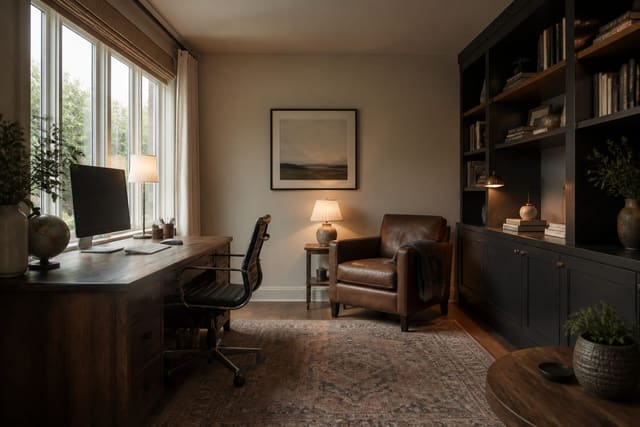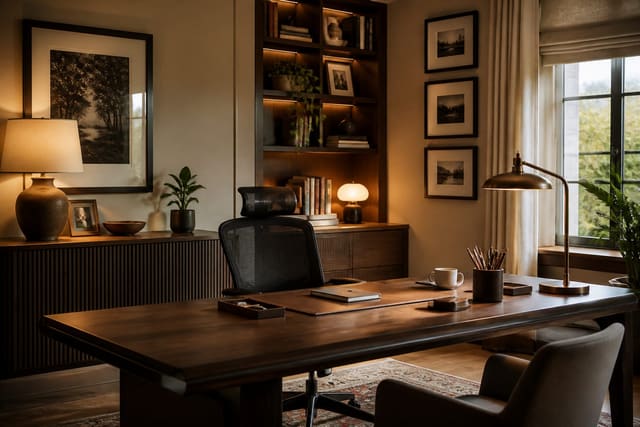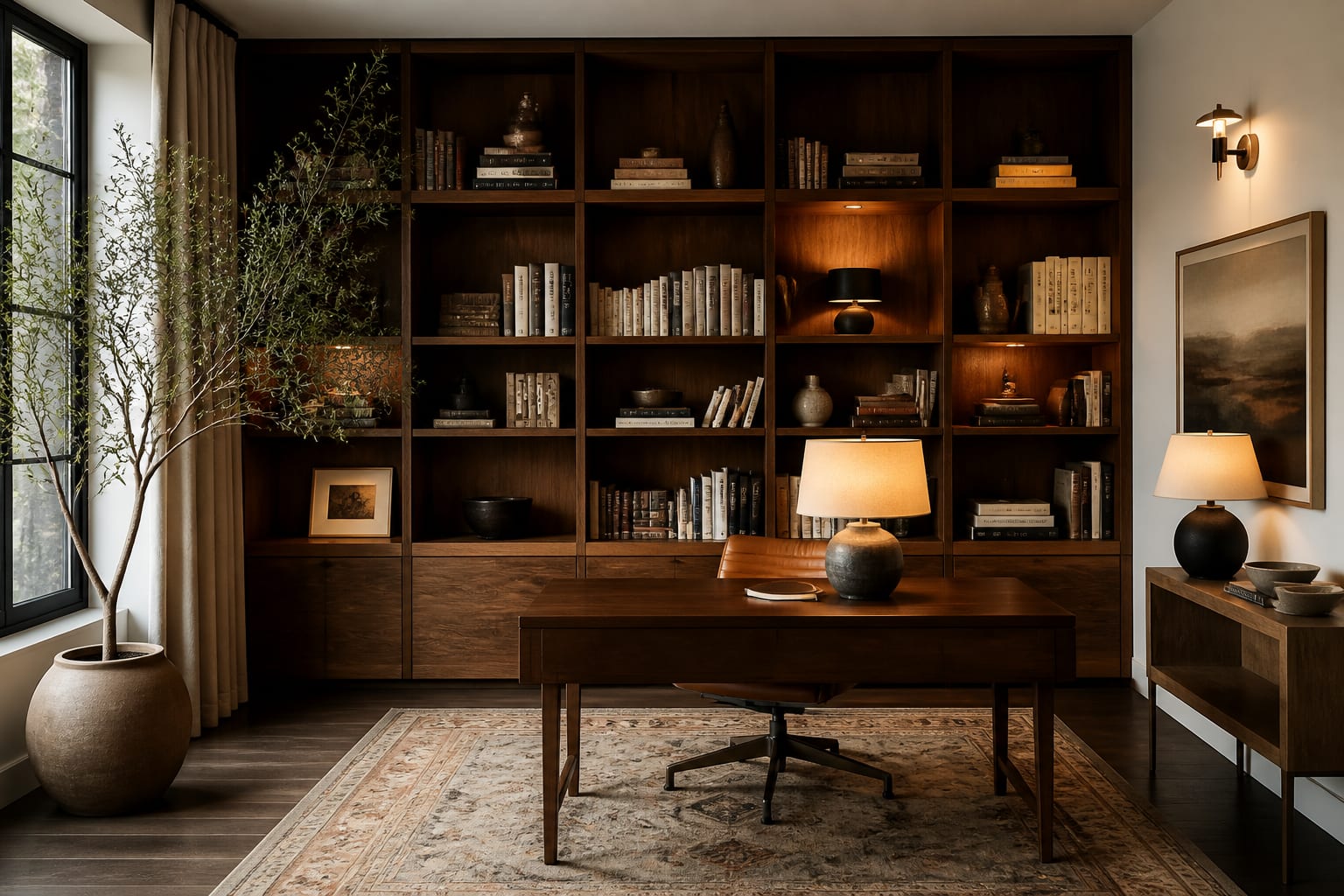
A bookcase behind your desk is now the most-seen piece of furniture you own, and most people style it like nobody is looking. The mistake is cramming it full of mismatched spines and stacked clutter, which on camera reads as visual noise behind your face. The better move is to design the bookcase as a backdrop first and storage second: control the ratio of books to objects, leave deliberate negative space, and place it where the camera flatters it. Get that right and your wall does quiet work in every meeting, signaling that you are organized and considered without you saying a word.
How do you style a bookcase that reads well on camera?
The camera flattens everything, so a shelf that looks fine in person can look chaotic on a call. The fix is restraint. Aim to leave about 30 percent of each shelf as negative space, because empty room around objects is what makes a bookcase look curated rather than stuffed. Group books in both directions: a vertical row anchored by a horizontal stack with a small object on top creates a rhythm the eye can rest on. Avoid filling every inch; a packed wall behind your head competes with your face for attention.
Color discipline helps more than anything. Spines in clashing colors read busy, so turn a few noisy books backward to show the pages, or slip on neutral dust jackets, and the wall calms instantly. Repeat two or three accent colors across the shelves so the backdrop feels intentional. A handful of objects, a small plant, a framed print, a ceramic, breaks up the books and adds depth. If you are building the whole room around the camera, our home office setup guide covers desk position and lighting that the bookcase has to work with. The bookcase is one layer of a composed frame, not the only one.
Where should the bookcase go relative to the camera?
Placement decides whether the bookcase helps or hurts. The strongest spot is directly behind your chair, filling the frame behind you, but set slightly off-axis so the shelves run at a gentle angle rather than dead flat. A perfectly head-on bookcase looks like a corporate stock photo; a few degrees of turn adds depth and looks more natural. Keep about 3 to 4 feet between you and the shelves so the background sits softly out of focus while your face stays sharp.
Watch the window. A bright window behind the bookcase will silhouette you and wash out the shelves, so position the unit on a wall perpendicular to the daylight, not in front of it. The camera should look at the bookcase with the light source to the side. If your office doubles as another room, a bookcase can also screen off a bed or clutter zone, doing double duty as backdrop and divider. Think about what the lens sees first, then arrange the furniture to serve that view.
What are the best bookcase configurations for a home office?
The right structure depends on your wall and budget, and there are more options than the standard five-shelf unit. Floor-to-ceiling built-ins make the most of a small room and read as architecture, but they are fixed and pricey. A few configurations worth considering:
- Floor-to-ceiling built-ins flanking the desk, turning the whole wall into integrated storage and a seamless backdrop.
- A pair of matching freestanding bookcases set symmetrically behind the desk for a balanced, framed look on camera.
- Open back shelving or a ladder unit for a lighter, airier backdrop that does not block light in a small room.
- A low credenza topped with a few framed pieces and a plant, for offices where a tall unit would crowd the camera.
- Modular cube shelving you can rearrange, mixing closed bins for clutter with open cubes styled for the camera.
Mix closed and open storage so the messy reality, cables, files, supplies, hides behind doors while the open shelves stay styled. The right desk organization keeps the working surface clear so the bookcase, not a pile of papers, defines the backdrop. Whatever you build, leave a few shelves you can keep camera-ready and let the rest do real work.
How do you light a bookcase backdrop?
Lighting separates a backdrop that glows from one that disappears into a gray blur. A bookcase lit only by overhead light casts hard shadows into the shelves and looks dull on camera. Add dedicated shelf light: an LED strip tucked under the front edge of each shelf, or a few small puck lights, at a warm 2700K to 3000K so the wood and objects feel inviting rather than clinical. That glow gives the backdrop depth and makes your whole frame look more produced.
Keep the bookcase lighting dimmer than the light on your face, so the backdrop supports you instead of stealing focus. A simple ratio works: light your face brightest, the bookcase a step below, so the camera reads you as the subject and the shelves as setting. A small picture light over a framed piece or a plant on an LED grow bar adds another layer of warmth. The goal is a backdrop that reads three-dimensional and alive on camera, with pools of warm light rather than one flat wash, the same principle that makes any room look styled rather than lit by accident.
Preview your bookcase wall in Re-Design
Styling a bookcase for the camera involves a lot of small judgment calls about color, density, and scale that are hard to picture in advance. Upload a photo of your office wall to Re-Design and preview a floor-to-ceiling built-in, a pair of freestanding units, or a low credenza in the exact spot the camera will see. You can test how full to style the shelves, whether warm shelf lighting reads better than cool, and how the unit looks slightly off-axis versus head-on, all before you buy or build. Seeing the backdrop in your real room takes the guesswork out of scale, so the bookcase frames you well on every call instead of fighting for attention.
Frequently Asked Questions
How do I make a bookcase look good on video calls?
Leave roughly 30 percent of each shelf empty so the backdrop reads composed rather than cluttered. Mix vertical book rows with horizontal stacks and a few objects, keep the spine colors to a calm palette, and add warm 2700K shelf lighting. Position the unit a few feet behind you and slightly off-axis so it fills the frame with depth while your face stays the focus. Restraint is what makes it look intentional.
Should a home office bookcase be built-in or freestanding?
Built-ins make the most of a small room, read as polished architecture, and give a seamless backdrop, but they cost more and cannot move. Freestanding units cost less, can be restyled or relocated, and let you swap configurations as your needs change. If you rent or expect to rearrange, go freestanding. If you own and want maximum storage in a fixed office, built-ins are worth the investment.
Where should I place a bookcase for the best camera background?
Put it directly behind your chair so it fills the frame, but turn it a few degrees off-axis so the shelves run at a gentle angle rather than dead flat. Keep 3 to 4 feet between you and the unit so it sits softly out of focus. Place it on a wall perpendicular to your window, never in front of the window, so daylight lights the shelves from the side instead of silhouetting you.
How do I light a bookcase for video calls?
Add dedicated shelf lighting, an LED strip under each shelf's front edge or small puck lights, at a warm 2700K to 3000K. Keep that backdrop light a step dimmer than the light on your face so the camera reads you as the subject. This creates depth and warmth on the shelves so the bookcase looks three-dimensional on camera instead of flattening into a dull, shadowed wall.