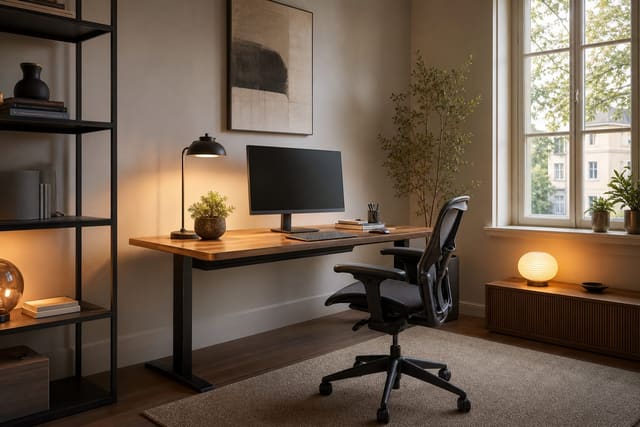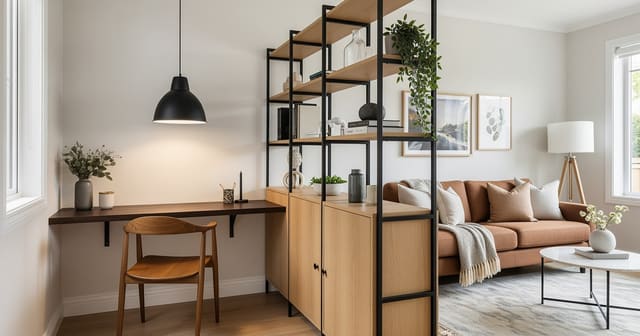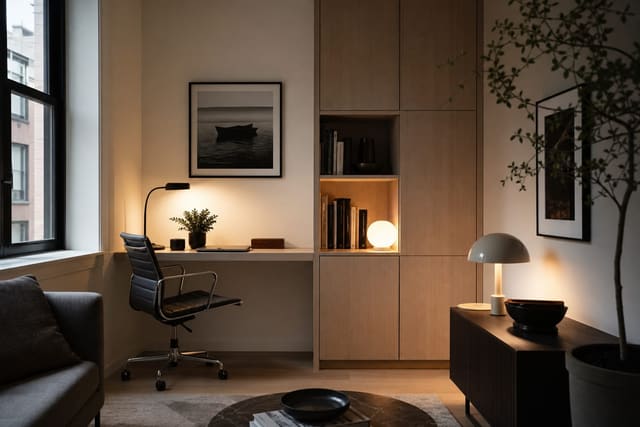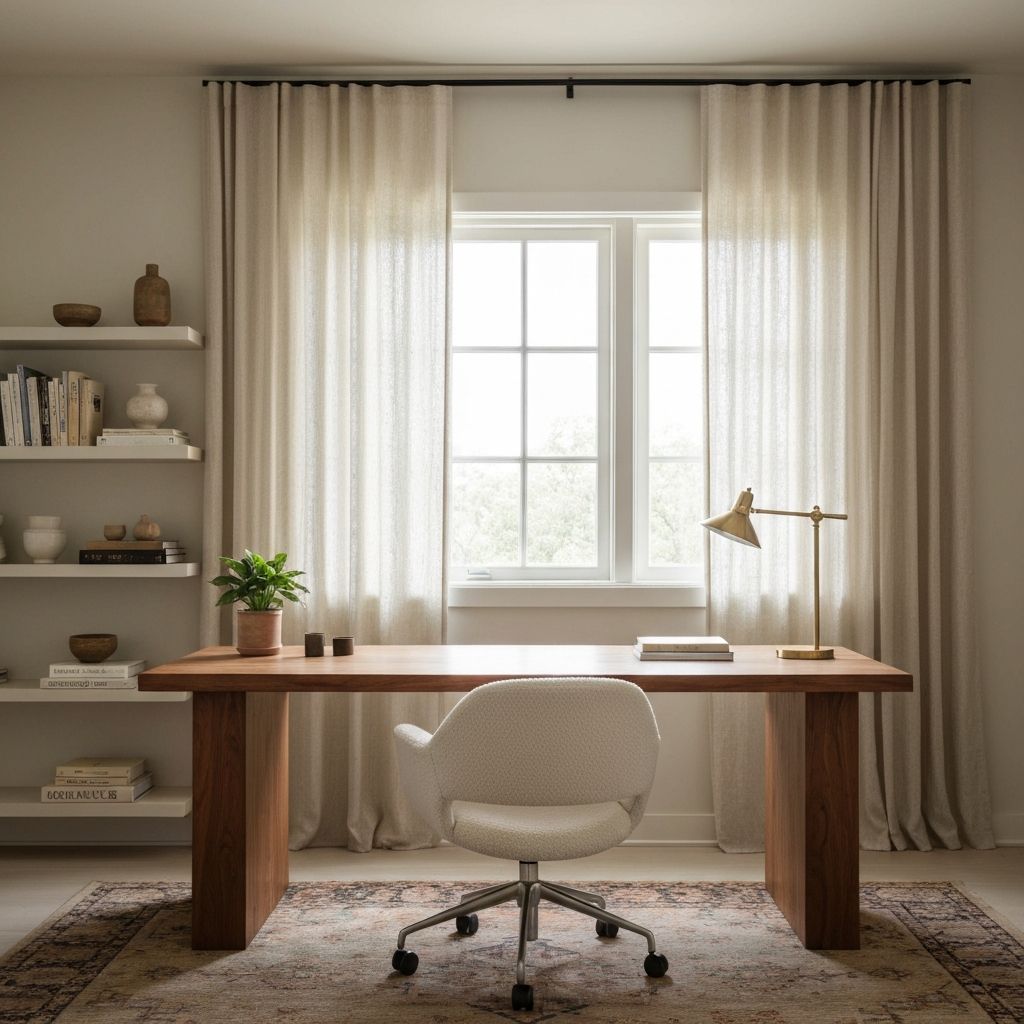
A home office reads designed and supports focused work when the room commits to four foundations — the desk faces a wall or window (not the door), the chair is real ergonomic (lumbar support, adjustable arms, breathable mesh), the lighting layers three sources (ambient, task, and warm fill), and the storage handles paper, supplies, and tech without spilling onto the desk. Working from home has gone from temporary to permanent for millions of people, and the home offices that were thrown together in 2020 are no longer good enough. A home office that actually helps you focus, performs well on video calls, and feels like a place you want to spend eight hours in is a real design project — even if it's a corner of a bedroom or a converted closet. Here's how to design a home office that supports deep work in any space.
Designing a home office in whatever space you have
Most home offices aren't dedicated rooms — they're corners of bedrooms, ends of hallways, converted closets ("cloffices"), and shared dining-table setups. The design principles are exactly the same regardless of footprint. Smaller spaces just demand more discipline.
The non-negotiables of any home office
- A door or visual barrier between you and the rest of the house. Even a folding screen, curtain, or open bookcase signals "work mode" to your brain — and to anyone else at home.
- A window or a great daylight-matched lamp. Natural light during the workday is the single biggest predictor of focus and mood. If you don't have a window, use a daylight-balanced LED at 4000-5000K during the day.
- A surface deep enough for a monitor and a notebook — 24" minimum, 30" is ideal. A 48-60" wide desk fits a monitor, laptop, notebook, and coffee comfortably.
- A chair that's actually comfortable for six-plus hours. This is not the place to economize. A good ergonomic task chair is one of the highest-ROI purchases you'll ever make.
- Cable management. Visible cords destroy the calm of an office faster than anything else. Use under-desk trays, grommets, and Velcro ties.
Lighting your home office correctly
Lighting is the single most underrated factor in a productive home office.
- Layer three sources: ambient (overhead or floor lamp), task (desk lamp aimed at your work), and accent (a small lamp on a shelf for evening warmth).
- Daylight bulbs (4000-5000K) for daytime focus, warm bulbs (2700K) for evening wind-down. Smart bulbs that shift across the day are worth the upgrade.
- Avoid overhead-only setups. Flat, harsh, and unflattering on camera.
For a useful room-planning comparison, keep Home Office Cable Management: From Disaster to Invisible, Small Home Office in a Living Room: Zoning Tricks That Work, and Compact Home Office Ideas: The Minimum Footprint That Still Works nearby so this retrofit stays connected to the adjacent lighting, storage, scale, and layout decisions in the same photo-led workflow.
Test this on your own room photo with ReDesign before you choose the final direction; keep the doorway, walls, windows, main furniture, lighting, and awkward fixed features visible so the preview solves the room you actually have.
Camera presence: your office is now a TV studio
Like it or not, your home office is on camera dozens of hours per week. Design for that explicitly.
- What's behind you matters. Avoid blank walls (boring) and cluttered chaos (distracting). A styled bookshelf, framed art, or a single large plant reads as professional and intentional.
- Light source should be in front of you, not behind. A window behind you turns you into a silhouette. A window in front lights your face beautifully — for free.
- Camera at eye level. A laptop on a desk puts the camera too low, which is unflattering to everyone. Use a stand or external webcam at eye level.
- One signature object. A piece of art, a vintage object, a meaningful book. It gives the camera something to land on and gives you something to talk about on small-talk calls.
Home office layout strategies for small spaces
- The closet office ("cloffice"). Remove the doors, add a desk surface (a slab of butcher block on brackets works), layer in lighting, and you have a fully separate workspace that disappears when not in use.
- The corner office. A small L-shaped or rectangular desk in a corner uses otherwise wasted square footage and creates an instant work zone.
- The hallway office. A narrow console table with a chair tucks against any hallway wall. Add a single sconce and you have a real office for under $500.
- The shared bedroom office. Use a screen, a rug, or a bookcase to visually separate the desk from the sleep zone. Never put a desk facing the bed if you can avoid it.
Common home office design mistakes
- Window behind the camera. every call is a silhouette and no software fix rescues it; rotate the desk so the window lights your face from the front.
- Skipping the chair. a kitchen chair for eight hours destroys your back and your focus; a real task chair is the single highest-ROI office purchase.
- One harsh overhead. a single ceiling fixture flattens the face and produces a clinical look on camera; layer ambient, task, and accent at 2700K to 4000K.
- Visible cable chaos. cords across the desk and floor destroy the calm of the room; under-desk trays and Velcro ties fix it for $30.
- Camera looking up from a laptop. the up-the-nose angle is unflattering to every face; a $20 stand or external webcam at eye level fixes it permanently.
- No visual barrier at all. a desk floating in the middle of a bedroom blurs work and rest; a curtain, screen, or open bookcase makes the boundary visible.
The look: design your office like a small living space
Your home office is a room, not an IT closet. Treat it like one. Add a rug. Hang real art. Bring in a plant. Use a real lamp instead of a built-in desk fixture. The room should make you want to sit down at 8 a.m. and feel calm enough to keep you focused until 5 p.m. Use AI design to preview different home office layouts, paint colors, and desk styles in your actual space before buying anything.
Frequently Asked Questions
Should my desk face the door or the wall?
Face the wall or a window — desks facing the door catch every visual interruption and reduce focus; if the room layout demands door-facing, place the desk at the diagonal so peripheral vision is partly screened. Use the room photo to compare the visible layout and fixed constraints before committing, because door swings, windows, outlets, storage reach, circulation, and existing furniture decide whether the idea survives daily use.
What size desk do I need for a home office?
60in wide by 30in deep is the standard for laptop plus monitor plus paper work; 48in wide is workable for laptop-only setups; below 48in everything stacks and the desk reads cluttered. Keep the preview honest by leaving the problem area visible in the frame, then compare one conservative version against one bolder version before you buy lighting, paint, furniture, or storage.
What is the most important furniture in a home office?
The chair — a real ergonomic chair with adjustable lumbar, arms, and seat depth costs 400 to 1,500 dollars and pays back in posture and stamina; cheap chairs cap focused work at 2 to 3 hours before the body checks out. Check the result against ordinary movement first: drawer clearance, chair pullout, walkway width, glare, switch access, and sightlines matter more than a perfect catalog angle.
Do home offices need a separate room?
No — a defined corner with clear walls, dedicated furniture, and consistent lighting works for daily remote work; a separate room only matters for client-facing roles or extended phone work that disturbs others. Use the image to narrow priorities and measurements before ordering anything custom; final purchases still need real dimensions, outlet locations, installation limits, and product clearances.
What lighting works best in a home office?
Three layers — daylight or warm 3000K ambient overhead, 3000K task lamp on the desk, and 2700K warm accent in a corner; single overhead lights cause eye strain and screen glare. If the preview invents architecture or hides the awkward feature you need solved, rerun it with stricter instructions so the result remains tied to your actual room.
> Try this: Ready to see this on your own room? Open ReDesign and run the preview.
Three transformations to try
1. Wall-facing desk with storage tower and warm task lighting 2. Window-facing desk with bookshelf wall behind 3. Corner office with L-desk and dedicated chair