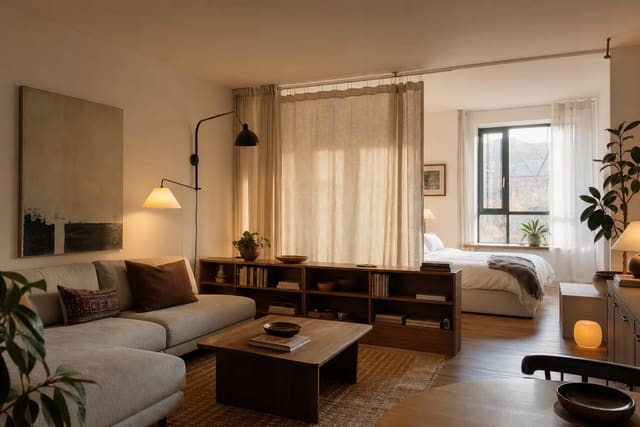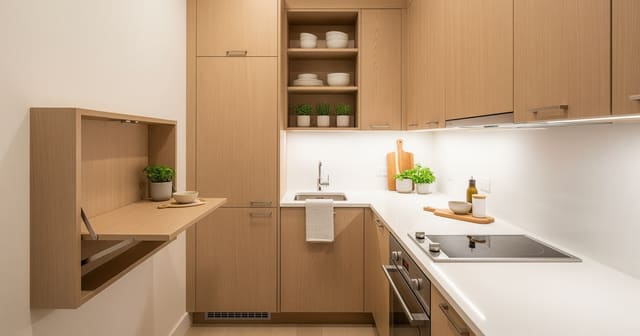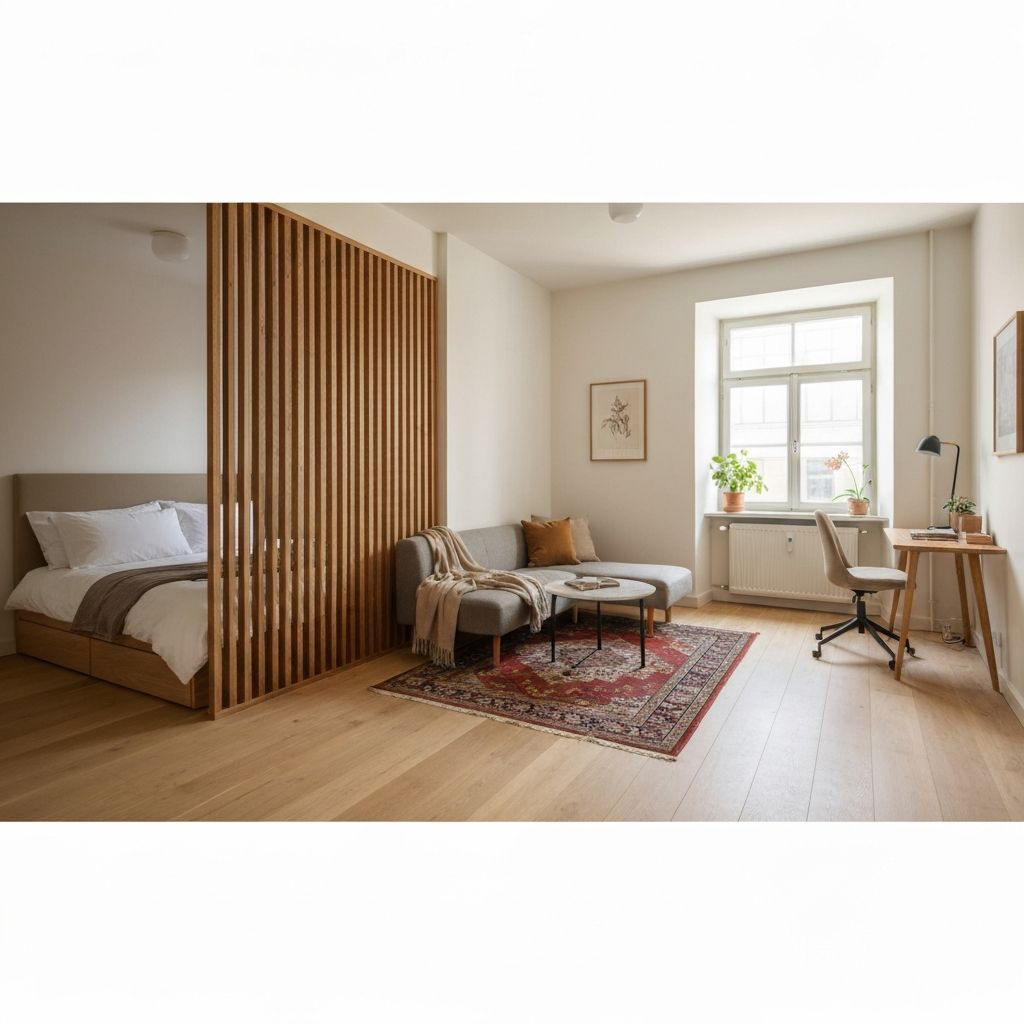
A studio apartment works as four zones in one room when the bed zone gets a defined boundary (a bookcase divider, a curtain track, or a strict rug edge), the work or sofa zone faces the bed, the dining zone shrinks to a 30 to 36-inch round drop-leaf, and the kitchenette stays edited to two visible counter items — every other piece closed behind a door. A great studio apartment isn't a smaller version of a one-bedroom — it's a fundamentally different design problem. You're trying to do everything (sleep, work, eat, entertain, store) in one room, without it looking or feeling like a single chaotic space. The studios and small apartments that pull this off don't follow normal design rules. They follow a specific playbook built around zones, multifunctional furniture, vertical storage, and ruthless editing. Master that playbook and a 400-square-foot studio can feel like a 700-square-foot one-bedroom.
The rules small spaces and studio apartments follow
These five principles consistently separate well-designed studios from cramped ones.
- Define zones with rugs and lighting, not walls. A studio is multiple rooms in disguise. Give each "room" — sleep, living, work, dining — its own rug, its own light source, and its own focal point. The eye reads these as separate spaces even when the physical room is open.
- Furniture that does two jobs minimum. Every piece in a studio should earn its square footage twice over. A storage ottoman is a coffee table, footrest, and a bin for blankets. A daybed is a sofa by day and a guest bed by night. A console table behind the sofa is also a desk. Lift-top coffee tables, expandable dining tables, and Murphy beds are all built around this principle.
- Vertical storage. Floor space is precious; wall space is free. Use floor-to-ceiling bookcases, tall slim cabinets, wall-mounted shelving, and pegboard systems. Every wall in a studio should be working.
- One color story. Studios fragment visually faster than larger spaces because the entire palette is visible at once. Commit to a tight palette — usually three to four colors maximum — and apply it across all the zones. The visual continuity makes the space read as bigger.
- Edit, edit, edit. In a studio, every item is visible all the time. There's no "spare bedroom" to absorb clutter. Ruthlessly edit your possessions; build storage for what you keep; display only what you love.
How to separate sleeping and living areas in a studio
The single biggest design problem in a studio is creating a clear visual break between the bed and the rest of the apartment. The most effective solutions:
- A bookcase room divider — Doubles as storage. Open backs let light through.
- A slatted oak or fluted wood divider — Architectural and warm.
- Floor-to-ceiling linen curtains mounted on a ceiling track — soft, removable, and dramatic.
- A daybed instead of a regular bed — Reads as a sofa during the day, eliminating the bedroom problem entirely.
- A platform bed on a raised section of floor — If you can build a slight level change, the bed reads as its own zone.
- A different paint or wallpaper color on the "bedroom" wall — Creates a visual room break without taking up any square footage.
Test this on your own room photo with ReDesign before you choose the final direction; keep the doorway, walls, windows, main furniture, lighting, and awkward fixed features visible so the preview solves the room you actually have.
For a useful room-planning comparison, keep Studio Apartment Bedroom Divider Ideas That Don't Feel Like Dorm Walls, Micro-Kitchen Design: Making 8×8 Feel Functional and Beautiful, and AI Interior Design: The Complete Guide to What It Does, What It Cannot Do, and When to Use It nearby so this retrofit stays connected to the adjacent lighting, storage, scale, and layout decisions in the same photo-led workflow.
The best multifunctional furniture for studios
The right pieces dramatically expand what a studio can do.
- Storage ottomans and benches — Coffee table, footrest, storage in one.
- Sleeper sofas and daybeds — Living and guest sleeping in one.
- Expandable dining tables — A 24" console expands to seat 6 for dinner.
- Lift-top coffee tables — Convert to a work surface or dining height.
- Murphy beds and wall beds — A full bed that disappears into a cabinet during the day.
- Nesting side tables — Pull apart when guests come; tuck together the rest of the time.
- Modular sectionals — Reconfigure for entertaining or for sleeping a guest.
- Drop-leaf or wall-mounted desks — Fold flat when not in use.
Color tricks that make small spaces feel bigger
- Light, warm walls reflect more light and read as airier than darker palettes.
- Matching trim and wall color eliminates the chopped-up feeling of dark baseboards on light walls.
- One bold focal wall can actually enlarge a studio — counterintuitively, the depth created by a darker accent wall makes the space feel longer.
- Large mirrors in unexpected places (the bedroom zone, behind a console) double the perceived volume.
- Continuous flooring throughout signals openness; different floors in different "zones" makes a studio feel chopped up.
Common small space and studio mistakes
- Buying furniture before measuring. a sectional that fit a friend's loft will dominate 400 square feet; preview the actual footprint before the truck arrives.
- Different flooring in different "zones". a stick-on tile under the kitchen and carpet under the bed chops a studio into pieces; continuous flooring reads as bigger.
- No divider between bed and sofa. a visible mattress from the living zone reads as messy; a bookcase, curtain, or daybed solves it without taking square footage.
- Single-purpose pieces. a coffee table that is only a coffee table is a luxury a studio cannot afford; every piece should do at least two jobs.
- Tiny matching set bought all at once. a small-scale catalog set reads as doll furniture; one full-scale sofa with one slim accent chair reads as a real room.
- Hiding the bed in a dark corner. a studio bed in the darkest corner reads sad; treat it as a zone with its own rug, lamp, and headboard so it reads as a real bedroom.
Use AI to test multiple studio layouts
The biggest mistake studio renters make is buying furniture before seeing how it fits. A sectional that looks compact online can dominate a 350-square-foot space. AI design lets you photograph your studio and preview different zone layouts — sleep nook in the corner vs. behind a divider, a sectional vs. a sofa-and-chair, a console-as-desk vs. a dedicated desk — all in minutes. The right configuration usually unlocks 50-100 square feet of usable space you didn't know you had.
Frequently Asked Questions
How do I divide a studio apartment into zones?
Use a 60 to 72-inch open bookcase as a half-wall between bed and living zones, a ceiling-mounted curtain track for visual privacy, or a strict rug-edge boundary; full walls fight the studio premise and require permits. Use the room photo to compare the visible layout and fixed constraints before committing, because door swings, windows, outlets, storage reach, circulation, and existing furniture decide whether the idea survives daily use.
Where should the bed go in a studio?
Place the bed in the farthest corner from the entry, with one wall behind the headboard and one side wall blocking the daytime view; never under a window unless the studio has only one wall option. Keep the preview honest by leaving the problem area visible in the frame, then compare one conservative version against one bolder version before you buy lighting, paint, furniture, or storage.
What dining setup works in a studio apartment?
A 30 to 36-inch round drop-leaf table that doubles as desk or counter overflow, with two folding chairs in a closet — studios cannot afford a dedicated dining table that sits idle 22 hours a day. Check the result against ordinary movement first: drawer clearance, chair pullout, walkway width, glare, switch access, and sightlines matter more than a perfect catalog angle.
How do I keep a studio kitchenette from dominating the room?
Keep the counter to one or two visible items (coffee setup, kettle), close every other appliance into an upper cabinet or cart, and run the kitchen color palette to match the rest of the room — not a contrast. Use the image to narrow priorities and measurements before ordering anything custom; final purchases still need real dimensions, outlet locations, installation limits, and product clearances.
What single move makes a studio feel like a real apartment?
A defined bed boundary — bookcase, curtain track, or strict rug edge — that separates sleep from living visually; without it, every guest sees the bed first and the studio reads as a hotel room, not a home. If the preview invents architecture or hides the awkward feature you need solved, rerun it with stricter instructions so the result remains tied to your actual room.
> Try this: Ready to see this on your own room? Open ReDesign and run the preview.
Three transformations to try
1. Bookcase divider between bed and living zones 2. Ceiling-mounted curtain track around bed zone 3. Drop-leaf round table doubling as desk