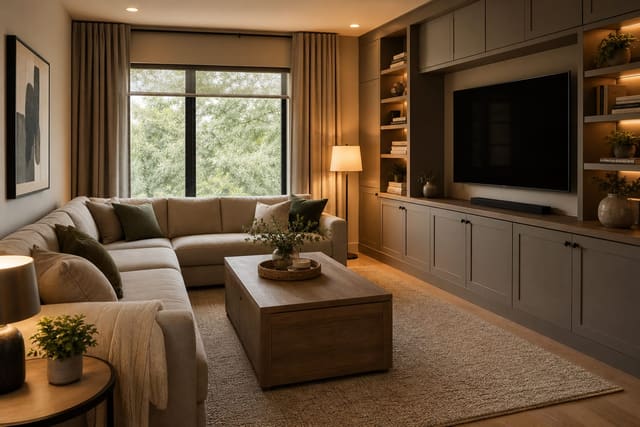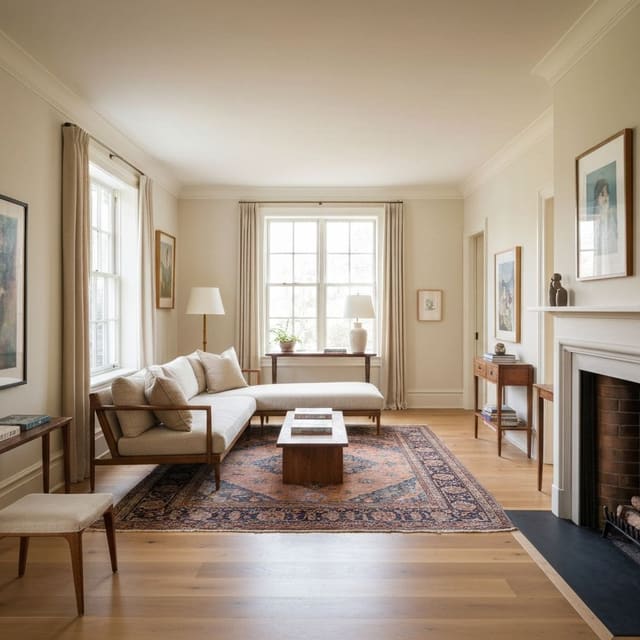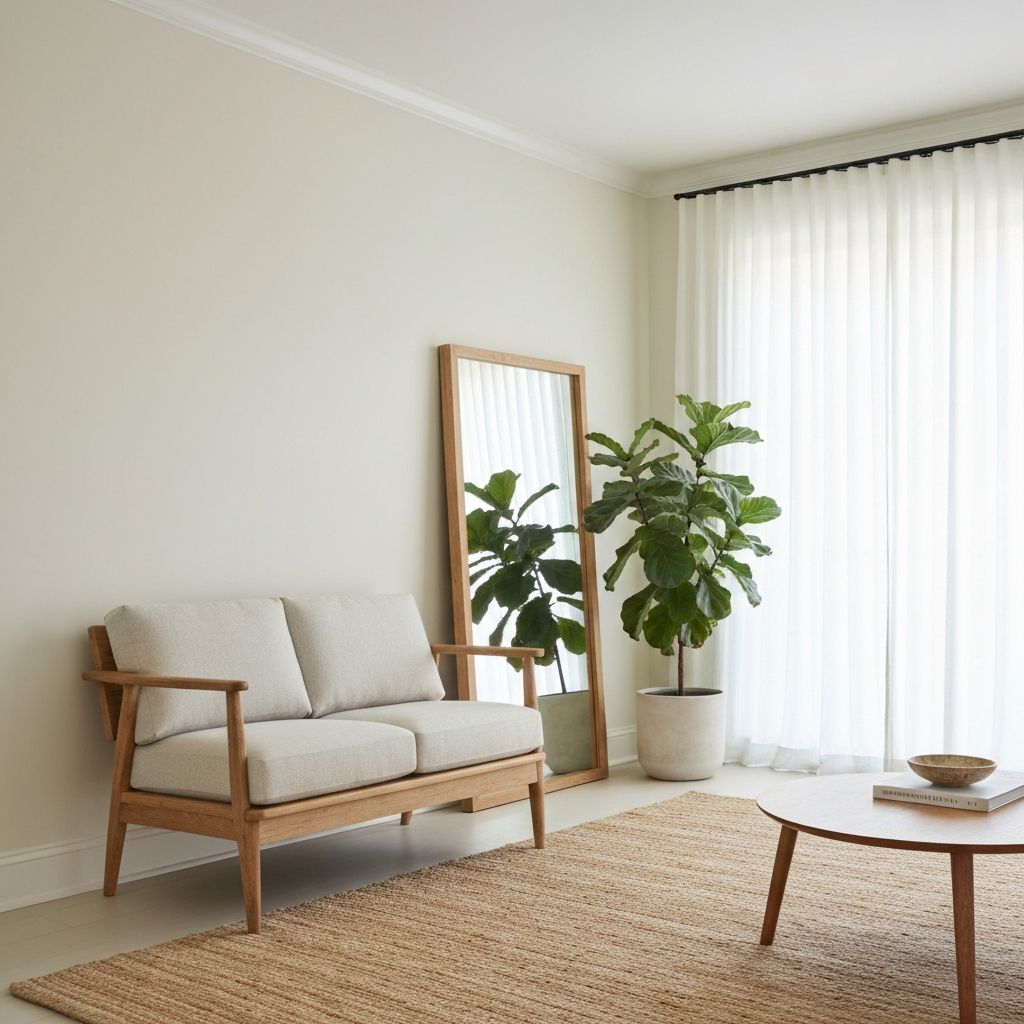
A small living room feels larger when the furniture floats off the walls 6 to 12 inches (not pushed against them), the largest piece sits on the longest wall, the rug extends under the front feet of every seat, and visual height comes from one tall element — a 72-inch bookcase, a floor-to-ceiling curtain, or art hung 60 inches center to draw the eye up. Small rooms aren't a styling problem — they're a perception problem. The square footage is fixed. What you can change is how big the room feels, and that comes down to a handful of designer tricks that work whether you have 90 square feet or 250.
How small rooms actually get bigger
Three forces make a room feel larger than it is: uninterrupted sightlines, vertical lift, and edited content. Everything in the list below is a different way to deliver one of those three. If you understand the underlying principle, you can apply these tricks to any room — not just living rooms.
The 12 tricks that actually work
1. Lift furniture off the floor
Exposed legs let light and floor pass under the piece, which the eye reads as more open space. A sofa on legs feels lighter than the exact same sofa on a skirted base. This single change can transform how a room reads.
2. Go tall, not wide
Floor-to-ceiling curtains and tall, narrow bookcases draw the eye up, making ceilings feel higher and rooms feel airier. Hang curtain rods within 4 inches of the ceiling, not above the window frame — the room will instantly feel taller.
3. Use mirrors strategically
A mirror opposite a window doubles the apparent depth of the room by reflecting the view and the daylight. A mirror opposite a wall just shows you more wall. Placement is everything.
4. Pick one statement piece, not five
Five "statement" pieces cancel each other out and create visual noise. One bold piece — a sculptural lamp, an art-sized mirror, a dramatic sofa — gives the room a hero and lets everything else be quiet. Visual quiet always feels bigger.
5. Skip the bulky sectional
Sectionals eat square footage. A sofa and two chairs at the same total seating capacity occupies less visual mass and provides more layout flexibility. If you must have a sectional, pick one with exposed legs and a low back.
6. Wall-mount the TV
A wall-mounted TV eliminates the credenza, recovers floor space, and lets the wall behind the TV stay clean. If you need storage, replace the credenza with a single floating shelf below the TV.
7. One large rug, not two small ones
Two small rugs slice a room into fragments. One rug large enough to anchor every seating piece unifies the space and reads as a single, larger room.
8. Cordless lamps
Battery-powered table lamps eliminate the cord-management spaghetti that small rooms can't hide. A single cord visible across a floor adds visual clutter wildly out of proportion to its size.
9. Light walls, dark floors
Light walls reflect daylight and recede visually; dark floors anchor the room without crowding it. The contrast feels intentional, not random.
10. Glass and lucite furniture
A glass-topped coffee table or a lucite chair reads as "not there." When you need a piece but the room can't afford the visual mass, transparency is the cheat code.
11. Multi-functional everything
Storage ottomans, nesting tables, sleeper sofas, lift-top coffee tables. Every piece earning two jobs means one fewer piece in the room.
12. Edit ruthlessly
The hardest one, the most powerful. Less of what you love beats more of what you tolerate. Walk the room, remove every item you don't truly value, and put it in a closet for a week. If you don't miss it, it doesn't come back.
Test this on your own room photo with ReDesign before you choose the final direction; keep the doorway, walls, windows, main furniture, lighting, and awkward fixed features visible so the preview solves the room you actually have.
For a useful room-planning comparison, keep Living Room Hidden Storage Ideas Without Visible Furniture Chaos, How to Fix an Awkward Living Room Layout (With AI), and AI Interior Design: The Complete Guide to What It Does, What It Cannot Do, and When to Use It nearby so this retrofit stays connected to the adjacent lighting, storage, scale, and layout decisions in the same photo-led workflow.
A 60-minute audit of your small room
Even without buying anything, this audit reliably makes small rooms feel bigger.
- Stand at the doorway and count visible surfaces. Coffee table, side tables, console, credenza, bookshelf, mantel. If you can see more than five surfaces, edit some out.
- Look at your sightlines. Can your eye travel from the entry to the far wall without hitting something tall? If not, swap a tall piece for a shorter one.
- Audit your rug size. If the front legs of any seat don't sit on the rug, the rug is too small.
- Lift one piece. Replace one skirted or solid-base item with one that has legs. Notice the change.
- Remove half the decor. Take everything off the coffee table, mantel, and side tables. Put back only what you actually love. The before/after will surprise you.
How AI design helps small rooms specifically
Small rooms are where AI design earns its keep. The cost of buying the wrong sofa is too high; the cost of trying five sofas in AI is zero.
Test scale before you buy
Generate the same room with three different sofa sizes and see which one breathes.
Visualize editing
Generate a version with half the furniture you currently have. Most people are stunned by how much bigger their room could feel.
Try the dramatic moves
Floor-to-ceiling curtains, dark floors, a wall-mounted TV — generate these changes before committing to any of them.
Common small-room mistakes
Tiny furniture for tiny rooms
Apartment-scale furniture often makes small rooms feel even smaller because too many pieces fragment the space. One properly scaled sofa beats two undersized loveseats.
Skipping the rug
"It's too small for a rug" is almost always wrong. The rug is what makes the room read as a room.
Over-lighting
Three carefully placed lamps beat five lamps fighting each other.
What to do this weekend
Pick three tricks from this list. Test them with AI generation before you commit to any. Then execute the one that produces the most "oh" — the moment when the room suddenly feels bigger than it is. That's the trick that was missing.
Frequently Asked Questions
How do I arrange a small living room to feel bigger?
Float the sofa 6 to 12 inches off the wall, add a sofa-table behind it as a circulation buffer, and angle one accent chair to break the boxy read; pushing everything to the walls makes the room read smaller, not bigger. Use the room photo to compare the visible layout and fixed constraints before committing, because door swings, windows, outlets, storage reach, circulation, and existing furniture decide whether the idea survives daily use.
What size sofa works in a small living room?
A 68 to 78-inch apartment sofa or two armchairs facing a 60-inch loveseat works in 100 to 150 square feet; an 84-inch sofa plus chairs only works in 160 square feet and up. Keep the preview honest by leaving the problem area visible in the frame, then compare one conservative version against one bolder version before you buy lighting, paint, furniture, or storage.
What rug size works in a small living room?
A 6 by 9 or 8 by 10 with the front feet of every primary seat on the rug; rugs that float in the middle without touching furniture make rooms look smaller, not bigger. Check the result against ordinary movement first: drawer clearance, chair pullout, walkway width, glare, switch access, and sightlines matter more than a perfect catalog angle.
Where should the TV go in a small living room?
Wall-mount the TV on a media wall opposite the sofa, ideally with a 36 to 48-inch console below; floor-standing TV stands eat 4 to 6 square feet a small room cannot give. Use the image to narrow priorities and measurements before ordering anything custom; final purchases still need real dimensions, outlet locations, installation limits, and product clearances.
What single move adds visual height in a small living room?
Mount the curtain rod 4 to 6 inches below the ceiling and run floor-length panels to the floor; this single move draws the eye up and makes 8-foot ceilings read 9 feet. If the preview invents architecture or hides the awkward feature you need solved, rerun it with stricter instructions so the result remains tied to your actual room.
> Try this: Ready to see this on your own room? Open ReDesign and run the preview.
Three transformations to try
1. Floating sofa with rug under front feet 2. Floor-to-ceiling curtains on small window 3. Wall-mounted TV with low console