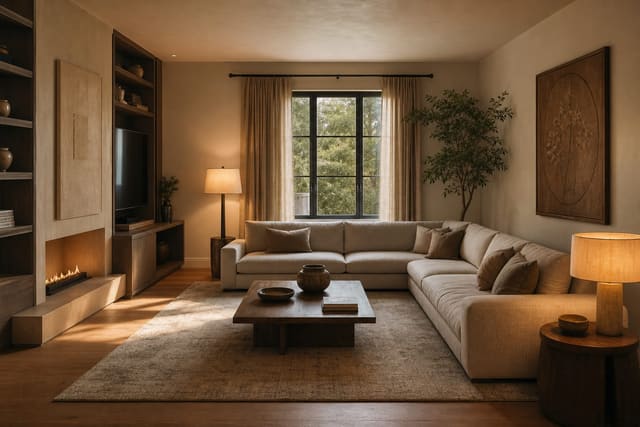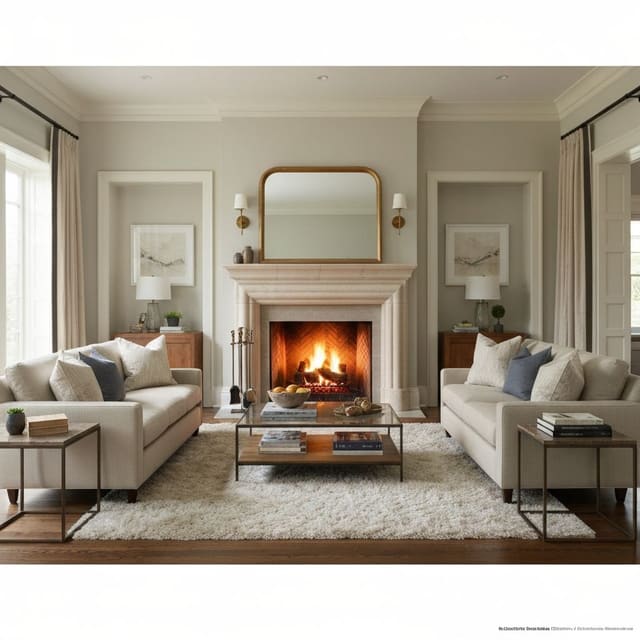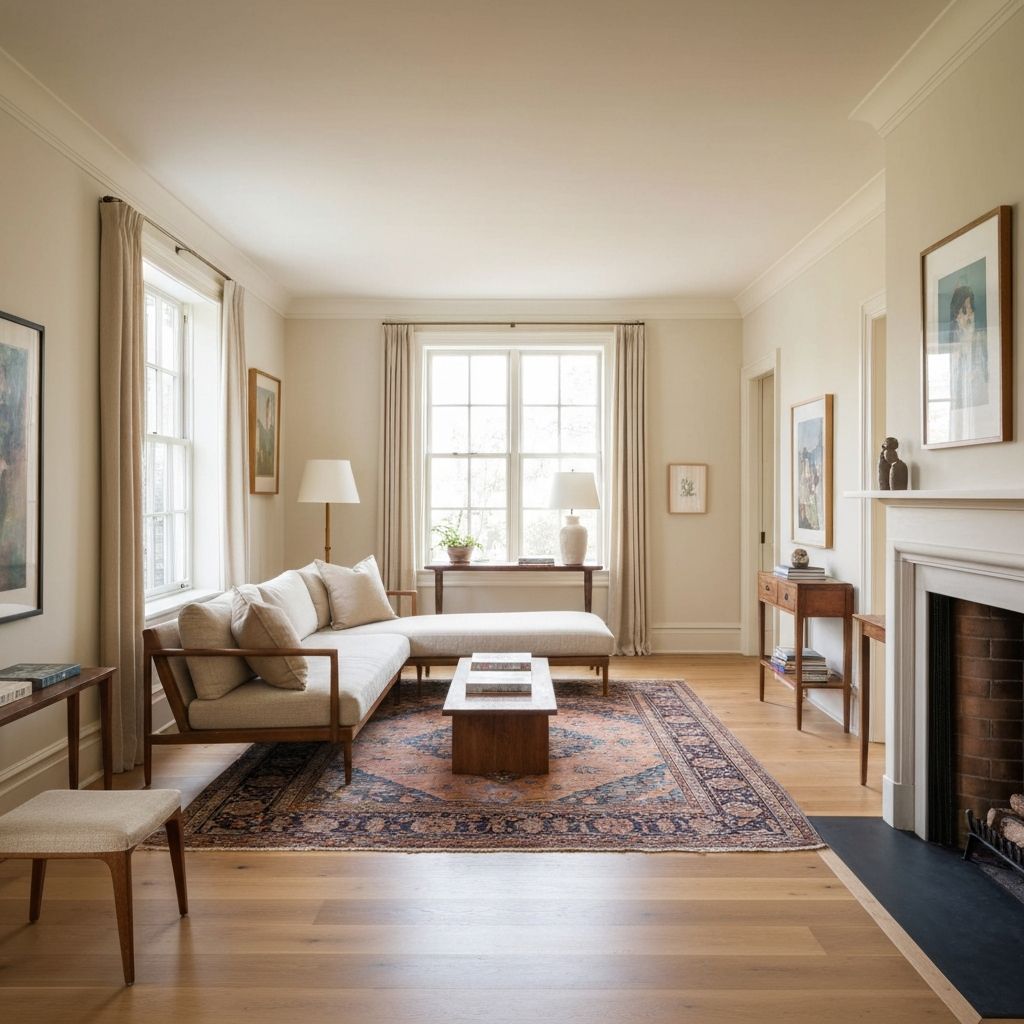
An awkward living room layout solves when you name the awkward fact — too narrow, too many doorways, asymmetric fireplace, traffic path through the seating — and then orient one anchor (sofa or sectional) to absorb that fact instead of fighting it, with the rest of the seating following the anchor. If your living room has felt "off" for years and you can't quite say why, you almost certainly don't have a furniture problem. You have a layout problem — and once you can see it clearly, it's almost always solvable without buying a single new piece.
Why "awkward" living rooms feel that way
Awkwardness is usually a conflict between three things: your room's architecture, your furniture's proportions, and how people actually move through the space. When any two are fighting each other, the room reads as wrong no matter how much you spend.
The five most common awkward layouts (and what's really wrong)
1. The off-center fireplace
One side of the fireplace has wall, the other has a doorway or window. Symmetrical layouts feel wrong because the room itself isn't symmetrical.
The fix: Stop trying to center the seating on the fireplace. Center it on the largest available wall plane instead, and let the fireplace be a feature on one side, like a piece of art.
2. The long, narrow room
Standard sofa-and-loveseat layouts produce a "bowling alley" feeling. Furniture pushed to long walls makes the narrowness worse.
The fix: Break the room into two zones — a conversation area and either a reading nook, a console-and-lamp, or a desk. Two intentional zones read as deliberate; one stretched-out zone reads as cramped.
3. The doorway-on-every-wall room
Three or four doorways means there's no full wall to anchor a sofa.
The fix: Float the sofa. A sofa that "swims" in the middle of the room with a console or low bookcase behind it solves a problem nothing against the walls can solve.
4. The open-plan blob
No real walls means no anchor points. Furniture drifts.
The fix: Define zones with rugs, not walls. A 9x12 rug under the seating area creates an invisible room within a room.
5. The corner-window challenge
Two adjacent windows eat a corner. Most seating arrangements waste the view.
The fix: Orient the primary seating to face the corner, not perpendicular to one window. Two chairs at a slight angle facing the corner outperform a sofa hugging one window.
For a useful room-planning comparison, keep Corner Sofa Square Room: Does a Wraparound Sofa Work?, Fireplace-Dominated Wall: How to Arrange Furniture Around It, and AI Interior Design: The Complete Guide to What It Does, What It Cannot Do, and When to Use It nearby so this retrofit stays connected to the adjacent lighting, storage, scale, and layout decisions in the same photo-led workflow.
Test this on your own room photo with ReDesign before you choose the final direction; keep the doorway, walls, windows, main furniture, lighting, and awkward fixed features visible so the preview solves the room you actually have.
A framework that fixes nearly every awkward layout
Designers call this the priority stack. Work the steps in order, not in parallel.
- Solve traffic first. Map how people walk through the room. Furniture goes around traffic paths, not across them.
- Anchor with a rug. A rug big enough that the front legs of every seat land on it is the fastest way to define a seating area. Anything smaller floats and makes the room feel choppier.
- Pick a single focal point. TV, fireplace, view, art — choose one and orient seating toward it. Two competing focal points create the awkwardness you're feeling.
- Pull furniture off the walls. Even three inches of breathing room behind a sofa reads as intentional. Furniture jammed against walls reads as temporary.
- Layer the lighting. Overhead alone is hostile. Add table lamps at mid-height and a floor lamp in every conversation area. Three light sources is the minimum.
How AI design helps you see the fix
The reason most people don't solve awkward layouts is the cost of being wrong. Buying a sectional you'll regret is a $2,000 mistake. Moving one is a weekend. AI removes that risk entirely.
Test layouts before moving anything
Generate three or four directions on the same photo: a sectional, a pair of sofas, a sofa-and-chairs, a floated layout. Compare side by side.
Preserve your actual architecture
Good AI design tools keep your windows, fireplace, and doorways exactly where they are. You're not designing a fantasy room — you're testing options in your room.
Identify the specific pieces that solve the problem
The best AI tools call out the rug size, sofa style, and lamp placement that make the layout work, so you can shop the look without guessing.
Common mistakes to avoid
Buying the sofa before solving the layout
The sofa is the consequence of the layout, not the cause. Decide the layout first; the sofa follows.
Pushing everything to the walls "to make the room feel bigger"
This is the most common myth in residential design. Wall-hugging furniture makes rooms feel like waiting rooms. Pulling furniture forward — by even a few inches — makes the same room feel deliberate.
Treating the TV as the focal point by default
The TV is a focal point. If you have a fireplace, a view, or great architecture, the TV should serve those, not compete with them.
A weekend you can actually execute
Saturday morning, take one wide photo of your living room. Generate two or three layout directions. Pick the one that makes sense for how you actually live. By Sunday night, you've either moved the furniture into a layout you love or made a short list of two purchases (typically a rug and a lamp) that complete it.
That's the whole project. The "awkward" was never permanent.
Frequently Asked Questions
How do I arrange a narrow living room?
Float the sofa lengthwise along the wider wall with a console behind, place two slim accent chairs on the opposite long wall, and leave a 36 to 42in walking path between — the room reads intentional rather than tunnel-like. Use the room photo to compare the visible layout and fixed constraints before committing, because door swings, windows, outlets, storage reach, circulation, and existing furniture decide whether the idea survives daily use.
What do I do with multiple living room doorways?
Map the traffic paths first, then orient the seating perpendicular to the busiest path so foot traffic does not pass between sofa and TV; an L-sectional often beats a parallel sofa-and-loveseat in rooms with 3+ doorways. Keep the preview honest by leaving the problem area visible in the frame, then compare one conservative version against one bolder version before you buy lighting, paint, furniture, or storage.
How do I balance an off-center fireplace?
Either commit to the off-center placement by anchoring the sofa to the fireplace and treating the empty side as a vignette (chair plus floor lamp), or visually re-center with built-in millwork that extends the fireplace surround. Check the result against ordinary movement first: drawer clearance, chair pullout, walkway width, glare, switch access, and sightlines matter more than a perfect catalog angle.
Can a sectional fix an awkward living room?
Often yes — sectionals absorb corner angles, hide weird walls, and define seating zones in rooms where pairs of pieces float; pick the chaise side to face the room's worst sightline so the chaise blocks it. Use the image to narrow priorities and measurements before ordering anything custom; final purchases still need real dimensions, outlet locations, installation limits, and product clearances.
Should I use a rug to fix an awkward layout?
Yes — a single rug sized to fit under the front legs of every seating piece pulls the layout together visually; tiny rugs make awkward rooms look more awkward because the seating reads as scattered islands. If the preview invents architecture or hides the awkward feature you need solved, rerun it with stricter instructions so the result remains tied to your actual room.
> Try this: Ready to see this on your own room? Open ReDesign and run the preview.
Three transformations to try
1. Sectional anchored to the busiest doorway path 2. Off-center fireplace balanced with built-in vignette 3. Narrow room with floated sofa and slim accent chairs