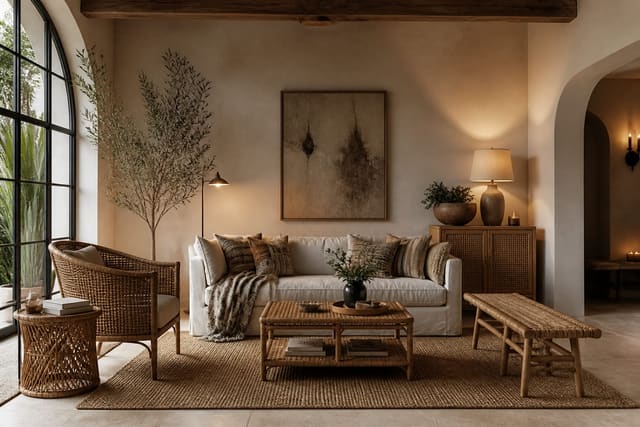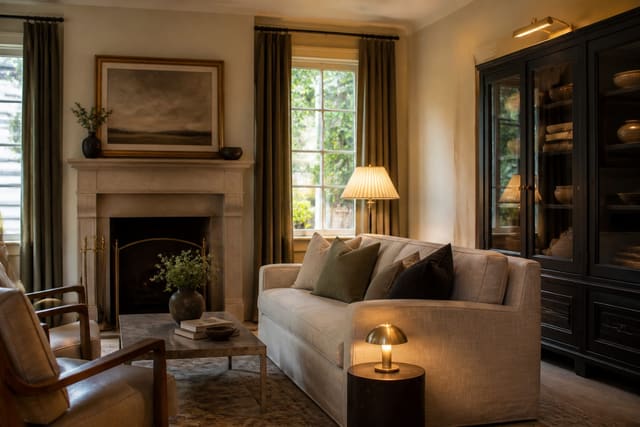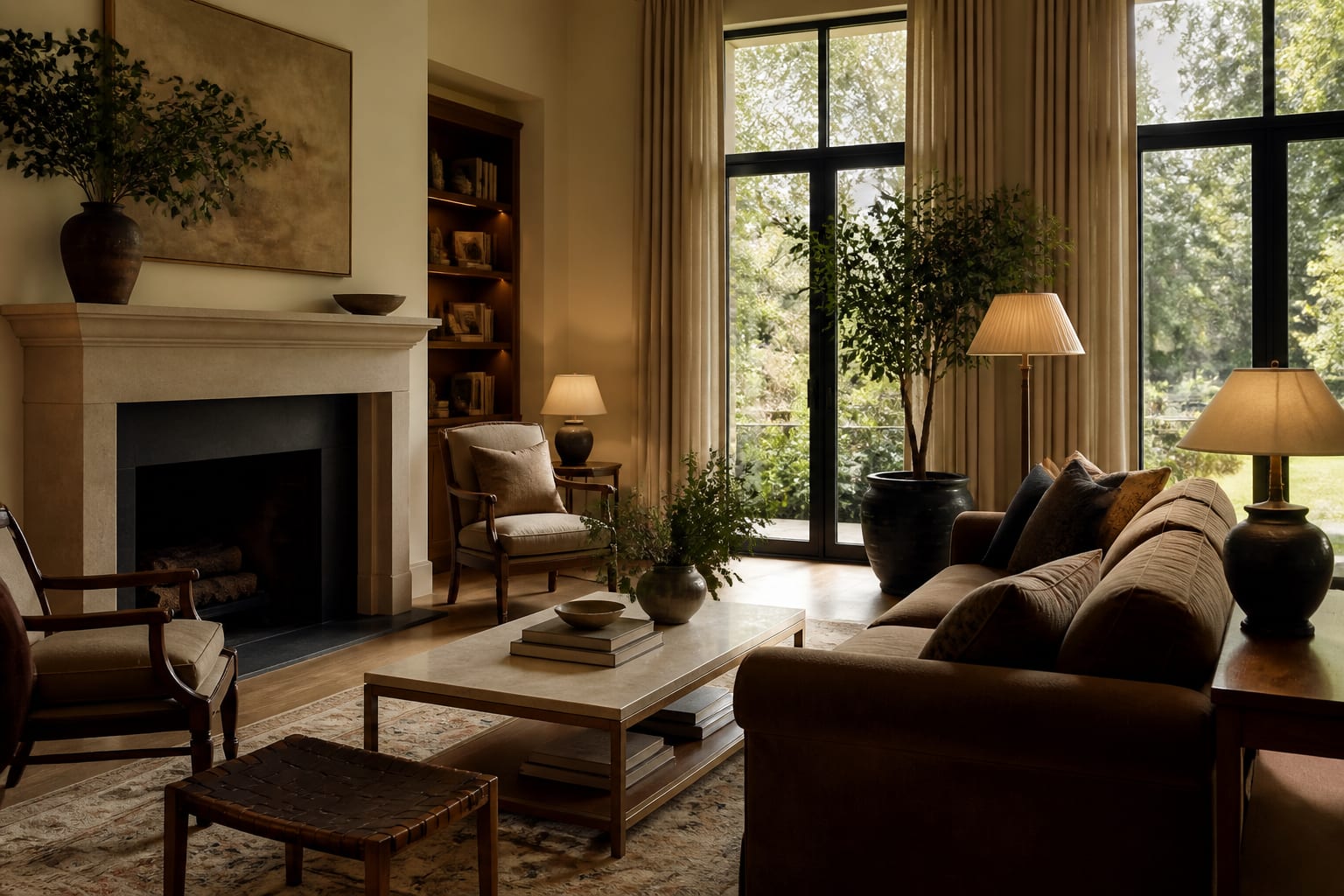
A room feels finished when the edges are handled: light at three heights, windows actually dressed, art hung at eye level, and a rug big enough to hold the furniture. The furniture itself is rarely the problem. My read is that most rooms stall at about 90 percent done, and that missing 10 percent is exactly what separates a space that looks decorated from one that looks like move-in week never ended.
Designers do not finish a room by adding more furniture. They finish it by addressing the parts amateurs skip because they feel optional: the lamp in the dark corner, the curtain rod mounted too low, the bare wall that has waited eight months for art. Those small calls are the whole game.
Layer light at three heights
The fastest way to spot an unfinished room is to count the light sources. One ceiling fixture doing all the work is the tell. A finished room carries light at three heights: an overhead layer for general fill, a middle layer at table or eye level (lamps, sconces), and a low layer near the floor (a floor lamp uplight, or a small lamp on a low shelf). Three sources minimum, ideally on separate switches or a dimmer.
Warmth matters as much as placement. Designers keep bulbs in the 2700K to 3000K range for living and sleeping spaces, because cooler 4000K light reads like an office and instantly cheapens a room. Match the color temperature across every fixture so the room glows evenly instead of mixing warm and blue pools. If your space fights you because it gets almost no daylight, the lighting fixes in my rattan and cane material guide pair well with these layers, since light, woven textures bounce what little light you have.
A quick test: turn on every lamp at night and stand in the doorway. If any corner falls into a dark void, that corner is unfinished. Add a source there before you add anything else.
Dress the windows and the walls
Bare windows and bare walls are the two loudest signs that a room is not done. Curtains do more than block light; they soften the hard rectangle of a window and add height. Mount the rod 4 to 6 inches above the frame, and let panels run all the way to the floor with a slight break, or about half an inch off it for a crisp look. Hanging curtains at frame height, stopping at the sill, makes the ceiling feel lower and the window feel smaller.
Art is the other half. The reliable rule designers use:
- Center the piece (or the group) at 57 to 60 inches from the floor, gallery height.
- Over a sofa, fill roughly two-thirds of the sofa's width with art, hung 6 to 10 inches above the back.
- For a gallery wall, lay it out on the floor first and keep 2 to 3 inches of consistent gap between frames.
- Scale up: one large piece almost always reads more finished than several tiny frames scattered around.
The metal and hardware you choose for rods, frames, and fixtures pulls the room together too. I get into the warm-versus-cool decision in the unlacquered brass guide, and the short version is to repeat one metal finish at least three times so it reads intentional.
Ground the room and layer texture
A rug that is too small is the most common reason a seating area looks like floating furniture. Size it so the front legs of the sofa and chairs sit on the rug at minimum; ideally all legs. In a standard living room that usually means an 8 by 10 foot rug, and in larger rooms a 9 by 12. A rug should leave 10 to 18 inches of floor showing around its edges, not stop awkwardly under the coffee table alone.
Texture is what makes a finished room feel rich rather than staged. Aim for at least 3 distinct materials in the same view: a wool rug, a linen pillow, a wood table, a ceramic lamp base. The contrast between rough and smooth, matte and glossy, is what the eye reads as depth. A room can have a perfect color scheme and still feel flat if every surface has the same sheen.
Pillows are the cheapest finishing lever, and most people under-buy them. On a standard 3-seat sofa, plan on 4 to 5 pillows in mixed sizes, a couple of 22-inch squares, a 20-inch, and a lumbar, rather than two matching 18-inch cushions stranded at each end. Vary the covers across at least 2 textures and let one carry the room's accent color. A throw blanket folded over one arm adds a third layer for almost nothing and softens the hard line of the sofa back.
Greenery is the last quiet finisher. A single large plant in a bare corner does more for the lived-in feeling than another piece of furniture, and a small trailing plant breaks up the straight edge of a shelf. Real or convincing faux both work; the point is to add one organic, irregular shape to a room full of straight manufactured lines.
Finally, edit. Designers leave about 30 percent of shelf and table surface empty so the things that stay can breathe. Group objects in odd numbers, vary their heights, and pull a few items off the shelf entirely. Restraint is a finishing move.
Common mistakes to avoid
The most common mistake is treating furniture as the finish line. People buy the sofa and the bed, then stop, leaving walls bare and corners dark for months. The room is framed but not dressed.
A second frequent mistake is hanging everything too high or too low: art floating near the ceiling, curtain rods pinned to the window frame. Both shrink the room. A third is the undersized rug that touches no furniture, which makes the whole arrangement look adrift. People also under-light, relying on a single overhead bulb, and over-style, cramming every surface until nothing stands out. The fix for that last one is subtraction, not addition. Clear 30 percent of the clutter and the remaining pieces finally read.
Use AI design to see the finished version first
The hard part of finishing a room is that you cannot picture the last 10 percent until it is installed, and by then the curtains are hemmed and the art is drilled into the wall. Re-Design closes that gap. Upload a photo of your actual half-finished room and the AI design re-renders it with curtains dressed, art hung at the right height, a properly sized rug, and layered lighting in place.
Because you upload your real space, the preview respects your existing furniture, your wall colors, and your window placement. You can test a floor-length curtain against your wall height, try a larger rug under your real sofa, and see whether warm light or cool light suits the room before you spend a cent on the finishing pieces.