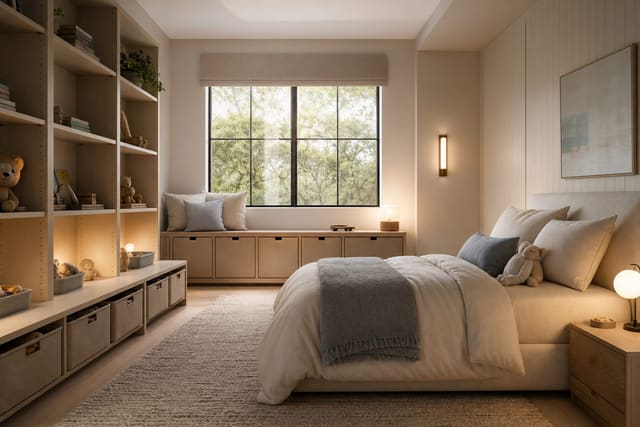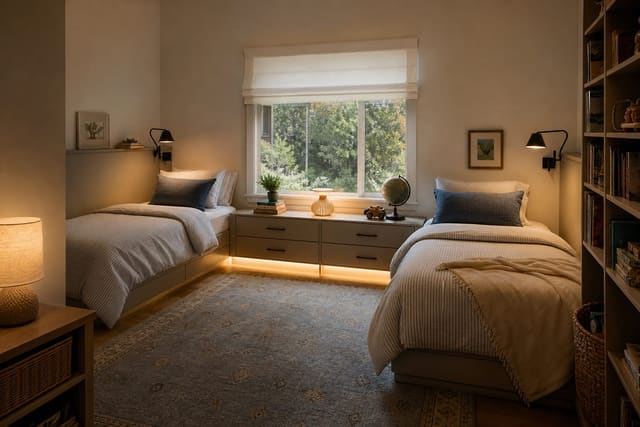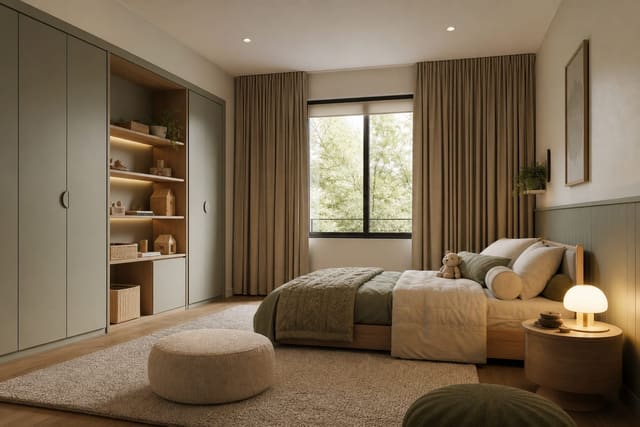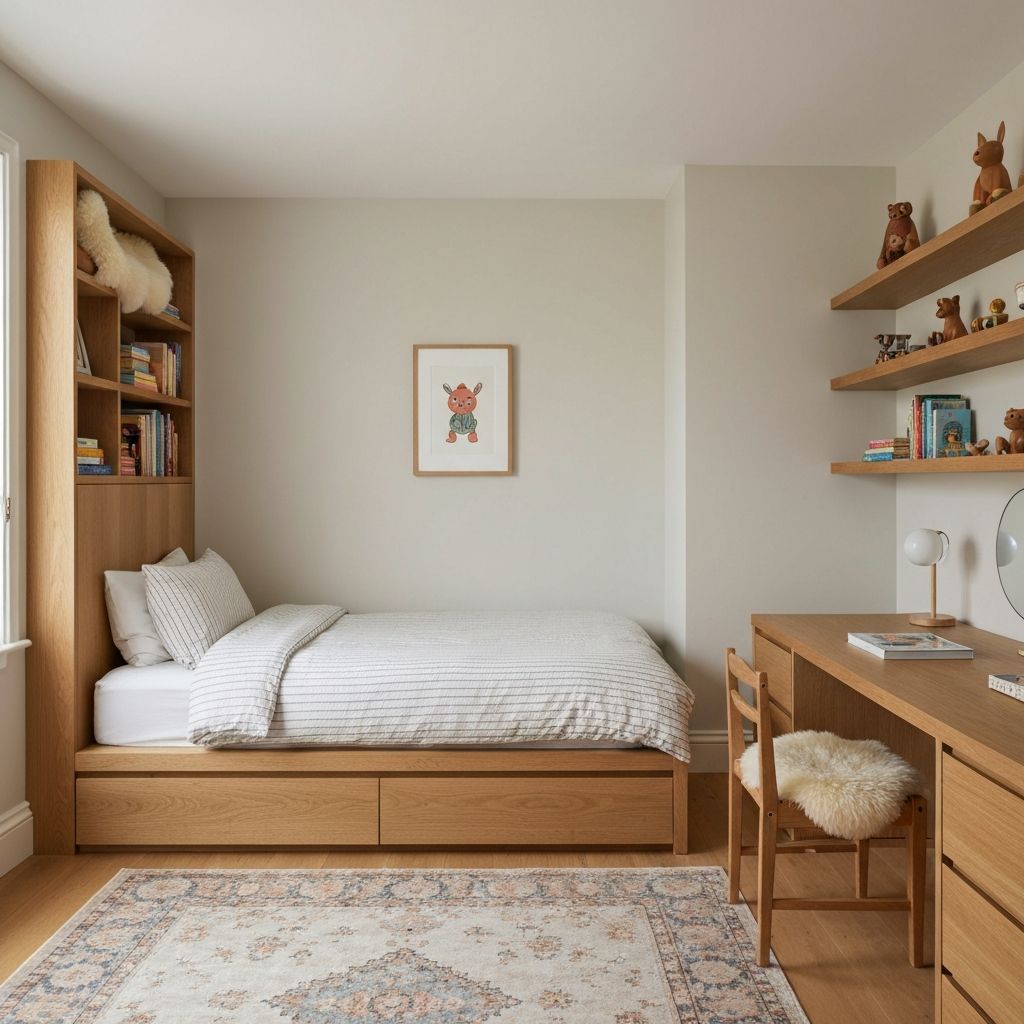
A kids room reads designed when it commits to four zones — sleep (bed plus warm bedside light), play (open floor area sized 5x7ft minimum, with a low rug), study or quiet (small desk or reading nook scaled to current age), and storage (cube shelving with bins that scale to teen years) — committing to four zones beats themed decor that the child outgrows in 18 months. Designing a kids room is a moving target. The toddler who's obsessed with trucks today wants outer space next year and rejects everything "babyish" the year after that. If you design too literally for one phase, you'll be redoing the room every 18 months. The smarter strategy: design a kids room with a timeless background and a swappable foreground, so the room evolves with your child without a constant remodel.
Design a kids room for the long game
The temptation is to lean hard into whatever phase your kid is currently obsessed with — dinosaurs, princesses, space, race cars. The problem is those phases burn out fast. A kids bedroom designed around a single theme stops working the moment they age out of it, which can be as little as 12 months.
The fix is to think in two layers:
The long-lived background (5–10 year lifespan)
- Neutral wall color — warm whites, soft greige, putty, sage. Anything you'd happily look at as the room shifts personalities.
- Quality wood furniture in a tone you'll love five years from now. Skip plastic furniture that says "kids" — go for real oak or walnut that grows into a teen room.
- A well-made rug in a pattern that hides crumbs and crayon. Vintage-style or muted geometric works for any age.
- Built-in or floor-to-ceiling storage in a neutral finish.
- Good lighting — a real ceiling fixture, a bedside lamp, and a reading nook lamp.
The easily swappable foreground (1–3 year lifespan)
- Bedding — duvet covers and shams are inexpensive to switch out.
- Wall art — especially framed prints in a consistent frame style. Rotate the prints as your kid changes.
- Accent pillows in fun colors and prints.
- Curtains if you used basic neutral ones in the background layer.
- Removable wall decals for a phase-specific dose of theme.
- Display shelves for the books, toys, and trophies that change every year.
Storage is the design
In kids rooms, storage is the aesthetic. Children accumulate stuff faster than any other room in the house, and a beautifully designed bedroom collapses under clutter in a week without serious storage planning.
Plan for two or three times the storage you think you need:
- Under-bed bins for out-of-season clothes, extra sheets, and large toys.
- A captain's bed or trundle with built-in drawers.
- Floor-to-ceiling closets with adjustable shelving for clothes, books, and bins.
- Open shelves for displayed favorites — but keep them at adult eye level so they read as styled, not chaotic.
- A toy chest or ottoman that doubles as seating.
- Labeled bins for younger kids, who can actually put away things they can identify.
For a useful room-planning comparison, keep Kids Bedroom Storage Ideas That Grow With the Child, Shared Bedroom Two Kids Ideas for Designing a Shared Bedroom for Two Kids Without Conflict, and Sensory Friendly Bedroom Design for Children nearby so this retrofit stays connected to the adjacent lighting, storage, scale, and layout decisions in the same photo-led workflow.
Test this on your own room photo with ReDesign before you choose the final direction; keep the doorway, walls, windows, main furniture, lighting, and awkward fixed features visible so the preview solves the room you actually have.
Designing a nursery that becomes a kids room
If you're starting with a nursery, design it from the beginning as a future kids room. Skip pieces that are nursery-specific (changing tables, novelty cribs in pink or blue) and choose furniture that converts: cribs that become toddler beds, dressers with changing pads on top, neutral rocker chairs you'll keep using for storytime at age six.
Common kids room design mistakes
- Designing for the current phase only. a fully themed room expires in 18 months; the background should outlive every phase.
- Plastic primary-color furniture. screams kids and rarely survives one growth spurt visually; real wood lasts into the teen years.
- Underestimating storage. visible toy chaos collapses any styled kids room within a week; plan storage for 2 to 3 times what looks reasonable.
- Nursery-only furniture. changing tables and novelty cribs are obsolete in two years; convertible pieces extend the room's usable life.
- White or very pale rug. a rug that shows every crumb and crayon line fails the actual use case; vintage-style or muted patterns hide the wear.
- No reading nook or lamp by the bed. a kids room without bedside reading light skips the routine that makes the room feel calm; one small lamp is non-negotiable.
The AI design approach
A kids room is the perfect candidate for AI design previews — partly because parents make so many decisions on this room (cribs, beds, paint, storage, art) and partly because most of those decisions are reversible only with serious effort. Photograph the room, preview five different paint colors, three rug options, and two bed configurations before buying anything. The version of the room your eight-year-old will love is rarely the version your toddler is currently in.
Frequently Asked Questions
What is the most important furniture in a kids room?
The bed — quality mattress with a strong-but-simple frame (twin or full, no themed character beds), because the bed is the room's daily anchor and adult-scale neutral furniture stays usable through teen years. Use the room photo to compare the visible layout and fixed constraints before committing, because door swings, windows, outlets, storage reach, circulation, and existing furniture decide whether the idea survives daily use.
How much play floor space does a kids room need?
5x7ft minimum of open floor area for play and building — that means the bed, desk, and storage push to the perimeter; without floor area kids play on the bed and storage clutters daily. Keep the preview honest by leaving the problem area visible in the frame, then compare one conservative version against one bolder version before you buy lighting, paint, furniture, or storage.
Should I theme the kids room?
Theme the textiles, art, and bins (changeable in 30 minutes), not the furniture, wall color, or built-ins; themed rooms read sweet for 18 months and dated by year 3, while neutral-furniture-plus-themed-accessories rooms stay current. Check the result against ordinary movement first: drawer clearance, chair pullout, walkway width, glare, switch access, and sightlines matter more than a perfect catalog angle.
What lighting works in a kids room?
Warm 2700K bedside lamp on a switch the child can reach, plus a 3000K overhead for ambient and play, plus one 2700K nightlight for stairs and bathroom routes — three layers cover sleep, play, and middle-of-the-night needs. Use the image to narrow priorities and measurements before ordering anything custom; final purchases still need real dimensions, outlet locations, installation limits, and product clearances.
How do I keep a kids room from looking like a toy store?
Closed bins on shelving hold 80 percent of toys hidden from view, one open shelf shows the current rotation, and toys not currently used get rotated out monthly — open-floor toy spread reads chaotic regardless of how cute the toys are. If the preview invents architecture or hides the awkward feature you need solved, rerun it with stricter instructions so the result remains tied to your actual room.
> Try this: Ready to see this on your own room? Open ReDesign and run the preview.
Three transformations to try
1. Kids room with sleep, play, study, and storage zones 2. Adult-scale neutral furniture with themed bedding 3. Reading nook and modular cube storage