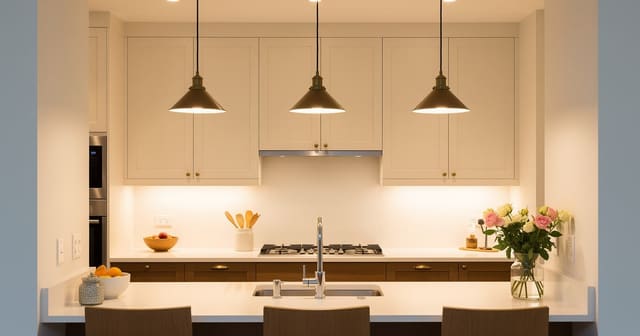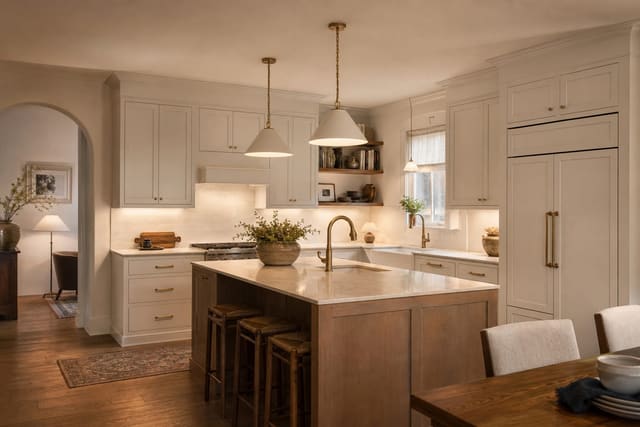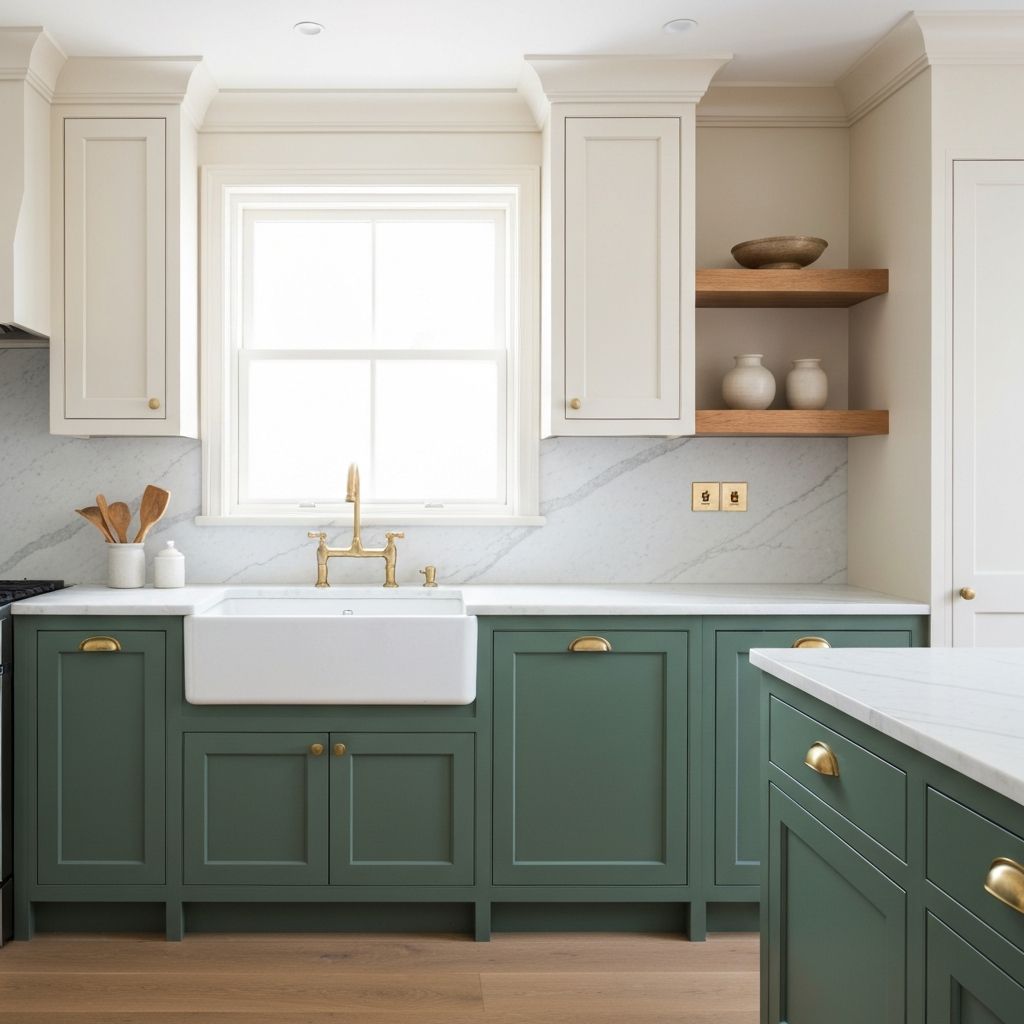
Kitchen cabinet color reads designed when the upper and lower cabinets answer a specific palette decision — match for one solid color, two-tone for contrast, or wood-plus-paint for warmth — tested against the actual countertop, floor, and daylight before any paint or refinish job. Cabinet color is the single most consequential choice in a kitchen remodel — and the most expensive to get wrong. Cabinets dominate the room visually, anchor everything else (countertop, backsplash, flooring, hardware) and account for a significant share of any kitchen budget. The good news: AI design tools now let you preview every cabinet color option on your actual kitchen photo before you order a single door.
The decision that haunts every renovation
Most homeowners agonize over cabinet color for months and still feel uncertain when they finally commit. The reason is straightforward: paint chips and tiny showroom samples cannot accurately predict how a color will read across an entire room, in your specific light, against your existing finishes. The mismatch between sample and reality is why so many kitchens look stunning in inspiration photos but flat or wrong once installed.
The current most popular kitchen cabinet colors
These are the cabinet color directions trending right now in both interior design publications and real-world renovations.
- Warm white — Bright, timeless, makes small kitchens feel bigger. Reads luxurious in any light. Best paired with brass or matte black hardware.
- Sage and olive green — The new white. Reads neutral but more interesting. Especially flattering in north-facing kitchens that get cool light.
- Deep navy, forest green, and charcoal — Bold and dramatic. Works best in kitchens with great natural light, high ceilings, or as the lower cabinets in a two-tone layout.
- Two-tone kitchens (light uppers, dark or wood lowers) — Grounds the room visually without darkening it. The single most popular new-build kitchen direction.
- Natural white oak and rift-sawn walnut — The fastest-rising trend in luxury kitchens. Reads warm, organic, and high-end. Best with stone or quartzite counters.
- Warm greige and putty — A safe middle ground between white and a deeper color. Surprisingly forgiving in any light.
- Black or near-black cabinets — Dramatic and architectural. Pair with brass hardware, marble counters, and excellent lighting.
Test this on your own room photo with ReDesign before you choose the final direction; keep the doorway, walls, windows, main furniture, lighting, and awkward fixed features visible so the preview solves the room you actually have.
For a useful room-planning comparison, keep How to Make a Dark Kitchen Feel Bright, Builder Grade Kitchen Upgrades: 5 Fixture Swaps That Lift the Room, and AI Interior Design: The Complete Guide to What It Does, What It Cannot Do, and When to Use It nearby so this retrofit stays connected to the adjacent lighting, storage, scale, and layout decisions in the same photo-led workflow.
How to choose your kitchen cabinet color
A reliable framework for narrowing down options:
- Start with your countertop and floor. Both are harder and more expensive to change than cabinets, so they set the constraint. The cabinet color should support — not fight — what you already have.
- Consider your light. Dark cabinets need light to come alive. A north-facing or windowless kitchen will fight a deep navy or forest green and may need a warmer, lighter palette to feel inviting.
- Think about your home's overall palette. Your kitchen is usually visible from the living and dining rooms. Choose a cabinet color that flows naturally with those connected spaces.
- Account for hardware finish. Brass loves warm white, green, navy, and wood tones. Matte black pairs well with white, greige, and charcoal. Chrome works almost everywhere but reads cooler.
- Preview multiple options on your actual kitchen. This is the single biggest unlock. AI design tools generate realistic renders of your kitchen in five or six different cabinet colors in minutes — far more reliable than a paint chip on the wall.
Painted vs. stained vs. wood
- Painted cabinets offer the widest color range and the cleanest, most furniture-like finish. Sherwin-Williams and Benjamin Moore both have full lines designed for cabinets.
- Stained or natural wood cabinets are having a major resurgence. White oak, rift-sawn walnut, and warm rift oak are the woods designers are reaching for most often in 2026.
- Two-tone (painted upper, wood lower or vice versa) is the most popular hybrid because it combines the brightness of paint with the warmth of wood.
Common kitchen cabinet color mistakes
- Choosing from paint chips alone. showroom and chip lighting bears no resemblance to your kitchen; AI renders or full door samples are the only reliable previews.
- Dark cabinets in a low-light kitchen. navy or charcoal in a north-facing or windowless room feels cave-like; reserve dark cabinets for kitchens with great natural light.
- Fighting the countertop. a cabinet color that competes with veining or a busy stone reads chaotic; the cabinet should support, not duel.
- Mixing hardware finish with cabinet temperature. chrome on warm wood reads cold; brass on cool gray reads off — match temperature, not just color.
- Trendy color you will hate in three years. cabinet doors are slow and expensive to replace; pick a color you will love past the current cycle.
- Picking before the floor and counter are set. cabinet color is the variable that bends to the constraints; lock floor and counter first, then narrow cabinets.
Use AI to preview your kitchen before you commit
Cabinet doors are expensive and slow to replace. Preview your kitchen in every color you're seriously considering — warm white, sage, navy, two-tone, natural oak — using AI design before you place an order. Spend an hour with the tool, narrow to two finalists, then order paint samples or door samples for those two only. You'll save weeks of agony and reduce the chance of regret to near zero.
Frequently Asked Questions
What is the most popular kitchen cabinet color right now?
Warm white, off-white, and muted greens dominate, with two-tone (white upper, walnut or navy lower) gaining share; pure cool white peaked in 2020 and now reads dated next to warm-toned floors and counters. Use the room photo to compare the visible layout and fixed constraints before committing, because door swings, windows, outlets, storage reach, circulation, and existing furniture decide whether the idea survives daily use.
Should kitchen cabinets be lighter or darker than the walls?
Lighter cabinets on darker walls make a small kitchen feel taller; darker cabinets on lighter walls anchor a large open kitchen — pick the contrast direction off the room scale, not the trend cycle. Keep the preview honest by leaving the problem area visible in the frame, then compare one conservative version against one bolder version before you buy lighting, paint, furniture, or storage.
Do upper and lower cabinets need to match?
No — two-tone (white upper, walnut or navy lower) reads intentional when the upper color repeats in the trim or ceiling and the lower color repeats in an island or rug; mismatched without that repeat reads accidental. Check the result against ordinary movement first: drawer clearance, chair pullout, walkway width, glare, switch access, and sightlines matter more than a perfect catalog angle.
How do I test a cabinet color before committing?
Photograph the kitchen in midday and evening light, upload the photo, and preview three palettes — match, two-tone, wood-plus-paint — against the actual counter and floor; paint swatches on a single door miss how the color reads across the whole run. Use the image to narrow priorities and measurements before ordering anything custom; final purchases still need real dimensions, outlet locations, installation limits, and product clearances.
What cabinet color is hardest to keep clean?
Pure white and high-gloss black show every fingerprint, water mark, and grease splash; warm whites, muted greens, and matte walnut hide daily wear and look better at year three. If the preview invents architecture or hides the awkward feature you need solved, rerun it with stricter instructions so the result remains tied to your actual room.
> Try this: Ready to see this on your own room? Open ReDesign and run the preview.
Three transformations to try
1. Warm-white upper plus walnut lower two-tone kitchen 2. Muted sage cabinet kitchen with cream walls 3. Navy lower with white upper and brass hardware