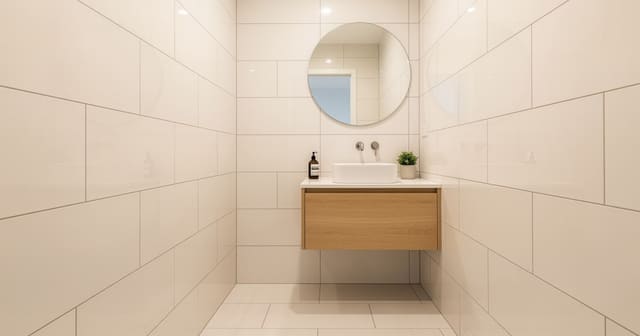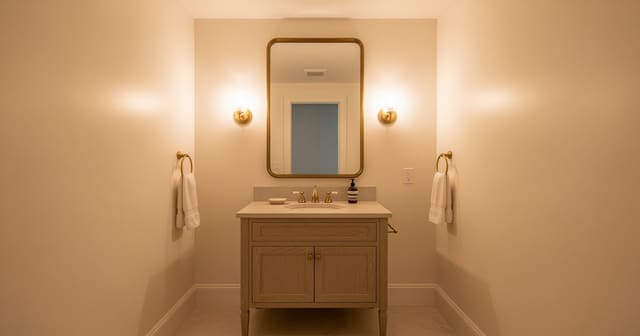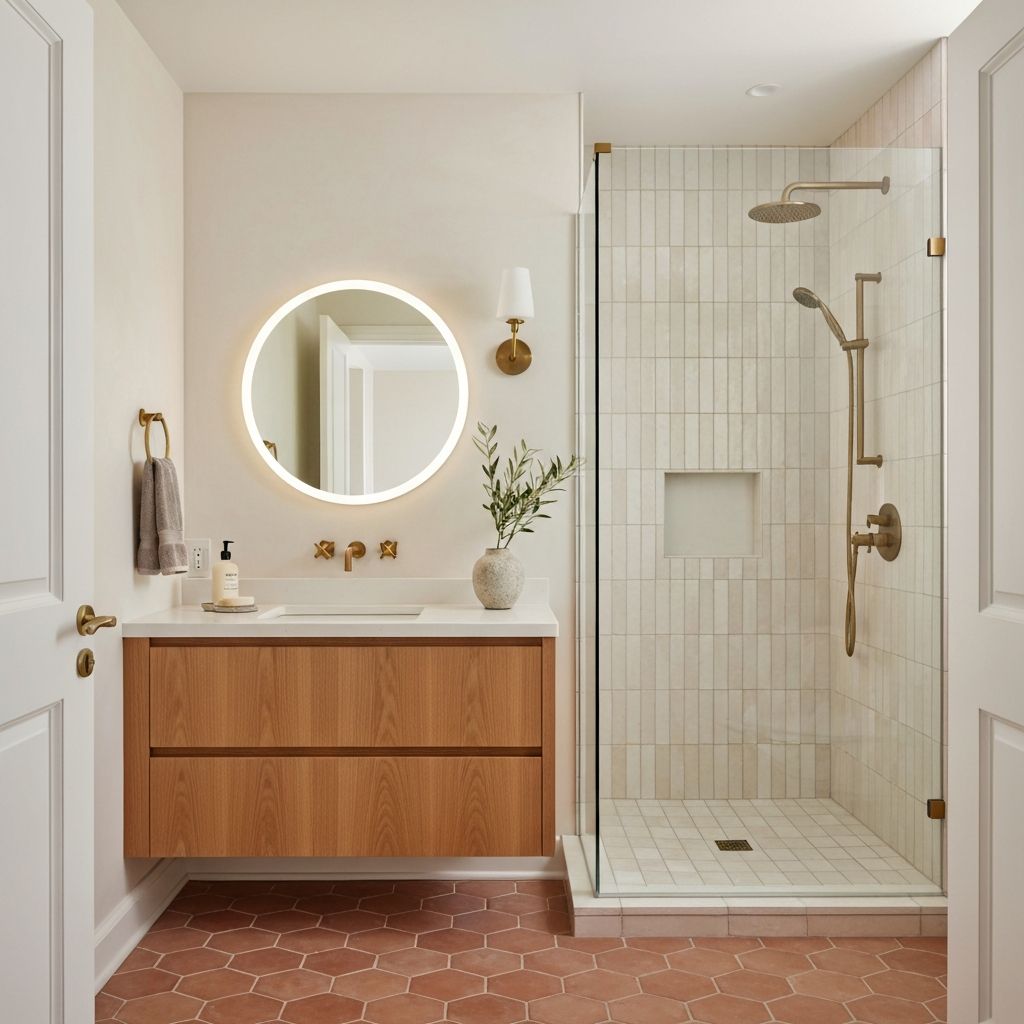
A small bathroom reads designed when the tile pattern runs floor-to-ceiling on one wall (the shower wall or the focal wall), the vanity floats off the floor so the room reads larger, and the lighting goes 2700K with two sconces flanking the mirror — not a single shadow-casting overhead — so the room feels like a hotel powder room, not a closet. A great small bathroom is one of the most satisfying design wins in any home. Square footage works against you, but the constraints actually make design choices easier — every surface, fixture, and finish has to earn its place. Done well, a small bathroom can feel more luxurious than a large one. Done poorly, it just feels cramped. The difference comes down to nine specific design moves that consistently make small bathrooms feel considered, spacious, and high-end.
The nine moves that transform any small bathroom
- Wall-hung floating vanity. A vanity that floats off the floor exposes more floor square footage, which your eye reads as a bigger room. Bonus: it makes cleaning the floor effortless.
- Frameless glass shower enclosure. Replaces the visual wall of a shower curtain or framed glass. Your eye continues through the glass, perceiving the whole footprint as one room instead of two cramped zones.
- Large-format tile. A 24" x 48" porcelain tile has dramatically fewer grout lines than a 4" x 4" mosaic. Fewer grout lines mean less visual noise, which reads as calmer and bigger. Use this on floors, shower walls, or both.
- One bold material as the hero. Pick one — a marble floor, zellige tile walls, a fluted wood vanity, or a slab of natural stone — and let it carry the entire room. Small bathrooms collapse under too many competing materials.
- Mirror to the ceiling. Stretching a single mirror from the vanity up to the ceiling doubles the perceived volume of the room. Pair it with sconces mounted directly on the mirror for an architectural look.
- Sconces, not just an overhead light. Layered light flatters faces and softens the harshness of a single ceiling fixture. Wall sconces beside or above the mirror are the single biggest "looks expensive" move you can make.
- A single accent metal. Choose one finish — unlacquered brass, matte black, polished nickel, or chrome — and use it on every fixture, towel bar, and knob. Mixing finishes makes small bathrooms feel cluttered. Mixing only works in spaces large enough to absorb the visual variation.
- A small piece of framed art. Most people skip art in bathrooms, but a single framed print, photograph, or vintage botanical immediately tells the eye the room is finished rather than utilitarian.
- One genuinely luxurious fixture. A statement faucet, a beautiful showerhead, or an unlacquered brass tub filler does more for perceived quality than a hundred dollars of accessories. Spend disproportionately on the one piece your eye lands on first.
Small bathroom color and lighting
Color choice has an outsized effect on how spacious a small bathroom feels.
- Warm whites and very pale tones — greige, blush, soft sage, putty — reflect the most light and visually expand the room.
- Avoid stark cool whites, which can feel cold and institutional in tight spaces.
- Limewashed or plastered walls add subtle texture and warmth without overwhelming a small footprint.
- Use warm white bulbs only (2700K or warmer). Cool bulbs make small bathrooms feel like dressing rooms at a department store.
- Add a dimmer to the main fixture so the room can transition from morning brightness to evening softness.
Test this on your own room photo with ReDesign before you choose the final direction; keep the doorway, walls, windows, main furniture, lighting, and awkward fixed features visible so the preview solves the room you actually have.
For a useful room-planning comparison, keep Small Bathroom Tile Choices That Make the Room Look Bigger, How to Brighten a Windowless Bathroom (Without a Renovation), and AI Interior Design: The Complete Guide to What It Does, What It Cannot Do, and When to Use It nearby so this retrofit stays connected to the adjacent lighting, storage, scale, and layout decisions in the same photo-led workflow.
The mistakes that make small bathrooms feel even smaller
- Open shelving over the toilet. Reads as clutter, not storage.
- A shower curtain instead of glass. Visually cuts the room in half.
- Mixed metal finishes. Adds visual noise the room can't absorb.
- Tiny art or too much art. One medium piece beats five small ones.
- A pedestal sink instead of a vanity. Saves a few inches but eliminates much-needed storage.
- An undersized mirror. A mirror that's smaller than the vanity makes the whole wall look unbalanced.
Common small bathroom mistakes
- Mixed metal finishes. three different finishes across faucet, towel bar, and lighting reads as cluttered; pick one and apply it everywhere.
- A shower curtain instead of glass. a curtain visually cuts the room in half; frameless glass continues the room and adds perceived square footage.
- Tiny mosaic tile floor to ceiling. 4x4 mosaic adds visual noise that small bathrooms cannot absorb; large-format tile is calmer and reads bigger.
- A pedestal sink for "space". the few inches gained are not worth the lost storage; a wall-hung vanity gives both floor visibility and real storage.
- Undersized mirror. a mirror smaller than the vanity reads as accidental; full vanity width or mirror-to-ceiling is the correct move.
- Stark cool whites. small bathrooms benefit from warmth; warm whites and pale tones reflect light without feeling clinical.
Use AI to preview your small bathroom redesign
Bathrooms are among the most expensive rooms per square foot to renovate, and small bathrooms have zero room for error. AI design lets you photograph your existing bathroom and preview a wall-hung vanity, large-format tile, a frameless glass shower, brass fixtures, or zellige walls — alone or in combination — before committing to a contractor's bid. You can test five directions in an hour and walk into your renovation with full conviction about every choice.
Frequently Asked Questions
What is the smallest functional full bathroom size?
A full bathroom works at 35 to 45 square feet with a 30 by 60-inch tub-shower, 24-inch vanity, round-front toilet, and 24 to 30-inch swing-clear door; below 30 square feet, plan for a powder room only. Use the room photo to compare the visible layout and fixed constraints before committing, because door swings, windows, outlets, storage reach, circulation, and existing furniture decide whether the idea survives daily use.
Should a small bathroom have a floating vanity?
Yes when possible — a wall-hung floating vanity makes the floor read continuous, the room feel 30 percent larger, and cleaning easier; pedestal sinks are second-best for visual scale. Keep the preview honest by leaving the problem area visible in the frame, then compare one conservative version against one bolder version before you buy lighting, paint, furniture, or storage.
Tile to the ceiling or stop at chair rail in a small bathroom?
Tile to the ceiling on one wall (the shower wall or the focal wall) draws the eye up and makes the room read taller; tile stopped at chair rail or 48 inches chops the room visually. Check the result against ordinary movement first: drawer clearance, chair pullout, walkway width, glare, switch access, and sightlines matter more than a perfect catalog angle.
What color works best in a small bathroom?
A single light-to-mid tone running floor-to-walls-to-ceiling (warm off-white, pale sage, soft blush) reads larger than a bright accent wall plus white; contrast in a small bathroom shrinks it. Use the image to narrow priorities and measurements before ordering anything custom; final purchases still need real dimensions, outlet locations, installation limits, and product clearances.
What is the biggest mistake in small bathroom design?
Cool 4000K LED overhead lighting — flat, shadow-heavy, and unflattering; replace with warm 2700K vanity sconces and a dimmable overhead, and the room transforms in one bulb swap. If the preview invents architecture or hides the awkward feature you need solved, rerun it with stricter instructions so the result remains tied to your actual room.
> Try this: Ready to see this on your own room? Open ReDesign and run the preview.
Three transformations to try
1. Floating vanity with floor-to-ceiling shower tile 2. Two-sconce vanity mirror with warm 2700K 3. Single-tone walls and floor for visual scale