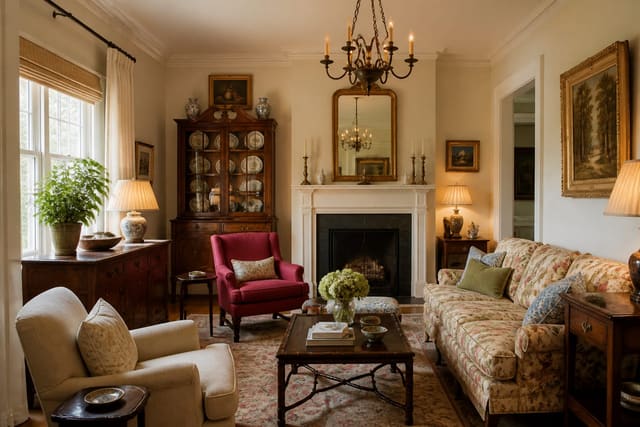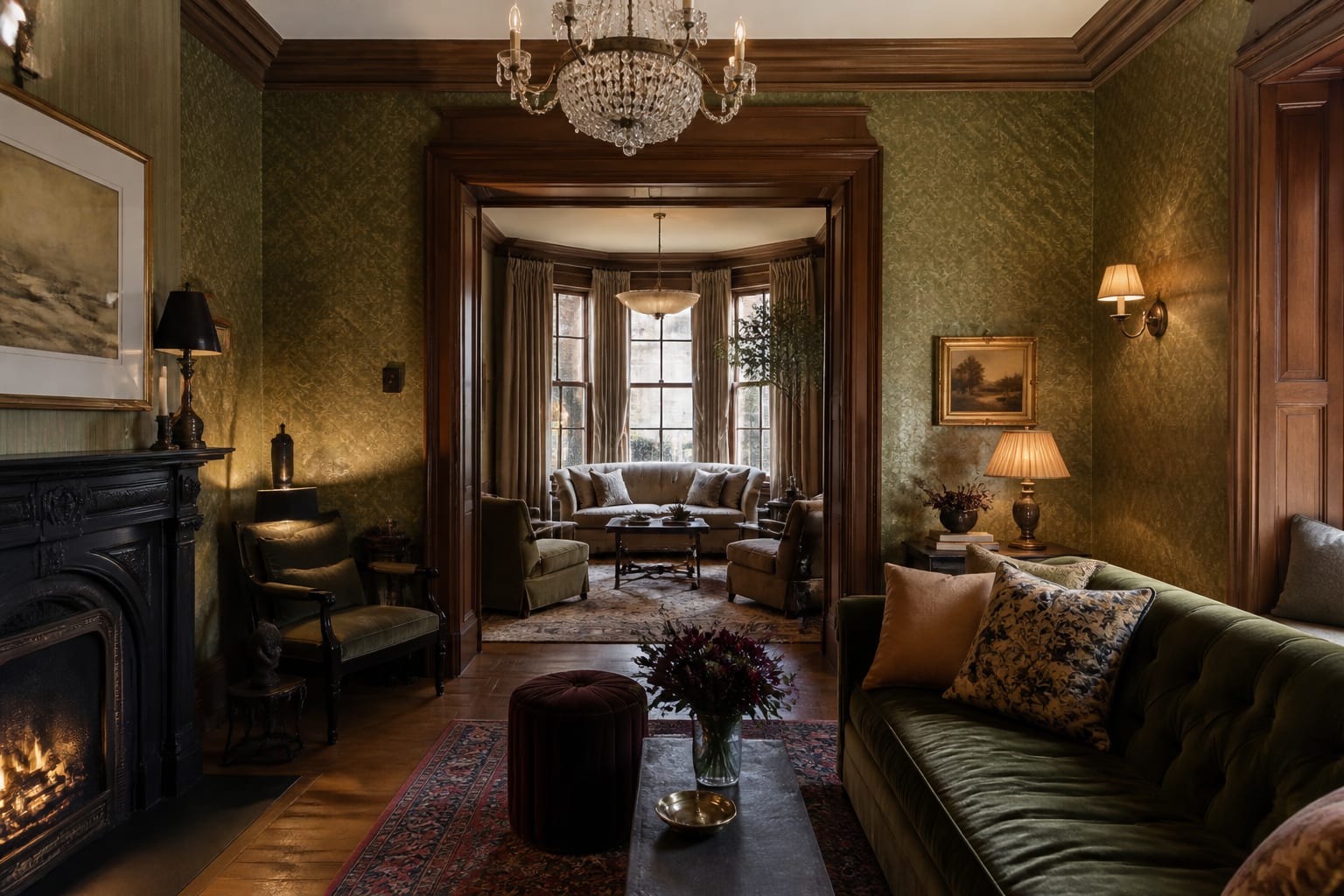
Victorian interiors get a bad reputation, and most of it is undeserved. People picture dark, cluttered parlors stuffed with doilies and assume the era is either all-in or not worth touching. My read is that the best Victorian rooms today keep the period's confidence with color and ornament but strip out the heaviness that made the originals feel airless. You honor the bones without living inside a costume drama.
The trick is knowing what is genuinely Victorian and what is just clutter we have come to associate with it. The era ran roughly from 1837 to 1901, and it loved depth: rich saturated walls, layered textiles, picture rails, and ceilings that earned their height. Edwardian interiors that followed softened the palette, which is worth borrowing from when full Victorian feels like too much. This guide covers the moves that read period-correct while keeping a home you actually want to relax in.
Reading the bones before you decorate
A Victorian home tells you what it wants if you look at the architecture first. High ceilings, often 9 to 10 feet, can carry deep color and large-scale pattern that would crush a modern 8-foot room. Tall sash windows, deep skirting boards, ceiling roses, and cornicing are the era's signature, and they are the features worth protecting before a drop of paint goes on. If previous owners boxed in a fireplace or ripped out the cornice, restoring those is usually a better first spend than new furniture.
Color is where the period really announces itself. Victorians used deep greens, oxblood reds, mustard, and inky blues, often with a darker dado below a picture rail and a lighter shade above. You do not have to commit to a full dark room to get the effect. A single deep-green wall behind a fireplace, paired with warmer trim, reads unmistakably period. When a room is short on natural light, those rich tones need help, and the layering tricks in decorating-with-inherited-furniture translate well to keeping antiques from feeling gloomy.
Texture carries as much weight as color in these spaces. Velvet, brocade, embossed wallpaper, and aged brass all do period work without you having to buy a single antique. The goal is a room that feels layered and slightly imperfect, the way a house lived in for a century actually looks.
It helps to know which Victorian sub-period your home leans toward, because the era shifted across its sixty-odd years. Early Victorian rooms were richer and heavier, mid-century work leaned into the high Gothic Revival ornament, and the later Aesthetic and Arts and Crafts movements pulled toward simpler forms and more nature-led patterns. If your house dates to the 1890s, you have more license to keep things relatively pared back than a 1850s parlor would suggest. Reading the date on the deed, or the style of the original fireplace and tile, tells you how ornate the house was always meant to be, which keeps your choices anchored to the building rather than to a generic idea of the period.
Pattern and texture without the clutter
Pattern is where Victorian style goes wrong fastest. The era loved florals, damasks, and geometric tiles, but the originals worked because they were layered with intention, not piled on. A reliable formula is two to three patterns per room at different scales: one large, like a wallpaper or rug, one medium, like a sofa fabric, and one small, like a cushion or trim. Keep them in a shared color family and the room reads rich instead of chaotic.
The livable version pulls back on quantity. Where a true Victorian parlor might have had every surface dressed, a modern take leaves breathing room so the good pieces get noticed. This is also where you can borrow a more relaxed, preppy confidence with stripes and checks, an approach I unpack in preppy-interior-design-ideas. The mix keeps the era present without the airless feeling.
When you are choosing what to layer, look for these period-friendly elements:
- Embossed or anaglypta wallpaper below a picture rail
- Encaustic or geometric floor tiles in an entry or hearth
- Heavy curtains in velvet or damask with a contrasting lining
- Aged brass or bronze hardware rather than chrome
- A single statement light fixture, like a brass pendant or a restored chandelier
Furniture, lighting, and keeping it comfortable
Victorian furniture is heavy by design, so the livable move is to mix it rather than match it. One genuine antique, a carved sideboard or a button-back chair, anchors a room. Surround it with simpler modern seating and the antique reads as a treasured piece instead of a set. If you want the era's spirit with softer lines, Edwardian and even Regency forms give you slimmer legs and lighter frames, and the lighter palette ideas in regency-core-interior-design bridge the two periods nicely.
Lighting is the detail that makes or breaks the livable Victorian. The originals were lit by gas and candle, which is why deep colors looked so good in them. Recreate that glow with warm bulbs around 2700K, layered across table lamps, sconces, and a central fixture, rather than one cold overhead light. Avoid bright daylight-temperature bulbs, which flatten the rich tones and make a deep green wall look like a hospital corridor.
Common mistakes to avoid
The most common mistake is treating Victorian like a theme. Buying a matching reproduction suite, swamping every surface with lace, and calling it period actually reads as a stage set. The originals were collected over decades, so mix eras and let some pieces feel modern.
Another mistake is painting away the architecture. Slathering original cornicing, picture rails, and skirting in the same flat white as the walls erases the very details that make the room special. Pick those out in a contrasting or slightly deeper tone so they read.
The last one is cold lighting. Installing 4000K LED downlights in a deep-toned Victorian room kills the warmth the color scheme depends on. Stick to 2700K and layer your light sources, and the whole scheme comes alive instead of looking flat and grey.
Use AI design to preview victorian interior design ideas before you commit
Deep color and layered pattern are the hardest looks to judge from a paint chip, because a swatch never shows you how an oxblood wall behaves with your light or your existing furniture. This is where Re-Design takes the gamble out of it. Upload a photo of your room and the AI can re-render it with a deep-green dado, a damask wallpaper, or a restored picture rail, so you see the period mood in your actual space before committing to a single tin of paint.
I find it most useful for testing how far to push the era. You can preview one wall in a saturated Victorian tone against a lighter version above the rail, compare a busy floral against a quieter geometric, and decide where the line sits between rich and overwhelming. Run a few variations, keep the one that feels like a home rather than a museum, and only then book the painter.