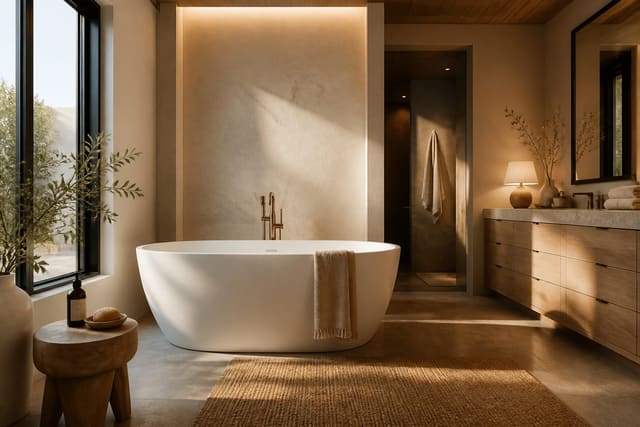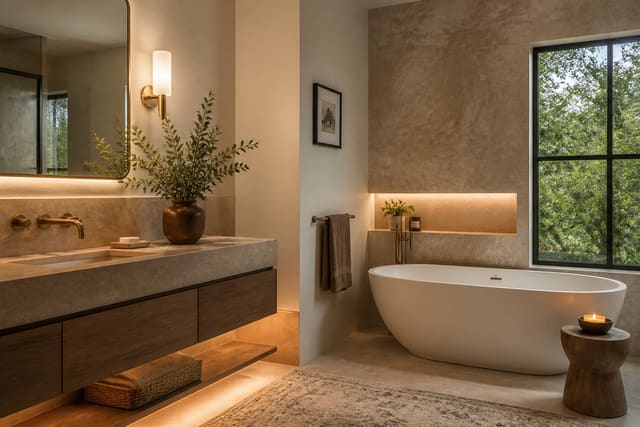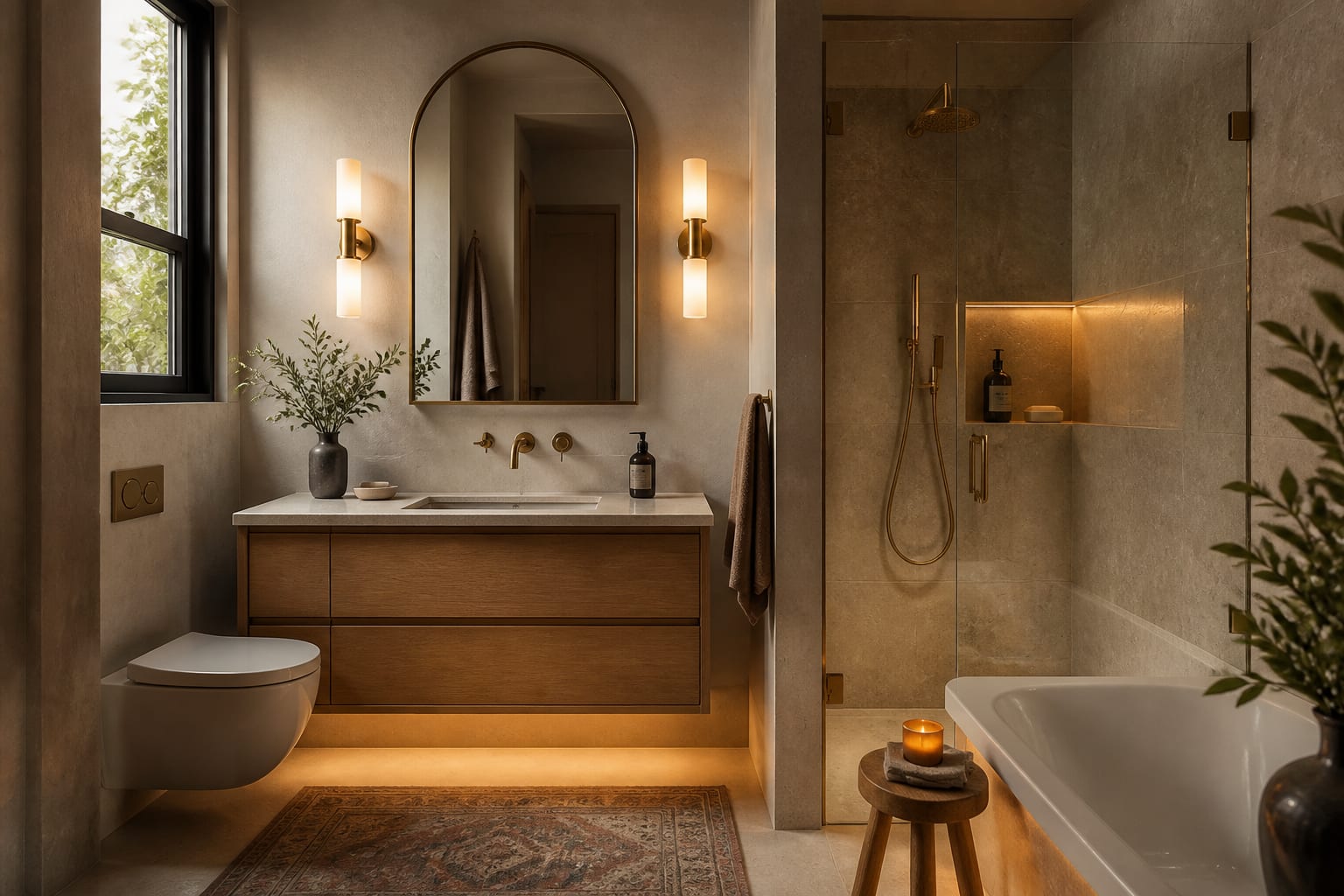
"A bathroom doesn't fail at the rendering — it fails at the towel bar, the toothbrush, and the Monday morning routine."
AI bathroom design ideas work when a tool turns a real photo of your bathroom into concept images that keep the toilet location, window, and ceiling height fixed while testing vanity, tile, lighting, and tub options. This lets you compare finishes and layouts before demolition instead of guessing. Treat every result as a decision draft, not a permit set, since plumbing, waterproofing, and code still need a professional.
Can AI visualize a bathroom renovation before demolition?
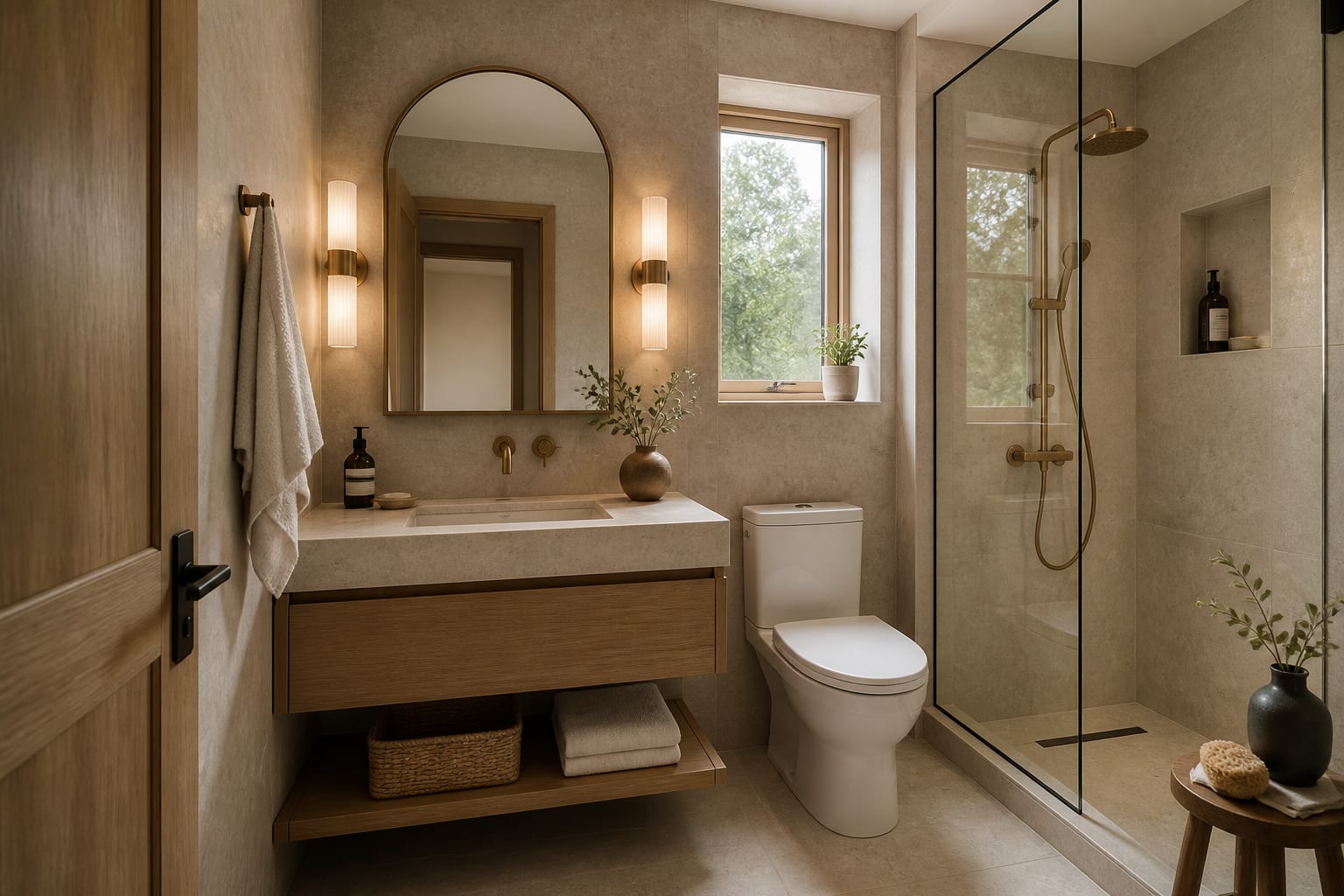
Yes. A clear bathroom photo can become realistic concept images for layout, tile, vanity, lighting, tub, shower, and hardware before you commit to anything. The value isn't guessing — it's speed: compare a walnut vanity against white oak, or test whether a freestanding bath actually fits the footprint. Before placing one, check freestanding tub layout ideas for real clearance needs around stepping in and cleaning.
A bathroom preview only earns trust when the prompt includes constraints a designer would ask for on-site: toilet location, a window, a radiator, a 60-inch alcove tub, a 36-inch shower opening, or an inward door swing. Plumbing walls, waterproofing, ventilation, and code still need qualified eyes. The preview simply answers whether a direction will look right in your bathroom.
What should you decide before choosing tile?
Decide the bathroom's hierarchy first. Most failed bathrooms have too many main characters — patterned floor, dramatic shower wall, veined countertop, brass faucet, black mirror, ribbed vanity, pendant light — all competing in 40 square feet. Pick one dominant surface and let the rest support it.
Start with whatever is hardest to change: layout, shower system, tub, or tile field in a full renovation, or an existing floor or countertop in a cosmetic update. Name that anchor instead of treating the room as blank. A small hall bath usually needs calm (a 24-inch vanity, 30-inch mirror, single sconce, quiet floor tile); a primary bath can handle more contrast, but still needs one loud element paired with restraint elsewhere.
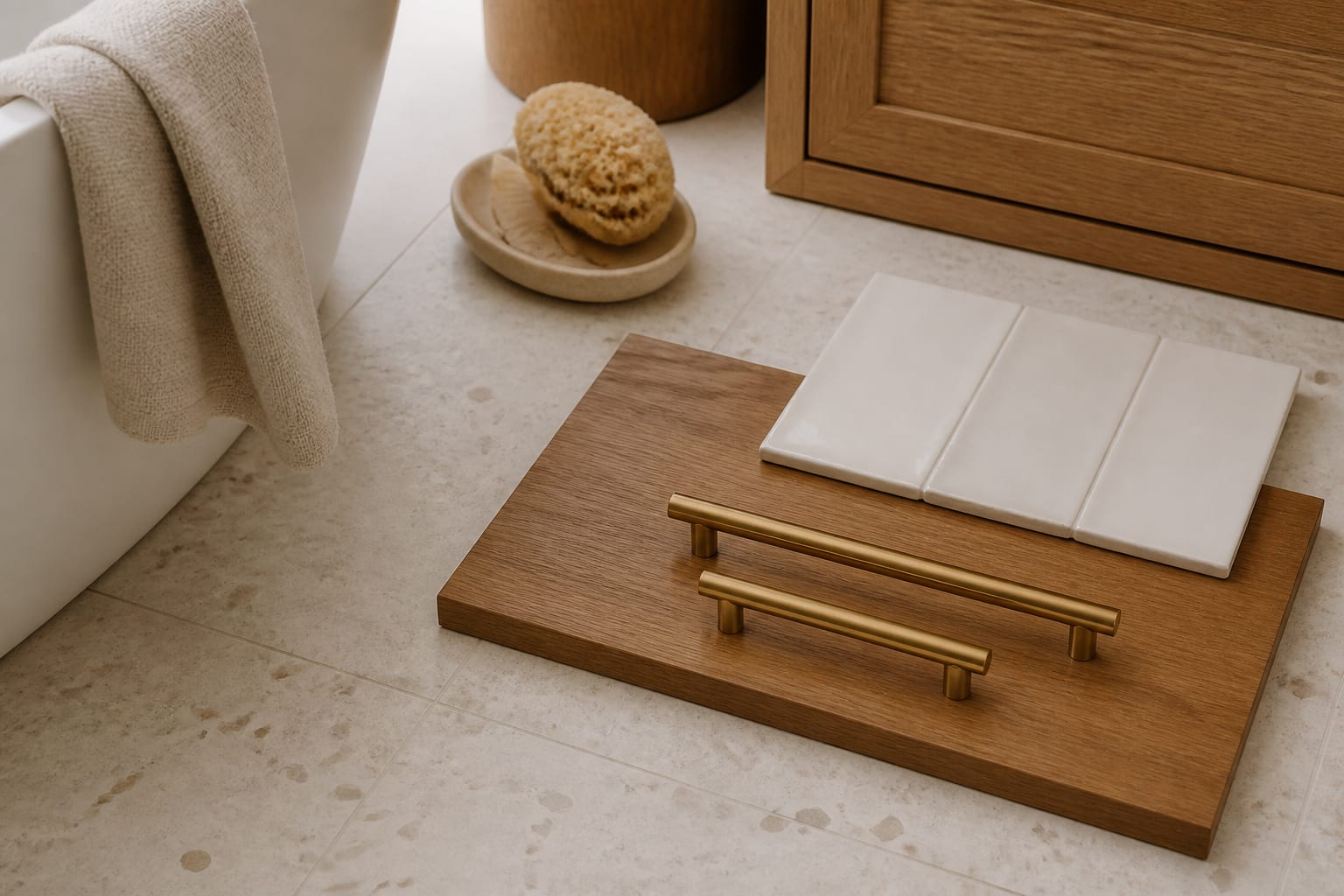
Hardware is where mixes drift. Compare your finish plan against a practical bathroom hardware guide so towel bars, hooks, shower trim, faucet, pulls, and mirror frame read as a family, even if they don't all match exactly.
How do layout, lighting, and storage change the result?
A bathroom can look expensive and still function badly. Test the invisible irritations before trusting any rendering: where towels land, whether drawers hit door trim, how the mirror light flatters your face, and whether products have a believable home.
- Keep at least 21 inches clear in front of the toilet; more where the room allows.
- Give a single vanity 24 inches minimum for a powder bath, 30-36 inches where daily grooming happens.
- Place sconces around 60-66 inches from the floor to avoid shadows under brows and noses.
- Choose 2700K-3000K bulbs; cooler light makes skin and warm tile read harsh.
- Size a shower niche around your actual products, with 12 inches of height as a starting point.
Storage deserves the same discipline as tile. A floating vanity looks lighter but loses drawer volume, so plan a recessed medicine cabinet or a wall cabinet if there's no nearby linen closet. Drawers beat doors for daily items since contents stay visible. Ventilation isn't glamorous, but matching the fan to room size and duct run protects the renovation a rendering can't show.
Common AI bathroom redesign mistakes
Most mistakes come from asking for a fantasy bathroom when the room needs a disciplined renovation. The image can look polished while the plan fails — a blocked cabinet, no shower-glass clearance, a faucet with nowhere to mount.
- Ignoring the fixed plumbing wall can balloon project scope; keep the toilet and wet wall in place unless you're pricing a full gut.
- Choosing tile from a rendering alone risks scale distortion; confirm whether it's 2x8-inch, 4x4-inch, 12x24-inch, or slab-size before ordering.
- Letting AI erase awkward features skips the real job; include the soffit, low window, sloped ceiling, or radiator so the concept actually solves the room.
- Forgetting towel placement hurts family bathrooms; reserve a 24-inch bar, hooks, or heated rail before every wall becomes mirror and glass.
- Assuming black fixtures are maintenance-free ignores hard-water spotting; use black where you'll clean often, or choose brushed nickel, chrome, or brass instead.
The same caution applies to freestanding tubs. Compare freestanding bath design ideas against your actual floor plan before letting a preview center the renovation on one object.
How do you use AI to preview your bathroom before committing?
Measure the room and choose your nonnegotiables first. Upload a straight daylight photo from the doorway or widest corner, showing vanity, toilet, shower or tub, window, and ceiling line; turn on lights if the room is dim and avoid night photos, which distort material colors.
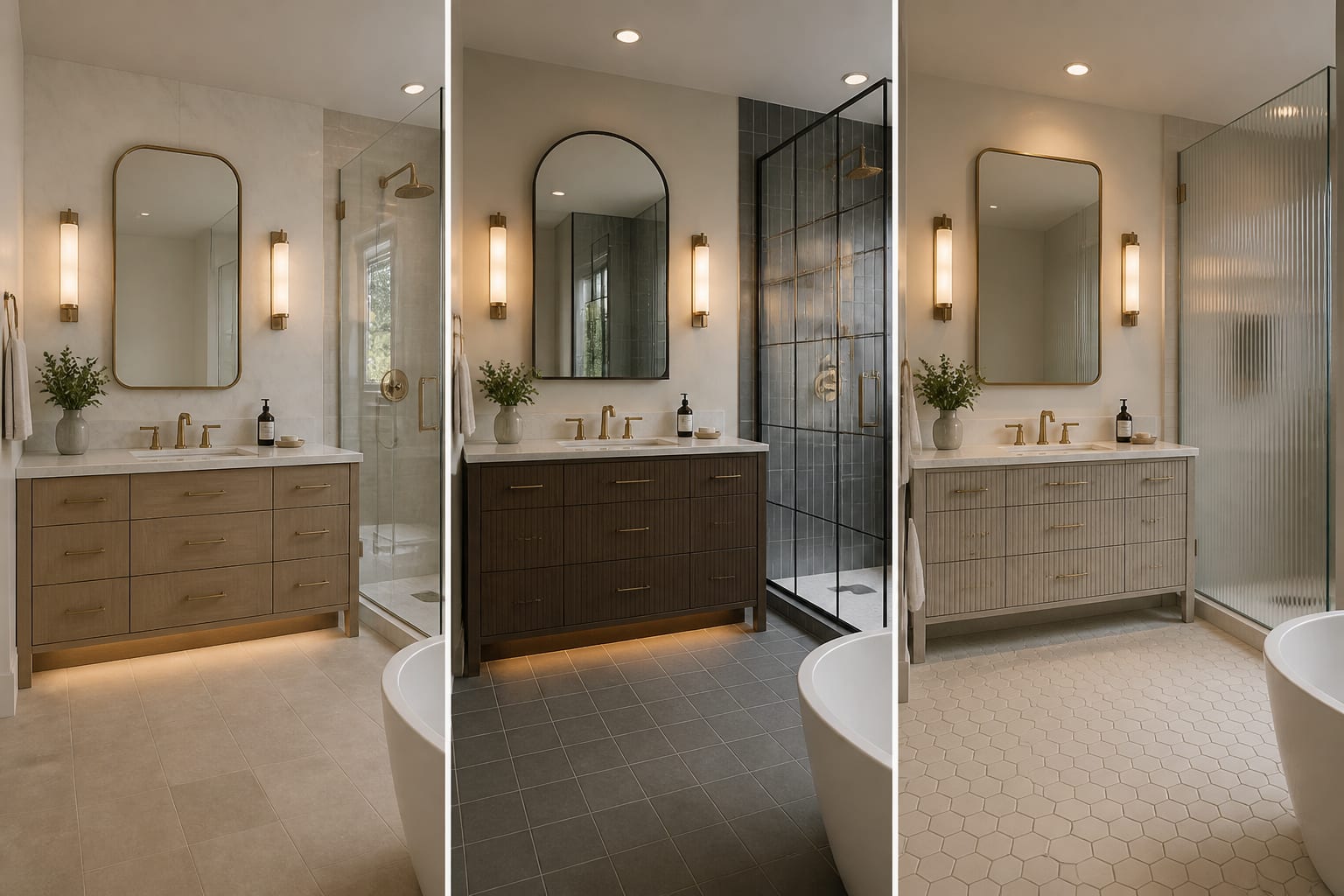
A strong prompt might read: "Keep the toilet and window location, replace the 60-inch alcove tub with a glass shower, add a 36-inch oak vanity with drawers, use warm white wall tile, terrazzo-look floor tile, brass hardware, a recessed medicine cabinet, and 3000K sconces." That specificity gives you real comparisons: oak versus painted vanity, brass versus chrome, curtain versus glass.
Generate at least three directions — one safe, one style-forward, one function-first. The winner is whichever still makes sense with wet towels, toothpaste, kids, pets, and a Monday-morning routine.
Which details make the concept worth pricing?
A concept is worth pricing once it survives measurement. Check vanity width, toilet centerline, shower entry, door swing, mirror height, and storage depth before sending images to a contractor. A toilet typically needs about 15 inches from centerline to each side obstruction, and a shower entry below 24 inches often feels tight despite looking generous in a render.
Material transitions matter too: where tile stops, how the shower curb or curbless edge works, and how the vanity backsplash meets the side wall. Ask the AI preview to show the full vanity wall and shower edge, not just one flattering angle.
Finally, narrow the palette before buying samples — one metal finish, one wood tone or paint color, one dominant tile, one quiet supporting surface. Order physical samples and view them in morning and evening light, since the final call belongs to your actual bathroom under your actual bulbs.
Frequently Asked Questions
Can AI design a bathroom renovation from one photo?
Yes. Upload a doorway photo showing the full room, then test vanity, tile, lighting, and fixture options while keeping toilet location, window height, and ceiling line fixed. Treat the result as a decision draft, not a permit set.
How accurate is AI bathroom tile scaling?
The pattern is usually right; the size is often wrong. Specify whether you want 2x8-inch zellige, 4x4-inch handmade, or 12x24-inch large-format tile in the prompt, then confirm with physical samples before ordering.
Should I move the toilet to get a better layout?
Usually no. Moving the wet wall turns a cosmetic renovation into a major project, so keep existing plumbing fixed and improve the layout through vanity width, shower size, and door swing instead.
Will AI show realistic bathroom lighting?
Only if you specify it. Ask for 2700K-3000K bulbs and eye-level sconces around 60-66 inches, since overhead-only fixtures create shadows even in a polished-looking rendering.
How many bathroom concepts should I generate before deciding?
Generate three: one safe version, one that pushes the style, and one that prioritizes function. The winner is whichever still makes sense under wet towels, toothpaste, and a real morning routine.