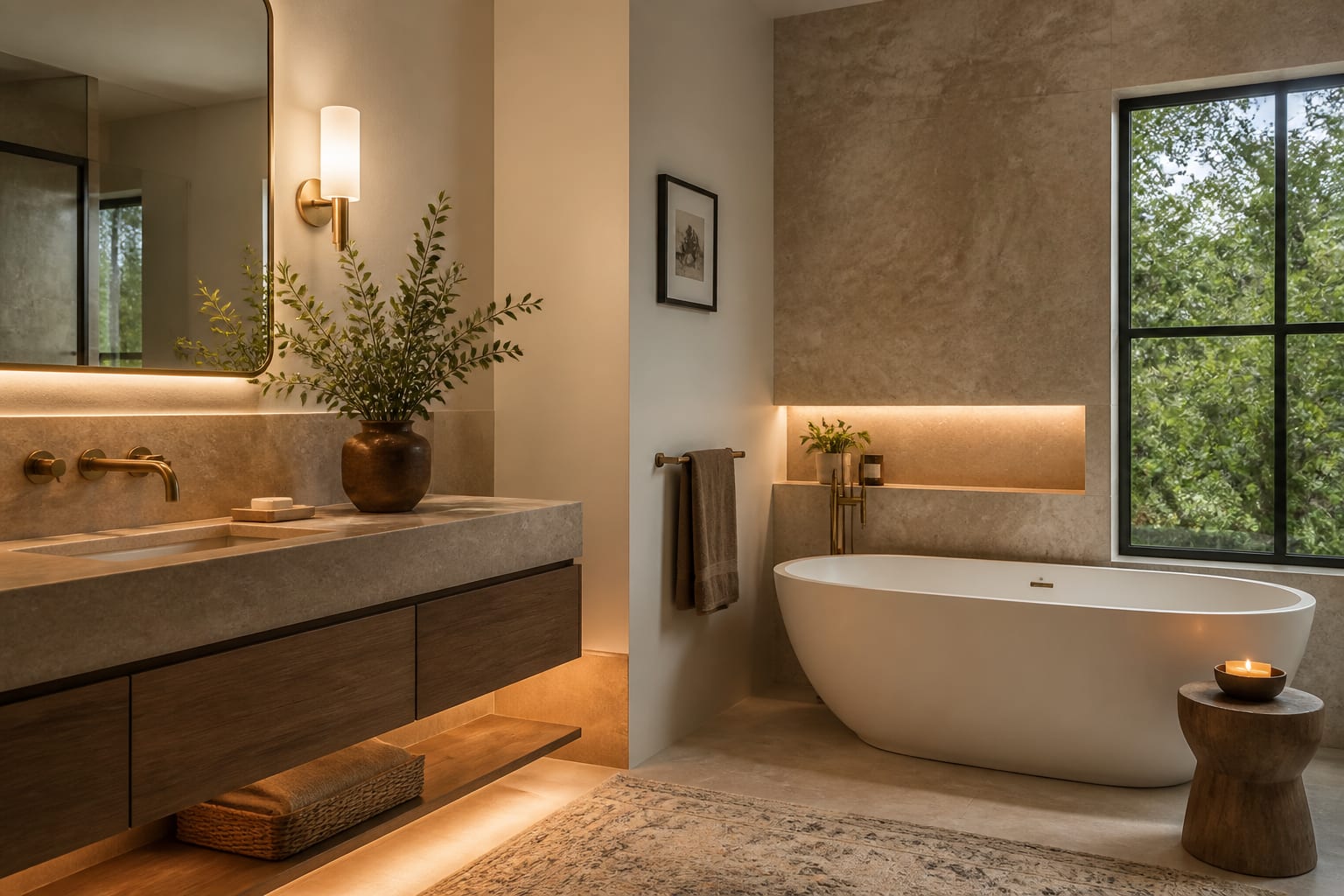
Bathroom hardware guide basics: towel bars mount at 48 inches, robe hooks at 70 inches, and toilet paper holders at 26 inches, all anchored into studs. Getting these heights and a single consistent finish right is what makes a bathroom feel designed instead of assembled from whatever matched the faucet at the last minute.
Where should towel bars, rings, and heated rails go?
A folded bath towel needs about 24 inches of bar to hang flat, so a standard 24-inch bar fits one towel while an 18-inch bar only suits a hand towel. If two people share the bathroom, plan two bars or a double bar rather than crowding one rod. Mount the bar at 48 inches from the finished floor, which clears the vanity backsplash and keeps towels off the ground.
Towel rings belong by the sink for hand towels, set 50 to 52 inches high and about 4 inches to the side of the vanity so a dripping hand reaches them without stretching over the faucet. Heated towel rails are a worthwhile upgrade in a primary bath, typically 20 to 30 inches wide and drawing 60 to 150 watts, doubling as a low-grade room heater. Our AI bathroom design ideas guide covers how hardware placement coordinates with the vanity and lighting plan before you drill.
How high should robe hooks and toilet paper holders be?
Robe hooks are the cheapest upgrade with the biggest daily payoff, and height is the only rule that matters. Mount a single hook at about 70 inches so a hung robe clears the ground for an average-height user. Two hooks should sit at the same height, spaced 4 to 6 inches apart; behind a door, drop the hook to around 60 inches so the door still swings clear.
Center the toilet paper holder 26 inches above the floor and 8 to 12 inches forward of the toilet bowl's front edge. Too far back and you twist to reach it; too low and the roll drags the floor. A wall mount looks cleaner than a freestanding stand and frees the floor for cleaning.
- Towel bar centered at 48 inches, 24 inches minimum length per bath towel.
- Robe hook at 70 inches on an open wall, 60 inches behind a door.
- Toilet paper holder centered at 26 inches, 8 to 12 inches ahead of the bowl.
- Towel ring at 50 to 52 inches, about 4 inches beside the vanity.
- Hand towel hook near a powder-room sink at 48 inches for guests.
Which finish holds up best in a wet room?
The safest move is one metal carried across the faucet, hardware, and light fixtures.
| Finish | Durability | Notes |
|---|---|---|
| Polished chrome | Highest | Hides water spots, resists corrosion for decades |
| Brushed nickel | High | Forgiving of fingerprints, fits warm and cool palettes |
| Matte black | Moderate | Shows hard-water residue and dust; needs frequent wiping |
| Brass or bronze | High, ages with patina | Runs 30 to 50 percent pricier per piece |
Confirm hardware is rated for bathroom humidity: solid brass or 304 stainless cores resist rust, while cheap zinc-alloy pieces with thin plating can bubble and flake within a year or two. Expect $15 to $40 per piece for solid mid-range hardware and $60 to $150 for designer lines; a full coordinated set typically runs $80 to $250.
What hardware mistakes should you avoid?
- Mounting the towel bar too low, under 42 inches, so towels brush the floor or trash can.
- Mixing finishes without intent, like a chrome faucet beside matte-black bars in a small room.
- Anchoring into drywall alone; a loaded towel bar can pull 20 to 30 pounds and rip out without a stud or toggle anchor.
- Buying an 18-inch bar for bath towels, then wondering why they never dry.
- Setting the paper holder behind the toilet tank, forcing an awkward backward reach.
- Choosing matte black in a hard-water home and fighting mineral spots for years.
Locate studs first and use anchors rated for at least 50 pounds wherever a stud is not available. The same care that protects a freestanding fixture wall, covered in our freestanding tub ideas breakdown, applies to every piece you screw into a wet wall.
See it first in Re-Design
It is hard to judge whether matte black or brushed nickel suits your tile until you see it against the actual room. Upload a photo of your bathroom to Re-Design and preview finishes and layouts on your own walls before ordering anything. Test how a double towel bar reads next to the vanity or whether a robe hook crowds the door before you pick up a drill.
Frequently Asked Questions
How high should a towel bar be mounted?
Mount a towel bar at 48 inches from the finished floor in most bathrooms, which clears a standard vanity backsplash and keeps a hanging towel off the floor. For a children's bathroom, drop it to around 36 inches. Allow at least 24 inches of bar length per bath towel so it hangs open and dries.
Where should the toilet paper holder go?
Center the holder 26 inches above the floor and 8 to 12 inches in front of the toilet bowl's front edge, on the side wall or vanity, for an easy forward reach. Avoid mounting it behind the tank, which forces an awkward twist, and avoid setting it too low where the paper drags the floor.
Can I mix metal finishes in a bathroom?
You can, but it takes intent, and one finish family across hardware, faucet, and lighting is the reliable approach. If you mix, pick metals that share a temperature, like brushed nickel with chrome, rather than pairing warm brass with cool matte black in a small room where the clash reads as an accident.
What hardware finish lasts longest in a bathroom?
Polished chrome and brushed nickel over a solid brass or 304 stainless core hold up best against humidity and hard water, resisting corrosion and hiding spots. Matte black shows mineral residue, and cheap zinc-alloy hardware with thin plating can bubble and flake within a year or two in a steamy room.