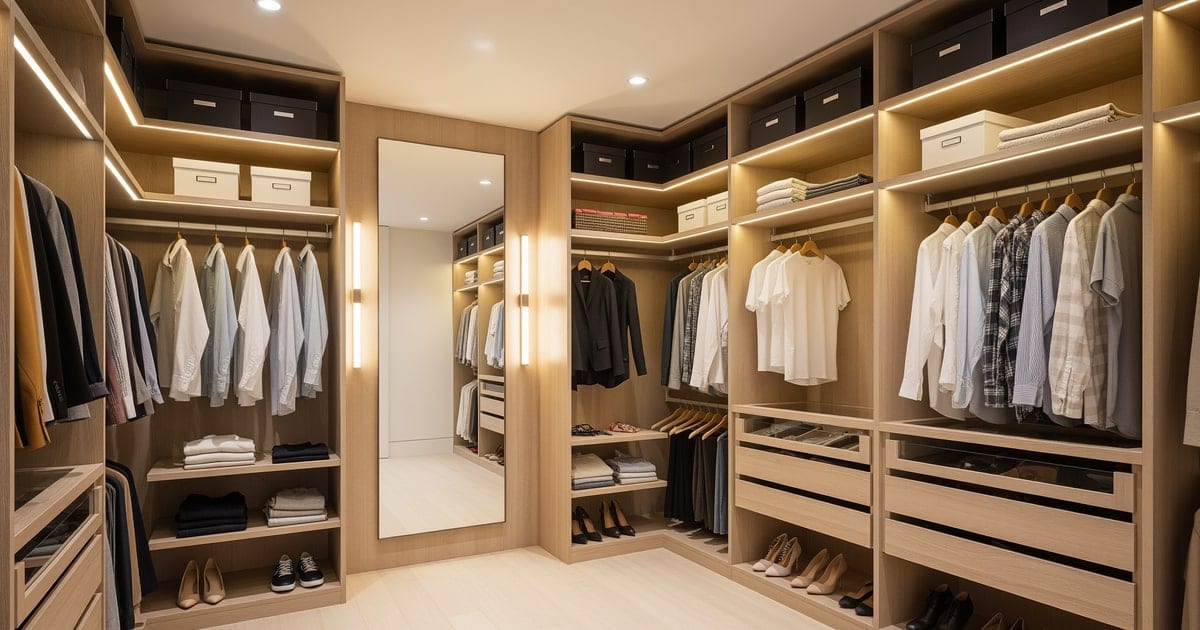
AI closet design works by uploading a closet photo, locking the door swing and rod height, and previewing shelving, drawer, and hanging-zone layouts side-by-side before ordering any millwork. Most closets fail not because they are too small but because they are organized for the wrong wardrobe. A 6-foot rod gets installed at 80 inches everywhere, all dresses and all coats get crammed in together, and the shelf above becomes a graveyard for sweaters and forgotten boxes. My opinion is blunt: closets are the highest-ROI room in any house, and AI closet design is the fastest way to redesign one because the variables are small in number, generic in shape, and easy to preview from a single photo.
Can AI design a walk-in closet from a photo?
Yes. AI closet design generates a custom storage system inside the existing closet footprint by previewing hanging zones, double-hung versus single-hung rods, drawer towers, shoe shelves, and lighting based on a photo of the empty closet and a description of the wardrobe it needs to hold. The strongest workflow is to clear the closet, photograph it from the doorway with all three walls visible, then prompt the AI for specific zones: "long hanging on the left for dresses and coats, double-hung in the center for shirts and pants, drawer tower with six drawers on the right, shoe shelves above the drawer tower, LED tape under each shelf." The render becomes the system spec; the system spec becomes the IKEA list or the custom-closet quote.
What AI closet design does well
Zoning is the biggest single win. A closet that mixes coats, dresses, shirts, pants, and sweaters in one rod is harder to dress from than a closet half its size with proper zones. AI shows you what each zone needs — 38 to 40 inches vertical for shirts and folded pants double-hung, 65 to 70 inches for long dresses and coats single-hung, 12 to 18 inches per drawer for folded items.
Custom-closet quotes are notorious for being three times what an IKEA Pax system would cost for the same function. AI lets you preview both. Run one version with a custom millwork closet, then a version with a Pax-style modular system from off-the-shelf parts. The comparison usually shows that the modular version is 90 percent of the function at 30 percent of the cost — and the preview is the proof your spouse needs.
Lighting is invisible in most closets and transformative when you add it. LED tape under the front edge of each shelf turns a dim closet into a usable storage system. AI shows the difference between a closet lit only by overhead and a closet with under-shelf lighting plus a sconce at the mirror. For the underlying lighting moves, the strategies in closet lighting ideas translate directly into prompt language.
Mirror placement is the second-strongest lighting move. A full-length mirror inside the closet door or on the back wall doubles the perceived size of a reach-in closet and gives you a real dressing station in a walk-in. AI shows you the difference and helps you pick the right placement.
Shoe storage is a specific category where AI helps. Single-tier open shelves, double-tier angled shelves, shoe drawers, or a dedicated shoe wall all have different capacities for the same square footage. Preview each and pick the one that matches your shoe count and footprint.
Color palette inside the closet matters more than people expect. A dark closet with dark walls is a black hole; a closet with warm white walls, LED tape, and a single sculptural light fixture reads as a luxury extension of the bedroom. AI shows you the difference cheaply.
Test this on your own room photo with ReDesign before you choose the final direction; keep the doorway, walls, windows, main furniture, lighting, and awkward fixed features visible so the preview solves the room you actually have.
What AI closet design does badly
Shelf depth and rod height precision are unreliable. AI may render a hanging rod at 70 inches when the prompt said 80, or shelves at 14 inches deep when they need to be 16 for sweater folding. Always verify final dimensions with a tape measure against the actual product or the contractor's drawing.
Door swing and clearance are often ignored. The render may show a beautiful closet that the door cannot open into. Always check that the swing of bifold, sliding, or hinged doors is preserved in your real closet.
Existing utilities — electrical outlets, HVAC vents, baseboard heaters, attic accesses inside closets — are usually edited out. Identify these in the photo and prompt the AI to preserve them; otherwise the design assumes a magical clean box.
Ceiling height in closets often matters more than in living spaces. A 7-foot closet ceiling cannot hold a 7-foot armoire even if the render shows it fitting. Always confirm ceiling height before specifying tall units.
Hardware finishes (rod color, drawer pull style, knob versus pull) come back inconsistent across renders. Lock these in by specifying them in the prompt, and confirm the actual finish in person before ordering.
How to use Re-Design for a closet preview
Be precise about the wardrobe and the use case. The closet preview gets shallow when the AI does not know what the closet will hold.
Example for a walk-in: "Convert this 6 by 8 foot walk-in closet for a couple. Left wall: long hanging for dresses and coats, single rod at 70 inches above the floor, with a shelf at 78 inches above it. Center wall: double-hung shirts and pants, rods at 80 inches and 40 inches, with a shelf at 88 inches above. Right wall: 6-drawer tower in walnut, 18 inches wide and 24 inches deep, with shoe shelves above. Add LED tape under every shelf. Mount a full-length mirror inside the door. Add a single warm white sconce above the mirror. Paint the walls warm white and use warm oak shelving."
Example for a reach-in: "Convert this 5 by 2 foot reach-in for one person. Add an IKEA Pax-style modular system with a single hanging rod at 80 inches, a drawer block of three drawers on the right, two shoe shelves above the drawers, and a single shelf running across the top at 88 inches. Add LED tape under each shelf. Replace the existing closet doors with bypass mirrored doors. Paint the inside warm white."
Run a second version with one variable changed — for example, swap the walnut drawer tower for a white melamine to compare custom-millwork against IKEA-style cost. The comparison usually decides the project.
For a walk-in that doubles as a small dressing space or even an occasional office, the conversion pattern in walk-in closet to mini home office shows the wider context — many closet redesigns are really mini-room redesigns.
Common AI closet design mistakes
- Trusting the render's rod heights instead of measuring against actual garment lengths.
- Skipping under-shelf lighting and ending up with a dim closet that defeats the redesign.
- Ignoring door swing and ordering a system that blocks the door.
- Running one preview instead of comparing custom millwork against modular systems.
- Forgetting the mirror; a closet without a full-length mirror is an unfinished closet.
- Designing for the closet you wish you had instead of the wardrobe you actually own.
- Buying custom-closet quotes without an AI preview to use as a negotiation tool.
Use AI design to preview your closet before you buy
Closets are small enough that AI gets the geometry right, and high-ROI enough that even a modest improvement pays back daily. Photograph the empty closet, prompt for specific zones and rod heights, run a custom-versus-modular comparison, and walk into the storage decision with a real plan. The result is usually 90 percent of the luxury closet at 30 percent of the price — and a closet that actually fits the clothes you own.
Frequently Asked Questions
Can AI actually design a functional closet layout?
Yes — when given an accurate closet photo with door swing and ceiling height locked, AI previews shelving heights, rod counts, and drawer placement that respect the existing footprint without over-stuffing the corners. Use the room photo to compare the visible layout and fixed constraints before committing, because door swings, windows, outlets, storage reach, circulation, and existing furniture decide whether the idea survives daily use.
What information does AI need to design a closet?
Upload one head-on photo of the closet from the doorway, note ceiling height, and tag the door swing direction; that is enough for the model to produce a layout that respects clearance and reach zones. Keep the preview honest by leaving the problem area visible in the frame, then compare one conservative version against one bolder version before you buy lighting, paint, furniture, or storage.
How accurate are AI closet designs to real-world build costs?
AI previews are accurate to layout and proportion, not to material cost; use the preview to confirm shelf counts and drawer banks, then price the build with a local closet installer or DIY kit retailer. Check the result against ordinary movement first: drawer clearance, chair pullout, walkway width, glare, switch access, and sightlines matter more than a perfect catalog angle.
Can AI design a reach-in closet differently from a walk-in?
Yes — reach-in previews focus on a single-wall shelving stack with one or two rod zones, walk-in previews add an L or U shape and a center island; the model routes off the photo geometry. Use the image to narrow priorities and measurements before ordering anything custom; final purchases still need real dimensions, outlet locations, installation limits, and product clearances.
Should I trust AI closet design for a custom millwork order?
Use AI to confirm layout intent and reach zones before millwork sign-off, but always cross-check final measurements with the installer; AI handles design direction, not field measurement tolerances. If the preview invents architecture or hides the awkward feature you need solved, rerun it with stricter instructions so the result remains tied to your actual room.
> Try this: Ready to see this on your own room? Open ReDesign and run the preview.
Three transformations to try
1. Reach-in closet with shelving stack and two rods 2. Walk-in closet with island and drawer bank 3. Closet with shoe wall and folded-storage cubbies


