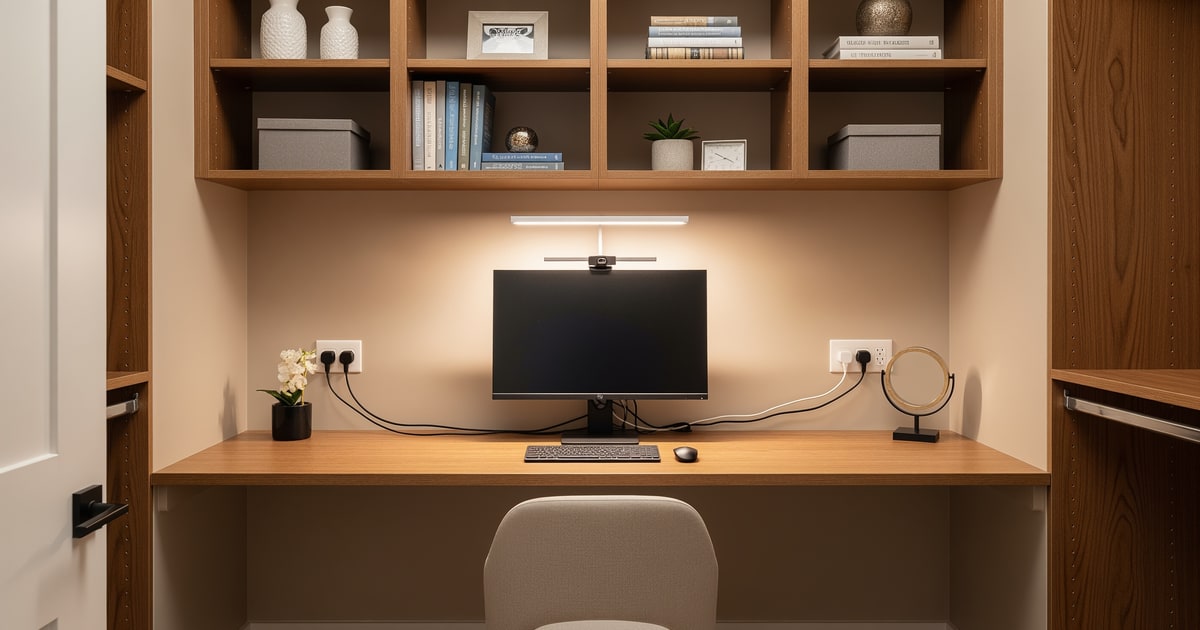
A walk-in closet converts to a home office when the long wall becomes a desk wall (24 inches deep, full closet width), the existing hanging rod above the desk gets repurposed as a shelf or stays for partial wardrobe storage, the door swaps to a barn slider or comes off entirely, and a single task lamp at 3000K plus a battery puck overhead light replace the need for new hardwired electrical. A walk-in closet is the most undervalued home office in any house. It's a dedicated room with a door, walls on three or four sides, and a ceiling — which is already more than any corner of a living room can offer. The conversion is straightforward when you approach it systematically: keep what storage you can, add a desk surface and a real chair, wire (or plug in) a light, and close the door when work is done. The result is a private, contained workspace in a home that never had one.
Can you turn a walk-in closet into a home office?
Yes — if the closet is at least 5'x5' (25 sq ft), has an electrical outlet, and has adequate ventilation. Most walk-in closets in 3+ bedroom homes are 5'x7' to 6'x8', which is exactly enough for a desk, a chair with rolling clearance, and a single shelf system above the desk. Closets under 5'x5' work only as standing-desk offices or Zoom-call booths. The door is the most valuable feature — it provides acoustic separation that no open-plan workspace can match.
What to keep and what to remove
A walk-in closet rarely needs to give up all its storage to become an office. The standard conversion:
Remove: - The lowest hanging rod (this is where the desk goes). - Any center island or shoe tower (blocks the chair). - Anything stored at desk height (28"–36") on the side walls.
Keep: - High shelves (above 72") for less-used items or office supply overflow. - One side of double-hang if the closet is wide enough (6'+) — one side office, one side clothes. - Corner shelves if the desk doesn't reach the corner.
The typical 6'x8' walk-in yields a 60"x24" desk surface, rolling chair clearance of 36"–42", and at least 40 linear feet of high shelving above the desk. More usable storage than most people realize.
Test this on your own room photo with ReDesign before you choose the final direction; keep the doorway, walls, windows, main furniture, lighting, and awkward fixed features visible so the preview solves the room you actually have.
Desk configuration for the most common closet shapes
- Single-wall closet (long and narrow, under 5' wide). A 48"–60" desk spans the back wall. Floating desk surface at 28"–30" height (no legs) gains 4"–6" of floor clearance and makes the space feel less cramped.
- L-shaped closet (5'x7' or wider). A floating L-desk spans the back wall and one side wall. The corner becomes a monitor alcove. Most productive surface-to-footprint ratio of any configuration.
- Square closet (5'x5' to 6'x6'). A 48" desk on the back wall with 30"–36" of roll-back clearance for the chair. The two side walls hold vertical shelving.
Lighting — the most common conversion failure
Closet lights are almost never adequate for sustained desk work. Standard closet lighting is a single incandescent or LED ceiling fixture at 2700K or lower, often directly overhead, producing harsh downlight that leaves the desk surface in shadow.
- Replace the overhead with a flush-mount at 3000K–3500K (slightly cooler than living areas, right for work).
- Add an under-shelf LED strip at the desk level — the same move as under-cabinet kitchen lighting. This is the desk-lamp equivalent when wall space is limited.
- A monitor light bar (BenQ ScreenBar, ~$100) mounted on the top of the monitor lights the desk surface directly. Solves the lighting problem without any electrical work.
- If the closet has no window: a 24"x36" backlit mirror on the back wall at 3000K simulates daylight well enough for a 4–6 hour workday and prevents the bunker feel.
Ventilation and temperature management
The biggest real complaint from closet offices: they get hot. Closets are insulated on three or four sides and have limited air circulation.
- Leave the door open during non-call work to allow airflow. A pocket door or barn door keeps the visual boundary without blocking air.
- A small USB-powered desk fan (8"–10") on the desk handles summer heat for under $30.
- Ensure the HVAC vent reaches the closet. Many walk-in closets have no vent. A simple 4"x12" grille added by an HVAC contractor costs ~$80 and makes the space habitable year-round.
- A smart plug on the closet light lets you turn it on remotely before you sit down — no walking into a hot dark room.
Finish and ergonomics that matter in a small space
- Paint the walls a medium warm tone — not white. A warm greige (Benjamin Moore Revere Pewter, Sherwin-Williams Accessible Beige) at medium saturation prevents the closet from reading like a cell. White walls in a confined space read stark.
- A proper desk chair, not a dining chair. A chair with lumbar support and adjustable height is non-negotiable for more than 2 hours of use. Compact options: Branch Task Chair, Humanscale Path, IKEA Markus. Any fit into a 36"x24" roll-back zone.
- Cable management from day one. A cable channel (J-channel or raceway) along the desk edge keeps the space from devolving into a visual mess within a week.
- One piece of art or a plant on the wall opposite the monitor. A workspace with nothing on the walls induces the cell feeling regardless of the paint.
The first measurement is not width; it is air. A closet office needs the door to stay open, a louvered or undercut door, or a small fan path so the nook does not become stale by noon. For the desk, 20 to 24 inches deep is usually enough, with at least 30 inches of knee width and 27 to 29 inches from floor to underside. A butcher-block shelf on cleats, a shallow wall-mounted desk, or a custom laminate top will outperform a freestanding desk because the side walls are already doing the support work. The glare rules from home office lighting are stricter here because every wall is close.
Keep some closet DNA if storage still matters. Upper shelves can hold labeled boxes, a printer, or archived files, while the work surface stays clear. Paint the interior one warm light color so the nook reads as a tiny room rather than a gutted closet. Renters should avoid removing rods permanently; use a clamp shelf or freestanding desk that can move out. Owners can add outlets, a sconce, and a quiet fan if the closet will be used daily. If the lease or resale plan demands reversibility, the removable product logic in rental-friendly design keeps the conversion from becoming a regret.
Common closet-office conversion mistakes
- Keeping a hanging rod at desk height. Impedes the chair; remove it.
- Leaving the original closet light. Inadequate for work. Upgrade before your second day in the space.
- No ventilation plan. Tolerable in winter; miserable in summer.
- Chair too large to roll back. Test the chair roll-out before ordering. A 36" roll-back clearance requires exactly 36" of floor space, measured from the front of the desk.
- Dining chair. One week of back pain confirms the upgrade.
- No cable management. The cables will multiply.
- Ignoring heat and air movement. A closet office can look good in a photo and still feel miserable if the laptop, lamp, and closed walls trap heat.
- Closing the door on heat and noise. A closet office without airflow turns every long call into a reason to abandon the setup.
Use AI design to preview your closet conversion
Deciding whether to do a full conversion or keep partial hanging space is hard when you're standing in a cluttered closet. AI design lets you photograph the existing walk-in and preview the desk-plus-shelving version — with the right paint color and lighting — alongside the current closet state. The visual tells you immediately which configuration uses the space correctly.
Frequently Asked Questions
How small can a walk-in closet office be?
A 30 to 36-inch wide by 60 to 72-inch deep walk-in fits a single-person office with a 48-inch desk, a task chair, and one shelf wall; below 30 inches no chair clearance works. Use the room photo to compare the visible layout and fixed constraints before committing, because door swings, windows, outlets, storage reach, circulation, and existing furniture decide whether the idea survives daily use.
Does a walk-in closet office need permits?
Rarely if you keep the room legally a closet (no permanent egress changes, no plumbing, no rewiring) and treat it as a furniture-only conversion; check local code if you remove the door permanently. Keep the preview honest by leaving the problem area visible in the frame, then compare one conservative version against one bolder version before you buy lighting, paint, furniture, or storage.
Where does the wardrobe go if the closet becomes an office?
Distribute to an armoire in the bedroom, a freestanding garment-rack tower elsewhere, or convert another closet for clothes; the office conversion fails when the original wardrobe has nowhere else to live. Check the result against ordinary movement first: drawer clearance, chair pullout, walkway width, glare, switch access, and sightlines matter more than a perfect catalog angle.
How do I light a walk-in closet office without rewiring?
A 3000K task lamp on the desk, a battery-powered LED puck above the desk on the back wall, and a USB-rechargeable LED strip under the upper shelf handle 90 percent of the work without any new hardwiring. Use the image to narrow priorities and measurements before ordering anything custom; final purchases still need real dimensions, outlet locations, installation limits, and product clearances.
Should the closet office have a door?
Yes — a barn slider, café curtain, or original closet door closes the office at end of day, hides the desk mess from the bedroom view, and reads more designed than an open conversion. If the preview invents architecture or hides the awkward feature you need solved, rerun it with stricter instructions so the result remains tied to your actual room.
> Try this: Ready to see this on your own room? Open ReDesign and run the preview.
Three transformations to try
1. Walk-in closet office with desk wall and barn slider 2. Closet office with task lamp and puck light 3. Office-by-day, partial wardrobe, hidden at night