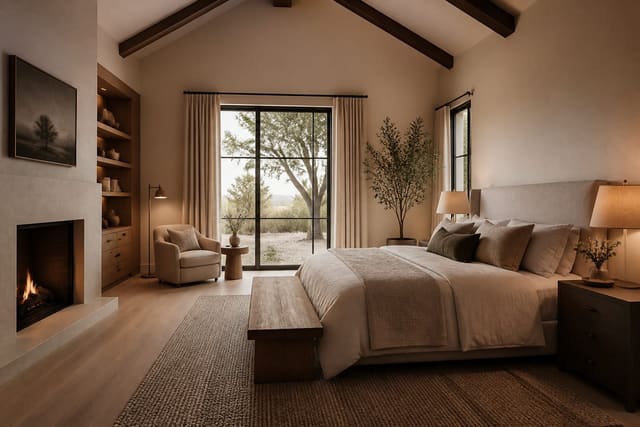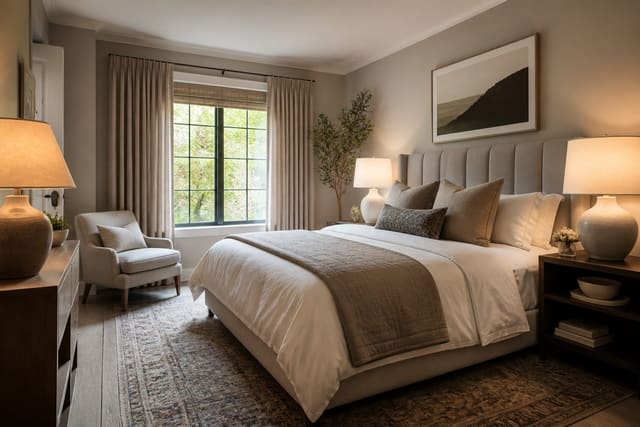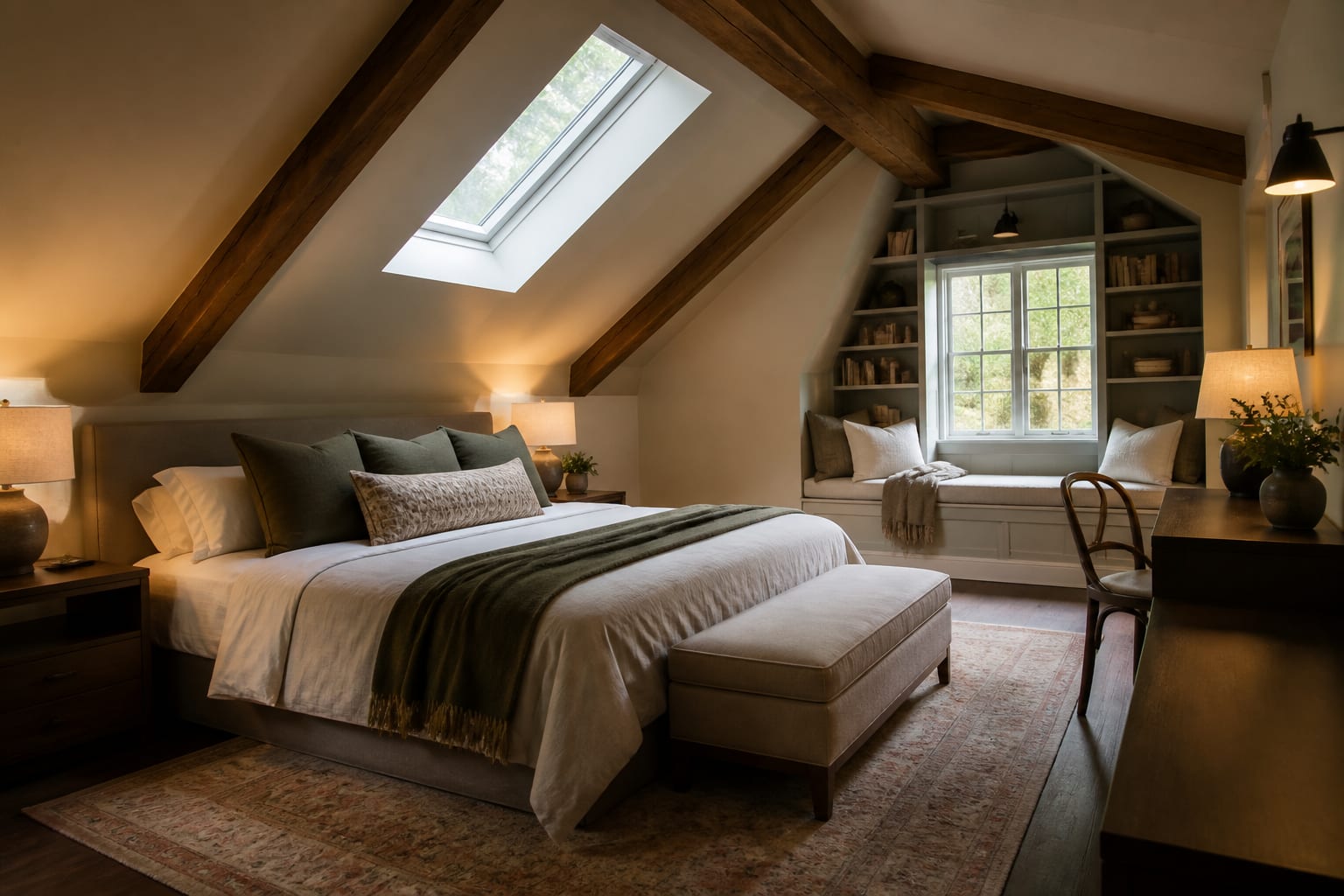
An attic bedroom lives or dies by where you put the bed, and the only right answer is under the highest part of the ceiling. Treat the slope as the room's best feature instead of a flaw to disguise, and the awkward angles start working for you. The low spots near the eaves were never meant for standing height anyway, so hand them to storage, a reading bench, or a desk. The goal is one tall zone where you walk and dress, plus cozy low zones that feel deliberate. Plan it that way and the room reads charming, not cramped.
Where should the bed go in an attic bedroom?
The bed anchors everything, so decide its spot before you buy a single other piece. Put the headboard against the tallest wall and run the mattress lengthwise down the center of the room, directly under the ridge line. That keeps the full sitting-up height of 5 to 6 feet over the pillows, so nobody bangs an elbow on a rafter at 2 a.m. A standard queen needs about 60 by 80 inches of floor, and you want at least 24 inches of walking room on the side you get out of. If the room is genuinely narrow, push one long side of the bed into the low slope and only leave clearance on the other. A low platform frame helps here because it keeps the mattress closer to the floor, buying you a few inches of headroom you would otherwise lose. Avoid tall four-poster or canopy beds entirely; they fight the geometry and make the ceiling feel lower than it is. If a dormer breaks up one wall, that alcove is a natural headboard pocket that frames the bed and pulls in window light. The wrong move, and I see it constantly, is shoving the bed into a corner where the ceiling drops to 3 feet. You end up crawling in sideways and the whole room feels like an afterthought instead of a place you actually want to sleep.
See also our guide to Master Bedroom Ideas for more on attic bedroom ideas.
How do you use the low knee walls and eaves?
The space under the slope, where the ceiling drops below standing height, is where attic bedrooms either gain a ton of function or waste half their footprint. Anything under roughly 4 feet of clearance is useless for walking but perfect for storage you reach by bending or sitting. Built-in drawers set into the knee wall are the highest-value upgrade you can make; they swallow off-season clothes and linens without eating any of your real floor space. If built-ins are out of budget, low dressers, rolling bins, or a long bench with a hinged lid do the same job for far less. Open shelving works along the eaves too, holding books and baskets where a tall bookcase would never fit. One stretch of low wall can become a reading nook with a thin cushion and a wall-mounted swing-arm lamp, turning dead space into the coziest seat in the house. Resist the urge to leave these zones empty just because they feel cramped; empty eaves read as wasted, not airy. The trick is matching the storage height to the actual clearance at each point, so a 30-inch-tall cabinet sits where the ceiling allows it and nothing gets jammed under a rafter. Done well, the knee walls hold everything a closet would, which matters in older attics that often have no real closet at all. That alone can decide whether the room functions as a true bedroom or just a guest crash pad.
For a related angle on attic bedroom ideas, read Guest Bedroom Ideas.
What colors and finishes make a low attic feel bigger?
Color does more heavy lifting in an attic than in any standard square room, because the slopes create visual clutter the eye has to resolve. Paint the walls, the sloped ceiling, and the flat ceiling all one continuous light shade, and the room stops announcing where the ceiling drops. Soft whites, warm off-whites, and pale greiges all work; the point is removing the contrast line that makes a low ceiling feel like it's pressing down on you. Carry that color over any built-ins and the knee walls so storage disappears into the architecture instead of chopping the room into pieces. If you want warmth or personality, save the bold color for textiles, a rug, or the bedding rather than the walls. Flooring should stay light to medium and continuous, since a busy or dark floor shrinks the footprint visually. Matte finishes beat high-gloss here because shine highlights every plane change and uneven old-attic surface. For trim, paint it the same color as the walls rather than a contrasting white, which would draw a hard frame around the slopes. The exception worth making is a single accent, maybe the wall behind the bed or the inside of a dormer, where a deeper tone creates a focal point that pulls the eye away from the angles. Keep patterns small and quiet on big surfaces. The overall effect you're after is a calm, enveloping shell where the architecture feels intentional and the low spots feel cozy rather than confining.
How do you light an attic bedroom without a ceiling fixture?
Attic ceilings rarely give you a clean spot for a centered overhead light, so plan on layered, lower lighting from the start. The slopes, the limited height, and the often-cramped wiring mean a single ceiling fixture would either hang too low over the bed or sit uselessly off to one side. Build the scheme from three layers instead. Start with ambient light from wall sconces mounted on the tall wall or recessed cans tucked into the flat part of the ceiling if there is one. Add task light right where you need it: a pair of swing-arm sconces flanking the headboard reads beautifully and frees up nightstand space, which is usually tight. Plug-in picture lights or a small lamp inside a dormer brighten the corners that slopes tend to throw into shadow. Choose warm bulbs around 2700K so the room feels restful at night rather than clinical. If you do have a usable flat ceiling section, low-profile flush mounts or even a track aimed at the slopes can wash light up the angled planes and make the ceiling feel taller. Dimmers everywhere are non-negotiable in a bedroom this size, since you'll want full brightness for dressing and a low glow for winding down. Avoid tall floor lamps that fight the slope. The whole strategy is to push light outward to the dark eaves and upward across the angles, so the room feels evenly bright instead of having one harsh pool of light and a lot of gloomy corners.
- Run the bed lengthwise under the ridge so you keep full sitting height over the pillows.
- Build drawers into the knee walls to claim storage from space too low to stand in.
- Turn a dormer into a window seat, a compact desk, or a dresser alcove with real daylight.
- Paint walls and sloped ceiling one light color to erase the line that makes ceilings feel low.
- Flank the headboard with swing-arm sconces to free up scarce nightstand surface.
- Use a low platform bed frame to recover a few inches of precious headroom.
- Add a thin cushion along a low eave to make a reading nook out of dead space.
- Keep flooring light and continuous so the footprint reads larger than it is.
Bring the look home with Re-Design
Sloped ceilings are hard to picture from a floor plan, so test your moves before you commit. Upload a photo of your attic to Re-Design and preview the bed under the ridge, a paint color carried across the slope, or built-ins along the knee wall. Seeing the angles rendered with real furniture tells you fast whether the bed clears the rafters and whether one continuous wall color actually opens the room up.
Frequently Asked Questions
What ceiling height does an attic bedroom legally need?
Most US codes require at least 7 feet of ceiling height over a minimum portion of the floor area, often half the room, with sloped sections counting only where they exceed 5 feet. Rules vary by jurisdiction, so confirm with your local building department before finishing, since egress windows and headroom both affect whether the space counts as a legal bedroom.
Can you add a closet to an attic bedroom?
Yes, and the smartest spot is usually built into a knee wall or a dormer rather than a freestanding closet that eats standing-height floor. A run of knee-wall drawers plus a short hanging section under a dormer often replaces a traditional closet entirely. If you need full-height hanging, place it against the tallest wall where the ceiling allows a 60-inch rod.
How do you keep an attic bedroom comfortable year-round?
Attics swing hot and cold because they sit directly under the roof, so insulation and airflow matter more than decor. Insulate the rafters or knee walls properly, add a ceiling fan or a quiet mini-split for temperature control, and use operable dormer or skylight windows for cross ventilation. Without those, even a beautifully styled attic bedroom becomes unusable in peak summer or deep winter.