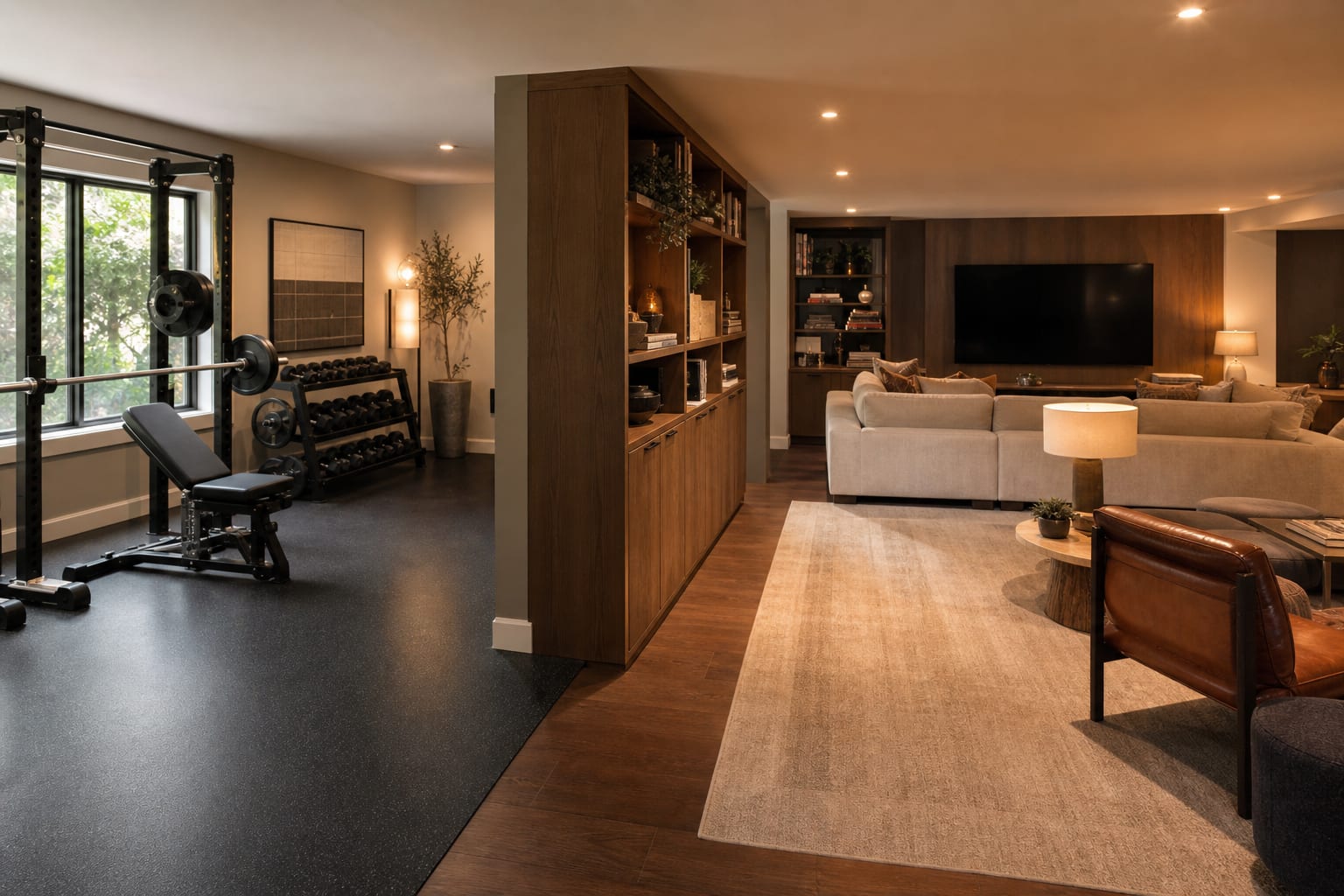
Basement gym and entertainment zones coexist when a visual divider — rug change, half-wall, or storage piece — splits the floor plan, the gym is sound-isolated to the perimeter, and lighting is zoned independently so each side reads as its own room. Start by planning the gym first: equipment has stricter clearance, vibration, and outlet needs than a sofa, and furniture is far easier to adjust around it than the reverse.
How do you split a basement between a gym and an entertainment area?
Give each function its own floor surface, lighting layer, storage wall, and sound strategy, then use furniture or partial dividers instead of a full wall when daylight and ceiling height are limited. In a rectangular basement, put the gym on the short end and entertainment on the longer, deeper end so machines don't slice the room in half.
In a 12 by 24 foot basement, an 8 by 10 foot gym area can hold a bike or rower, a dumbbell rack, a bench, and a stretching mat if storage stays vertical. If the gym includes a treadmill, leave at least 24 inches behind it and check ceiling height with the tallest user on the moving deck, not standing on the concrete.
Use the least pleasant basement edge for the hardest-working function. A low duct run, utility door, or support column is annoying beside a sectional but works fine as the edge of a training zone with hooks, shelves, and mirrors. If the ceiling is exposed or patched, compare options before committing — a thoughtful ceiling plan matters as much as the floor, especially around ducts, speakers, and recessed lights; see drop ceiling basement alternatives.
What flooring keeps both zones from feeling wrong?
Flooring is the clearest visual line between workout and hangout, and it shouldn't be one material everywhere. For the gym zone, use interlocking rubber tiles or rolled rubber around 8 millimeters thick for light workouts, thicker if free weights are involved. Extend rubber at least 12 inches beyond the equipment footprint so sweat and shoes don't constantly hit the border, and avoid glossy vinyl under heavy machines since it dents and gets slick.
For the entertainment zone, carpet tiles, low-pile carpet, engineered vinyl with a rug, or a large washable rug over a basement-rated floor all work — as long as moisture is solved first. If the concrete feels cool, has old adhesive, or has had water issues, address that before adding softness. The same vapor, pad, and perimeter questions apply here as in a carpet over concrete basement plan.
Don't run plush carpet under gym equipment — it traps dust, holds odor, and makes benches wobble. Don't run black rubber wall to wall unless the basement is a gym first; it can make movie night feel like a training facility. The better compromise: rubber in the workout rectangle, softer floor or rug in the lounge, and a straight transition aligned with a column, beam, or storage unit.
Test this on your own room photo with ReDesign before choosing a final direction — keep the doorway, walls, windows, main furniture, and awkward fixed features visible so the preview solves the room you actually have.
How should furniture and storage divide the room?
The best divider in a basement is often useful storage, not a decorative screen. A 15 to 18 inch deep cabinet, open-backed bookcase, low media console, or slatted partition separates zones without stealing scarce ceiling height. Full walls make sense only when the gym is noisy, the entertainment side needs darkness, or both zones may be used at once.
Face entertainment seating away from the gym whenever possible. Place the sofa so its back becomes a soft boundary, then add a console or low cabinet behind it for remotes, towels, and chargers. Keep at least 30 inches of walkway between the sofa back and gym storage.
Use vertical storage for exercise gear since basement floors fill up fast:
- Wall-mounted hooks for jump ropes, bands, and mats, 48 to 72 inches up.
- A stable dumbbell rack instead of a floor basket.
- A closed cabinet for gear that mirrors an opening bench on the entertainment side.
Mirrors are visually loud — put one on the gym wall for form checks, not opposite the TV where it will double every screen flicker. A 36 inch mirror panel is usually enough for a compact basement gym.
If guests may sleep in the basement occasionally, plan for that third job before buying permanent dividers. The same circulation and comfort rules apply as in basement bedroom ideas: egress, privacy, lamps, and a path that skips the weight bench.
What mistakes ruin a shared basement gym and lounge?
- Letting the TV dictate the whole room. A screen wants a centered wall, but equipment may need the only outlet or the only tall ceiling bay. Draw gym clearance first, then place the screen.
- Using one lighting plan for both sides. Use 3000K–4000K in the gym zone, dimmable 2700K near the entertainment area, and separate switches so a movie night doesn't feel like a clinic.
- Ignoring sound. Rubber flooring won't fix a booming subwoofer or clanking plates. Add a rug, upholstered seating, and curtains on the entertainment side; use rubber feet on racks in the gym.
- Hiding all storage on the entertainment side. The gym produces the daily mess — towels, shoes, bands, water bottles — so it needs the easier storage, or the sofa becomes the staging table.
- Designing for the most ambitious version of your life. A squat rack, bar, treadmill, bike, and punching bag rarely fit together without crowding. Keep the equipment used weekly, then leave one open rectangle at least 6 by 8 feet for stretching or floor work.
How can AI preview the zoning before you commit?
Upload a clear photo from one corner so the existing floor, ceiling, support posts, utility doors, windows, and stair approach are visible. Keep real equipment in frame instead of imagining an empty box, since the water heater door, old freezer, and storage bins usually decide whether a layout actually works.
Ask for three controlled versions: gym on the far wall with lounge near the stairs, gym behind the sofa with a storage divider, and gym in the low-ceiling end with the screen on the longest wall. Keep wall color and ceiling treatment consistent across previews so the zoning decision stays clear. Add constraints to the prompt: 8mm rubber gym floor, soft lounge rug, 30 inch walkway, warm media lighting, brighter gym lighting, vertical storage, and no equipment blocking utility access.
Check the boring parts before the pretty parts: headroom over the treadmill, cabinet access while someone sits on the sofa, screen reflection in the gym mirror, and a clean path from the stairs to both zones. The best preview is the version where a workout can end, towels disappear, and the room turns over for a movie without a full reset.
Frequently Asked Questions
Where should the gym zone go in a basement?
Place the gym on the side closest to the mechanical room or under the kitchen, away from bedrooms above. That containment reduces sound transfer upward and keeps the entertainment zone quiet during workouts.
What visually separates a gym zone from the entertainment zone?
A 6x8 or 8x10 rug under the entertainment seating, rubber gym flooring under the equipment, and one tall storage piece or half-wall on the boundary. The floor change alone does most of the visual work.
Should the basement have separate lighting for each zone?
Yes. Use bright cool-white overhead light (4000K–5000K) for the gym and warm dimmable 2700K–3000K light for entertainment, each on an independent switch so a workout never floods the movie zone.
How much square footage does a basic basement gym need?
A 10x12 zone holds a treadmill or rower, a 6x6 mat area, and a wall-mounted dumbbell rack. A 12x14 zone comfortably adds a squat rack or all-in-one tower.
Does AI help me preview the basement split?
Yes. AI previews the zone divider, rug placement, and lighting direction so you can compare a half-wall, a floating shelf, or a storage-unit divider before building anything.
> Try this: Ready to see this on your own room? Open ReDesign and run the preview.
Three transformations to try
1. Half-wall divider between gym and entertainment 2. Rubber gym floor + 8x10 rug on entertainment side 3. Tall storage piece as zone divider