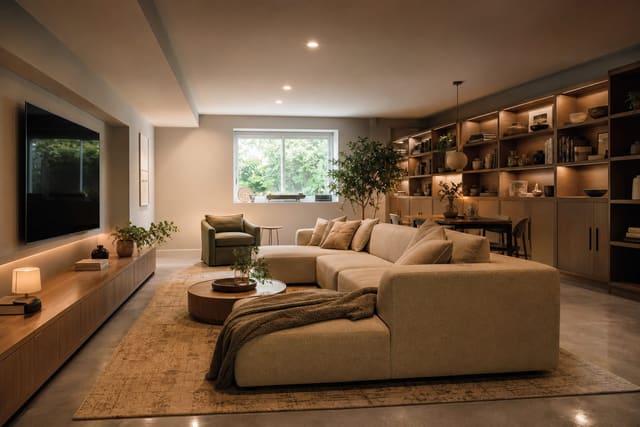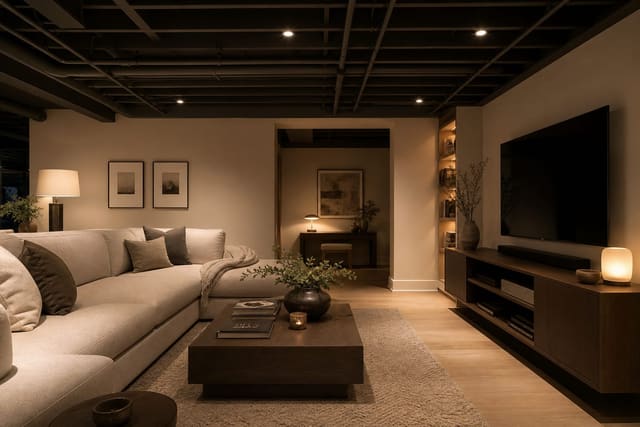
A walkout or partial above-grade basement reads as a room — not a basement — when the lighting commits to three layers: 3000K recessed cans on a 6 to 8ft grid for ambient, 2700K wall sconces or torchieres for warm fill, and a generous daylight strategy (window-well solar tubes or enlarged egress windows) that gets sun into the slab. Most basements feel underground because they are lit like utility rooms — two ceiling cans, 4000K bulbs, nothing on the walls or near the floor. The fix is not more lumens. It is a layered lighting plan that mimics how a sunlit ground-floor room is lit: light from multiple heights, in multiple directions, at a warm-leaning color temperature. Get the layers and the Kelvin right, and a basement reads as a real room within an afternoon's work.
How do I make a basement feel brighter and less cave-like?
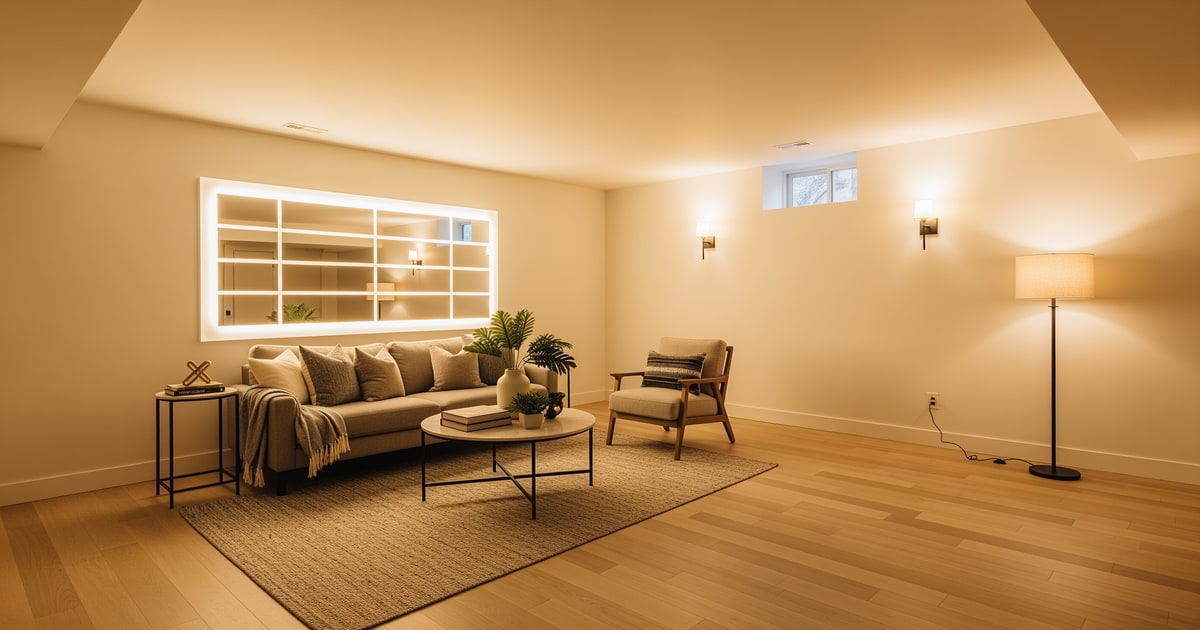
Build three layers of light — overhead, mid-height, and floor-adjacent — at 2700K–3000K, and add at least one "faux window" (a backlit mirror or LED-frame art piece) on a longer wall. The reason basements feel underground is not low ceiling height or paint color. It is that the only light is coming from above at a cool temperature, the same lighting signature humans associate with parking garages and bunkers. Change the signature and the room reads differently before you spend a dollar on finish work.
The lighting plan that converts a basement to a living space
- Overhead at the right temperature. Replace any 4000K or higher recessed bulbs with 2700K wide-beam LEDs (90° beam angle minimum). For a typical 400 sq ft basement plan on 6–8 recessed cans on a dimmer. Skip the surface-mounted bare-bulb fixtures still common in older homes — they cast hard shadows.
- A mid-height ambient layer. Wall sconces or picture lights mounted at 60"–66" off the floor anchor the room visually. Two sconces on a long wall do more than four extra ceiling cans. A plug-in version costs ~$40 each from any hardware store and runs to a nearby outlet with cord covers.
- Floor-adjacent light. Two or three floor lamps with shades that throw light up and down, plus a single table lamp on a side table. The goal is light at multiple heights so the eye reads the room as full-height rather than ceiling-only.
- A "faux window" on the long wall. An LED-frame light box, a backlit mirror at 36"x48" minimum, or a deeply-mounted artwork with a perimeter LED frame mimics the soft diffused glow real windows provide. Lutron and Cololight both make remote-controlled versions; Ikea makes a $99 one that genuinely passes for a window in photos.
- Toe-kick or stair-tread LED strip. A 2700K strip along the base of the wall or the underside of any stair makes the floor recede and the room feel taller. ~$30 of materials.
Test this on your own room photo with ReDesign before you choose the final direction; keep the doorway, walls, windows, main furniture, lighting, and awkward fixed features visible so the preview solves the room you actually have.
Color temperature: why 2700K wins underground
Basements get treated like utility spaces, and utility spaces get cool-white bulbs. That's the entire reason most basements feel like bunkers regardless of finish quality. Cool white (4000K and up) is the color signature of parking garages, hospitals, and unfinished commercial space. Your brain has been trained for decades to read that signature as "I am underground." Warm white (2700K) is the signature of the daylit ground-floor rooms your eyes spend most of their life in — applied in a basement, it overwrites the underground read before any paint or rug does.
Every fixture in the basement, including the laundry zone and the storage corner, should run 2700K. The cost difference between a cool-white and warm-white LED bulb is zero. The visual difference is the difference between a finished basement and an unfinished one.
Paint and finish choices that compound the lighting
- Warm whites or warm greiges only. Benjamin Moore White Dove, Sherwin-Williams Alabaster, or Farrow & Ball Skimming Stone all reflect warm light back into the room. Cool grays read as concrete bunker no matter how good the furniture is.
- Light the ceiling the same color as the walls or one shade lighter. A bright white ceiling in a basement reads stark; a continuation of the wall color reads like a finished room.
- Avoid dark accent walls in a basement that has no windows. They eat photons and reinforce the cave read.
- Pale wood or high-LRV LVP flooring. Dark floors absorb the light layers you just built. White oak look-alike LVP at LRV 45+ keeps the bounced light alive.
Basements need more wall light than people expect. A simple target is one broad ceiling source every 6 to 8 feet, then a lamp or sconce on at least two walls so the perimeter stops disappearing. In a 12 by 18 foot basement room, that often means four to six 800-lumen wafer lights on dimmers plus two shaded floor lamps or plug-in sconces at 60 to 66 inches high. Halo-style canless wafers are useful for low ceilings, but they should not be the only layer. The bathroom logic in windowless bathroom ideas applies underground: side glow makes a low room feel inhabited, not excavated.
Choose finishes that behave well under artificial light. Warm white paint with LRV 75 or higher, pale oak vinyl plank, wool-look rugs, and matte black or aged brass lamp hardware give the room contrast without pulling it back into cave territory. If the basement has one small window, keep the window wall almost empty and place the brightest lamp on the opposite side to pull the eye across the room. Owners should wire dimmers while the ceiling is open; renters can get surprisingly close with plug-in swag pendants and cord covers. For palette help, the north-light approach in north-facing living room colors is a useful cousin, because both rooms punish cool gray.
Common basement lighting mistakes
- Treating it like a utility room. Two ceiling cans and a bare fluorescent above the laundry. Every basement starts here; finished ones don't end here.
- 4000K or 5000K LEDs. Reads like a Costco no matter how nice the rug is.
- All-overhead, no mid-height or floor. Flat lighting flattens any room — basements especially.
- Window-well covers that block daylight. If you have any window wells, scrub them, paint the inside warm white, and remove anything covering them outside. Free lumens.
- Bare bulbs in fixtures. Diffused shades or glass globes are non-negotiable; bare bulbs spike contrast and harden every shadow.
- A single overhead fan-light combo. The most common basement fixture and the worst. Replace it with separate lighting + a quieter fan.
- Treating the basement like a utility room. Shop lights, exposed bulbs, and cool-white strips may be bright, but they keep telling the eye this is storage space instead of living space.
- Letting the ceiling do all the work. Low recessed lights without wall glow make a basement feel shorter, even when the measured brightness is high.
Use AI design to preview your basement as a real room
The hardest part of finishing a basement is committing to a vision when the existing room is still concrete-floored and bunker-lit. AI design lets you photograph the unfinished space and preview it with warm white walls, layered lighting, pale flooring, and a backlit faux window in the right wall — alongside the current state — in minutes. Owners who have stared at a half-finished basement for years pick a direction in an evening once they can see the after.
Frequently Asked Questions
How many recessed lights does a basement need?
Plan one 6in recessed can per 35 to 50 sq ft on a 6 to 8ft grid for general ambient; below that the room reads cave, above that the ceiling reads like a parking lot. Use the room photo to compare the visible layout and fixed constraints before committing, because door swings, windows, outlets, storage reach, circulation, and existing furniture decide whether the idea survives daily use.
What color temperature works in a finished basement?
3000K for ambient recessed and 2700K for accent and table lamps reads like an upstairs room; 4000K or 5000K daylight bulbs make finished basements read commercial and chase warmth out. Keep the preview honest by leaving the problem area visible in the frame, then compare one conservative version against one bolder version before you buy lighting, paint, furniture, or storage.
Can solar tubes really light a basement?
Yes — a 14in solar tube delivers the daylight of a 200 to 300W incandescent bulb during daylight hours; pair two tubes per 200 sq ft and the basement reads daylit through the middle of the day. Check the result against ordinary movement first: drawer clearance, chair pullout, walkway width, glare, switch access, and sightlines matter more than a perfect catalog angle.
Are sconces a good idea in a basement?
Yes — wall sconces at 60 to 66in centerline add warmth that recessed cans cannot, and they break the flat ceiling reading; choose sconces with both up and down throw on stairwells and seating walls. Use the image to narrow priorities and measurements before ordering anything custom; final purchases still need real dimensions, outlet locations, installation limits, and product clearances.
Should basement lighting be on dimmers?
Yes — basements live in two modes (work and lounge), and dimmable cans plus sconces let the same room serve a Monday workout and a Saturday movie; non-dim basements feel one-note. If the preview invents architecture or hides the awkward feature you need solved, rerun it with stricter instructions so the result remains tied to your actual room.
> Try this: Ready to see this on your own room? Open ReDesign and run the preview.
Three transformations to try
1. Recessed grid plus wall sconces in walkout basement 2. Solar tube daylit basement seating zone 3. Warm table-lamp lounge layer in finished basement