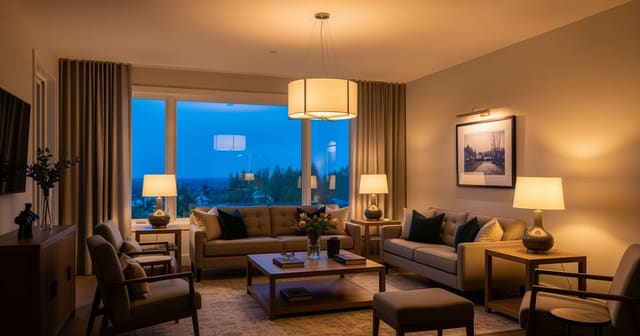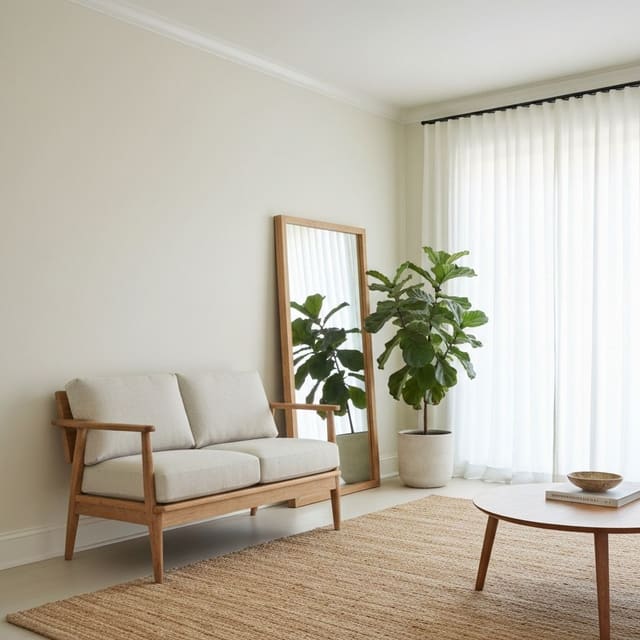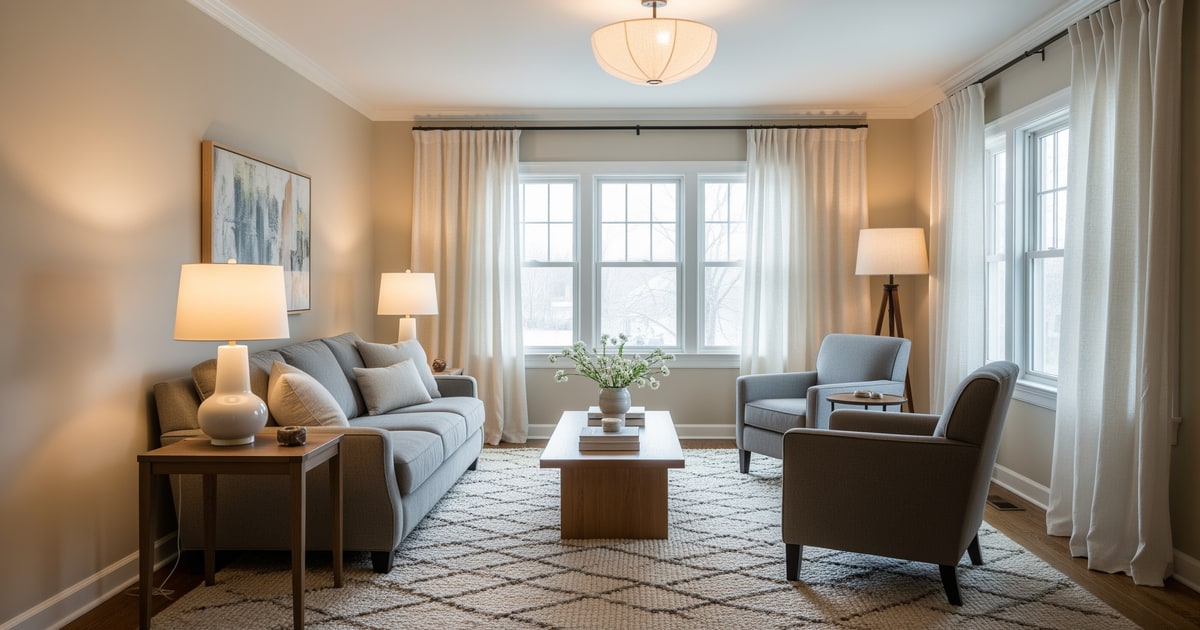
A north-facing living room warms up when the wall color shifts to a warm off-white or warm greige with a yellow or red undertone (never blue or green), the bulbs all run 2700K, and at least one wall carries a wood-tone, terracotta, or warm-art moment to push back against the cool daylight. North-facing living rooms get a bad reputation they only half-deserve. The light is cool, flat, and steady — which is exactly why painters and photographers prize north-facing studios. The problem isn't the light itself. The problem is that almost every owner picks paint colors and bulbs that amplify the cool cast instead of correcting for it. Get the palette and the lighting right and a north-facing living room reads serene and elegant. Get them wrong and the same room reads like a bus stop.
What colors and lighting work best in a north-facing living room?
Warm-undertone paints — never anything with blue, green, or gray undertone — paired with 2700K bulbs across three layers of lighting. The rule of thumb: choose paint that looks too warm on the chip in the store, because north light will cool it down by one to two degrees of warmth. Cool the lighting and you get a morgue; warm the lighting and walk into a hug.
The paint colors that actually work in north light
These are the colors that consistently land well in north-facing rooms — chosen on the basis of undertone, not just hue.
- Benjamin Moore White Dove (OC-17). Warm white with a soft yellow undertone. The single most reliable white for cool-light rooms.
- Farrow & Ball Slipper Satin (No. 2004). Warm cream that reads almost pink in good light. Magical in north-facing rooms with white trim.
- Sherwin-Williams Accessible Beige (SW 7036). Greige with a brown rather than gray undertone. Adds visual warmth without going beige-1990s.
- Benjamin Moore Pale Oak (OC-20). A pale greige that holds its warmth under cool light. The reliable safe choice.
- Farrow & Ball Setting Plaster (No. 231). Soft pink-beige. Reads sophisticated in north light, never childish.
- Sherwin-Williams Evergreen Fog (SW 9130). A sage with warm undertone. The rare green that works in cool light.
- Benjamin Moore Cromwell Gray (HC-103). When you want a darker room, this warm sage-gray reads deep and intentional rather than flat.
Avoid anything with a gray, blue, green, or violet undertone. That includes most of the popular "greiges" of the 2010s — Repose Gray, Agreeable Gray, Edgecomb Gray are all cool enough to read flat in north light.
How to test paint before you commit
- Buy 2'x2' peel-and-stick samples (Samplize sells almost every major brand). Stick them to the wall that gets the most light and the wall that gets the least.
- Look at them at 8 a.m., noon, and 6 p.m. North light shifts less than south light, but it still has morning and afternoon character. A color that looks great at noon and dead at dusk is the wrong color.
- View them next to your existing rug, sofa, and big art. Paint reads off everything around it.
- Always paint at least one full wall before committing. A 2'x2' patch lies; a full wall doesn't.
Test this on your own room photo with ReDesign before you choose the final direction; keep the doorway, walls, windows, main furniture, lighting, and awkward fixed features visible so the preview solves the room you actually have.
Lighting strategy for north-facing rooms
Three layers, all at 2700K. Cool 4000K bulbs in a north-facing room are like adding ice to an already-cold drink.
- Ambient. A central pendant or chandelier handles the broad ambient layer. Add a dimmer; the room needs different light levels at different times of day. If you have recessed cans, swap the bulbs to 2700K with a wide beam angle (90°+).
- Task. Two floor lamps flanking the seating area — one beside the sofa, one across — give you readable, evenly distributed light. A floor lamp behind each end of a sectional is the gold standard.
- Accent. A pair of table lamps, a picture light over the mantel art, or a small accent lamp on a console adds the low-angle warm glow that humans read as "inviting." This is the layer most people skip and it's the one that does the most work.
The total fixture count for a 14'x18' north-facing living room should land around 7–9 sources, all at the same color temperature. A room with three sources is underlit; a room with twelve at three different temperatures is chaotic.
Materials and finishes that warm the room without changing paint
- A wool or jute rug. Wool especially — it absorbs cool light and reflects warm. A wool rug is the single most affordable warmth upgrade in any north-facing room.
- Curtains in linen or velvet. Linen for casual rooms, velvet for formal. Hung wide and high (curtain rod 6"–10" above window, panels 6"–8" wider than window) so the window itself looks larger.
- Brass or unlacquered brass hardware on doors, lamps, and accent furniture. Brass warms; chrome and nickel cool.
- Wood tones with red or yellow undertone — white oak, walnut, cherry — over cool-gray-stained woods like driftwood or weathered gray.
- A textured wall finish — limewash, Roman clay, or a paneled wainscot — adds depth that flat paint can't deliver under flat light.
North rooms need color discipline because their light is steady enough to expose every undertone. If a sample reads green-gray at noon, it will usually read colder at 5 p.m.; aim for warm whites and putty tones with LRV in the 60 to 82 range instead of ultra-bright laboratory whites. A second useful spec is bulb quality: 2700K is the temperature, but 90+ CRI is what keeps cream walls, oak, and linen from looking muddy. Pair that with the lamp placement logic in layered living room lighting so the paint is supported after sunset.
Finishes should add warmth without turning the room sepia. White oak, tobacco leather, oatmeal boucle, aged brass, and wool rugs with red or ochre threads are better than gray linen, black metal, and blue-white marble. If you rent, put the warmth in curtains, lampshades, a large rug, and art mats; if you own, a limewash or roman-clay style finish on one wall can soften the cold light without darkening the whole room. A large mirror only helps when it reflects the warm side of the room, so borrow the placement tests from mirrors that amplify light before leaning one across from the sofa.
Common north-facing-room mistakes
- Painting the room white because you thought it would brighten it. Pure white walls in north light read blue-gray. Use a warm white instead.
- Using 4000K or higher bulbs. Doubles down on the cool cast. The room ends up feeling like a dentist's office.
- Skipping the floor lamps. Overhead-only light flattens everything and leaves the corners dark.
- Cool-stained wood floors. Driftwood or gray-washed floors fight the room. If the floors are fixed, layer a wool rug.
- All-glass coffee tables and acrylic furniture. Adds reflectivity without warmth. Use wood and upholstered pieces instead.
- Trying to fight north light with cool blue accents. Reinforces the temperature problem.
- Testing paint under the wrong bulbs. A sample that looks fine under a store light can go lifeless under cool LEDs at home. Always test paint with the actual bulbs you plan to use.
- Testing paint under store light only. North light edits color all day, so a sample that never sits beside your sofa and lamps is not a real test.
Use AI design to preview your north-facing room in warmer skin
Owners often resist painting a north-facing room something warm because they're afraid it'll look orange. AI design preview solves this in minutes — photograph your existing room and preview it in White Dove, Slipper Satin, and Pale Oak alongside the cool gray you've been living with. The difference is shocking even on a phone screen. Pick the warmest of the three that still reads as a usable neutral, and you'll never go back.
Frequently Asked Questions
What wall color works best in a north-facing room?
Warm off-whites and warm greiges with a yellow, peach, or red undertone read balanced against cool north light; pure white, cool gray, and blue-leaning paints read clinical and gray in north-facing rooms. Use the room photo to compare the visible layout and fixed constraints before committing, because door swings, windows, outlets, storage reach, circulation, and existing furniture decide whether the idea survives daily use.
What color temperature bulbs for a north-facing room?
Use 2700K everywhere — overhead, lamps, accent; cooler bulbs (3000K and above) double the cool cast of the daylight and the room reads blue all day. Keep the preview honest by leaving the problem area visible in the frame, then compare one conservative version against one bolder version before you buy lighting, paint, furniture, or storage.
Can I use white walls in a north-facing living room?
Yes if the white has a strong warm undertone (warm bone, soft cream, oat) and the room is balanced with wood-tone furniture, warm fabric, and 2700K bulbs; cool whites need direct south or west sun to read warm. Check the result against ordinary movement first: drawer clearance, chair pullout, walkway width, glare, switch access, and sightlines matter more than a perfect catalog angle.
How do I add warmth to a north-facing room without painting?
Layer wood-tone furniture, warm fabric (linen, wool, leather in oat or rust), terracotta or brass accents, and 2700K plug-in lamps; the room reads warmer in a single evening swap. Use the image to narrow priorities and measurements before ordering anything custom; final purchases still need real dimensions, outlet locations, installation limits, and product clearances.
Should I add a mirror to a north-facing living room?
Yes — a large mirror opposite the window doubles the daylight on the wall behind, but tilt it so it reflects warm surfaces (wood, art, lamp) instead of cold sky, which only amplifies the cool cast. If the preview invents architecture or hides the awkward feature you need solved, rerun it with stricter instructions so the result remains tied to your actual room.
> Try this: Ready to see this on your own room? Open ReDesign and run the preview.
Three transformations to try
1. Warm-greige wall with wood-tone furniture and 2700K lamps 2. Mirror opposite window reflecting wood and brass 3. Terracotta and rust accents in fabric and art