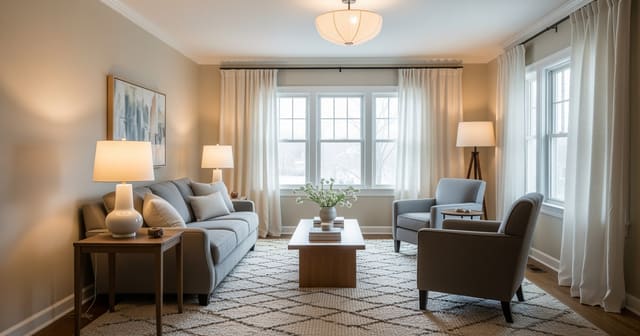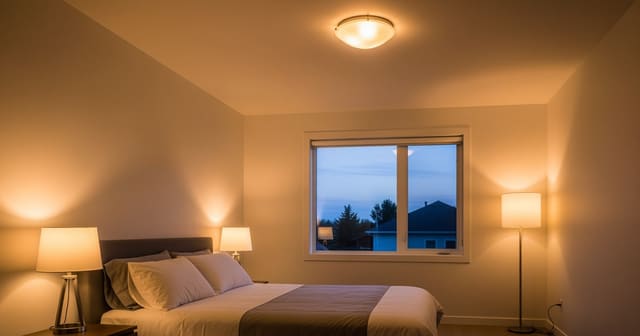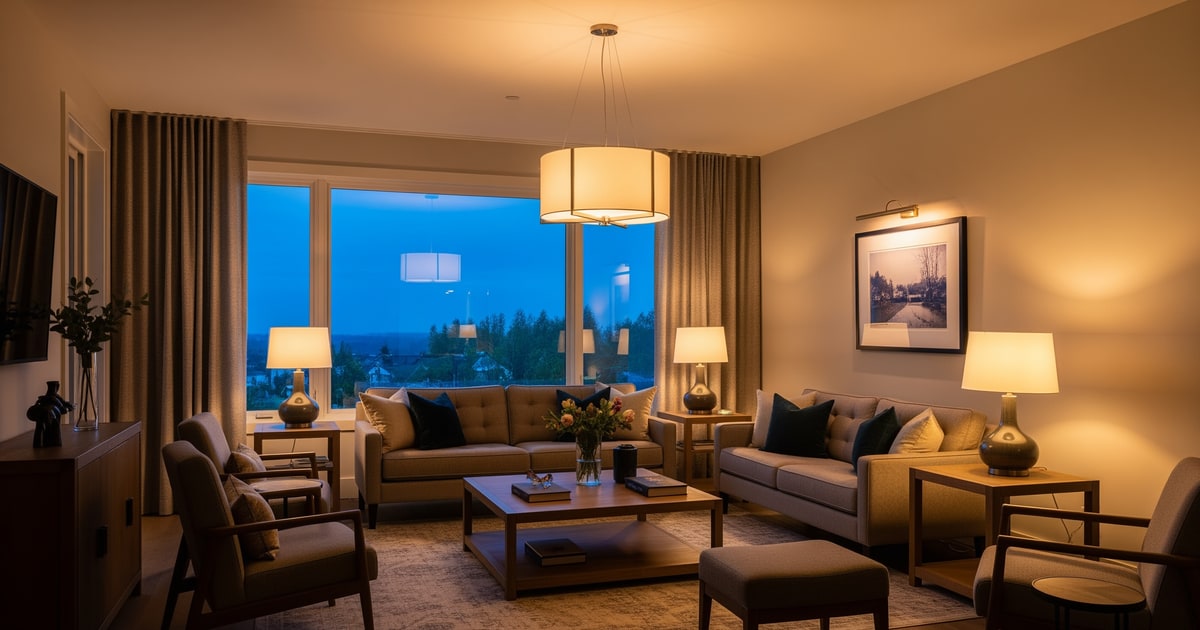
Living-room lighting reads layered when three independent sources answer three tasks — overhead or wall wash for cleaning and entertaining, two floor or table lamps for reading and conversation, and one accent (picture light, sconce, or up-lit plant) for evening mood — each on its own switch or smart bulb. A living room with one bright ceiling light feels like a doctor's office. A living room with seven lamps at three different color temperatures feels chaotic. The difference between those two failure modes and a room that actually reads designed is a three-type lighting plan: ambient, task, and accent. Every great-looking living room you've ever seen runs this system. Once you see it, you can't unsee it.
How do you layer lighting in a living room?
Three types of light: ambient (fills the room evenly), task (lights what you actually do — reading, conversation), accent (adds the low-angle warm glow that makes the room feel inviting). Plan on 7–9 total fixtures for a typical 14'x18' living room, all at 2700K, all on dimmers, with each type controlled separately. Skip any single type and the room feels off; layer all three and the room reads designed without expensive furniture.
Layer 1: Ambient (fills the room)
Ambient lighting is the background fill. It should make the room evenly lit at low intensity, never spike contrast, never cast hard shadows.
- One central pendant or chandelier in rooms with 9'+ ceilings. Hang the bottom of the fixture at 7' minimum off the floor; in vaulted rooms, hang it 8'–10'.
- Recessed cans on a dimmer in rooms with 8' ceilings or in additions to a pendant. Plan one can per 25 sq ft, wide beam (90°+), 2700K. Avoid narrow-beam cans that spotlight floor — they make the room feel like a museum.
- Wall washers if there's a long blank wall. A trio of recessed cans tilted toward a feature wall washes the wall in light and visually enlarges the room.
- Whichever you pick, put it on a dimmer. Ambient at full intensity is rarely the right call; ambient at 40%–60% with task and accent layers active is the everyday setting.
Test this on your own room photo with ReDesign before you choose the final direction; keep the doorway, walls, windows, main furniture, lighting, and awkward fixed features visible so the preview solves the room you actually have.
Layer 2: Task (lights what you do)
Task lighting is the layer most owners skip and it's the one that does the most work. It lives at human height and lights the activities that happen in the room.
- Two floor lamps flanking the seating area. A floor lamp at each end of the sofa or beside the two main chairs. Plan 60"–66" total height with a diffused shade. The reading-height standard: bottom of the shade at 40"–42" off the floor when you're seated.
- A table lamp on every end table. Even one table lamp per side of the sofa is enough. Skip the matching-set look — slight asymmetry in lamp style with matching shade height reads more curated.
- A desk-height lamp at any console or workspace in the room — homework table, drink cart, side desk. 2700K, 25–40W equivalent LED.
- Avoid the single ceiling fixture as the only light at human level. The single biggest reason your living room photos never look like Pinterest is missing task lighting.
Layer 3: Accent (adds warmth and depth)
Accent lighting is the smallest in lumen output and the largest in mood impact. It's the layer hotels nail and houses miss.
- A picture light over the main artwork or above the mantel. Battery-powered LED picture lights ($80–$150) clamp onto any frame and turn art into a focal point. 2700K, dimmable.
- A small lamp on a console, shelf, or buffet. 18"–22" total height, low-watt LED, on a timer if you can. The "always-on warm glow" in the corner of a dim room.
- Toe-kick or under-cabinet LED strip behind a built-in, under a console, or behind the TV. Acts as bias light and softens the contrast between dark TV/screen and bright wall.
- Candles count. Real or LED. They add point sources of warm low-angle light that no fixture replicates.
Color temperature, fixture counts, and dimming
- All 2700K, no exceptions. Mixed Kelvin temperatures in a living room are the single most visible amateur mistake.
- Fixture count: 7–9 for a typical 14'x18' room. One overhead + two floor + two table + one accent + one picture light + one strip. Less than 7 reads underlit; more than 11 reads cluttered.
- Three separate dimmer circuits. Ambient, task, and accent on three separate switches. The room runs differently at 6 p.m. vs 9 p.m. vs movie-watching.
A useful living room target is 10 to 20 lumens per square foot across all layers, but the distribution matters more than the total. A 180-square-foot room might need a dimmable overhead for cleaning, two table or floor lamps near seats, and one accent source aimed at art, shelves, or a plant. Keep most bulbs at 2700K; if the room has heavy shade or north exposure, use 3000K only on task lamps and leave the ambient layer warm. Lutron Caseta dimmers, Philips Warm Glow bulbs, or any warm-dim equivalent are worth the extra cost because they let the room shift instead of snapping from bright to black. The paint advice in north-facing living room colors becomes much easier when the lamps support it.
Do not make every fixture the same finish. A black floor lamp, brass picture light, and ceramic table lamp can live together if the shades share warmth and the bulbs match temperature. The better rule is to vary height: one source above eye level, one at seated eye level, and one low glow on a shelf or console. Renters can build this entirely with plug-ins; owners should hardwire only the pieces that solve switching or cord problems. If the furniture plan is awkward, solve that before buying a chandelier by checking the seating logic in awkward living room layouts.
Switching is part of the design. Put the overhead, reading lamps, and accent lights on separate controls, or at least use smart plugs so one button can set a night scene. The room should have a bright cleaning mode, a normal conversation mode, and a low evening mode. If every source turns on together at full output, the layers exist on paper but not in daily life.
Common living-room lighting mistakes
- Single ceiling fixture as the only light. Default. Wrong. Will make any room look like a rental.
- Cool-white bulbs (4000K+). Even worse in a living room than in a kitchen.
- All-matchy lamp sets. Two identical end-table lamps + matching floor lamp = catalog-bored. Vary the silhouette, keep the Kelvin.
- Skipping the picture light. Cheapest visual upgrade per dollar in the room.
- Smart bulbs at 6500K "daylight" set as default. Daylight is for offices.
- Not putting the layers on separate dimmers. Can't run the room at three different intensities.
- Counting bulbs instead of layers. Six recessed cans are still one layer. The room needs height variation, direction, and dimming, not just more wattage.
- Buying three statement fixtures at the same height. Layering needs different jobs and levels, not a matching set of lamps competing for attention.
Use AI design to preview your living room layered
If you've never seen your own room with proper layered lighting, you can't picture what's possible. AI design lets you photograph the current room and preview it with the three-type system in place — picture light over the art, table lamps on the end tables, dimmed ambient — alongside the current single-fixture state. The before-and-after is what convinces the household to actually buy the lamps.
Frequently Asked Questions
How many light sources should a living room have?
Plan for three layers minimum: ambient (overhead or wall wash), task (reading lamp at every primary seat), and accent (one picture light, sconce, or up-light); fewer than three flattens the room. Use the room photo to compare the visible layout and fixed constraints before committing, because door swings, windows, outlets, storage reach, circulation, and existing furniture decide whether the idea survives daily use.
What is the right color temperature for living-room lighting?
Use 2700K bulbs in lamps and accent fixtures and 3000K in overhead recessed; mixed temperatures within a single room read clashy because skin tones shift between sources. Keep the preview honest by leaving the problem area visible in the frame, then compare one conservative version against one bolder version before you buy lighting, paint, furniture, or storage.
Should the overhead light be on at night?
Usually no — turn the overhead off for evening seating and let two lamps and one accent carry the room; overhead-on at night flattens shadow and reads like an office. Check the result against ordinary movement first: drawer clearance, chair pullout, walkway width, glare, switch access, and sightlines matter more than a perfect catalog angle.
How do I light a living room without ceiling fixtures?
Use two floor lamps (one per primary seat), one wall sconce or picture light, and one table lamp on the sideboard or media console; smart bulbs handle the switching from a single app. Use the image to narrow priorities and measurements before ordering anything custom; final purchases still need real dimensions, outlet locations, installation limits, and product clearances.
What is the easiest lighting upgrade in a rental living room?
Swap every bulb to 2700K, add a plug-in dimmer to the main fixture, and install two floor lamps with smart bulbs; reversible, no hardware, transforms the room in an evening. If the preview invents architecture or hides the awkward feature you need solved, rerun it with stricter instructions so the result remains tied to your actual room.
> Try this: Ready to see this on your own room? Open ReDesign and run the preview.
Three transformations to try
1. Two floor lamps plus one picture light evening mood 2. Overhead off with three-layer lamp setup at night 3. Sconce-led reading nook in a windowless corner