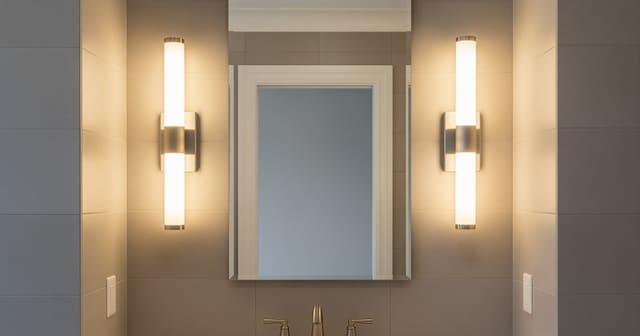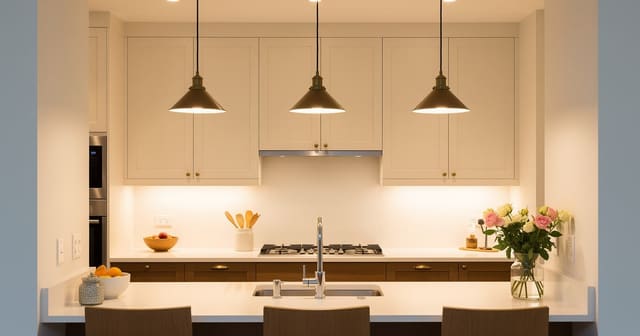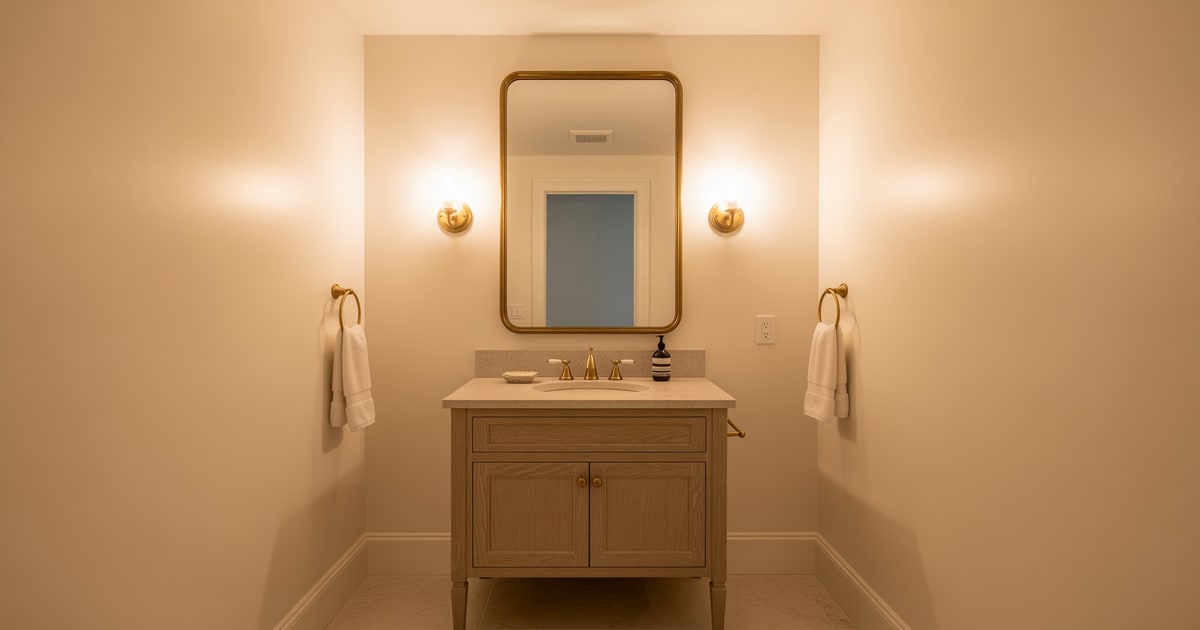
A windowless bathroom brightens when the lighting commits to three sources — flanking vanity sconces or strip lights at 3000K, one overhead can or flush mount at 3000K, and a warm 2700K accent (toe-kick LED, niche LED, or recessed shelf strip) — paired with a high-LRV wall paint (cream, soft white, or pale blue at LRV 70+) and a mirror sized to fill the vanity wall. A windowless bathroom is one of the most fixable problems in any home, and one of the most overlooked. Most owners assume the only real answer is a renovation — punch in a skylight, blow out a wall, accept the dark. None of that is true. A bathroom without a single square inch of natural light can read as bright, calm, and even luxurious if you stop trying to fake daylight and start designing for the light you actually have.
How do I make a windowless bathroom feel brighter?
You light it like a stage — three layers, warm-leaning bulbs, every surface tuned to reflect light back at the room. The mistake most people make is doubling down on overhead recessed cans at 4000K cool-white, which flattens the room and turns every shadow into a hard edge. The fix is layered light at 2700K–3000K, a paint palette with high light-reflectance value, and at least one large mirror placed across from your strongest fixture. Done correctly, a windowless 5x8 bath reads brighter than half the bathrooms with actual windows.
The lighting layers that make windowless bathrooms work
- A warm vanity light at face level, not above your head. A vertical sconce on either side of the mirror at roughly 64"–66" off the floor lights your face cleanly with no nose shadow. This is the single most consequential change you can make — it's how every well-lit hotel bathroom is wired. If you can only do one electrical change, do this.
- One overhead with a glass or fabric diffuser. Replace the bare-bulb dome or harsh recessed can directly over your vanity with a flush-mount that uses frosted glass, alabaster, or a fabric shade. Diffused overhead bounces evenly off the ceiling and walls; bare bulbs spike hot spots and deepen shadows.
- A small in-shower light. Showers with no light at all are surprisingly common in older homes. A single wet-rated 4" LED can or pendant inside the shower stall makes the room feel bigger because the eye sees light through the glass into the space beyond. ~$40 fixture, ~$200 install. Disproportionate effect.
- A plug-in lamp at counter level. A small ceramic accent lamp on the vanity counter — yes, in a bathroom — adds the warmth restaurants use to make rooms feel inviting. Use a low-wattage LED bulb at 2700K. This single move pushes the room from "utility bathroom" to "considered."
- Toe-kick or under-vanity strip lighting on a motion sensor. A 12V LED strip tucked under the vanity toe-kick at 2700K turns into a perfect nightlight and a daytime glow that makes the floor recede. ~$25 from any hardware store.
Test this on your own room photo with ReDesign before you choose the final direction; keep the doorway, walls, windows, main furniture, lighting, and awkward fixed features visible so the preview solves the room you actually have.
The color palette that does most of the work
- Warm whites with high light-reflectance value (LRV 78+). Benjamin Moore Simply White, Sherwin-Williams Alabaster, and Farrow & Ball Pointing all bounce light back rather than absorb it. Avoid stark cool whites like Decorator's White — in a windowless room they read clinical, not bright.
- A single warm mid-tone for the lower third. Wainscoting, half-tile, or a beadboard run in greige, putty, or soft sage gives the room a horizon line without going dark.
- Skip cool grays entirely. They were everywhere in 2018 and they are the single biggest reason older bathrooms feel like dentist's offices. Cool gray + no natural light = the room reads dead.
- Brass or unlacquered brass over chrome. Brass adds warm reflection at every fixture point — faucet, towel bar, toilet-paper holder, sconce. Chrome bounces neutral; brass bounces gold. In a daylight-starved room, gold wins.
Mirrors: where to put them and how big
Mirrors are the cheapest square footage in any small bathroom. The rules:
- Hang one mirror that's at least as wide as the vanity. A mirror that's narrower than the sink makes the wall look unfinished. A mirror as wide as the vanity makes the wall feel architectural.
- Stretch it taller, not wider. Going from a standard 30"-tall mirror to a 48"-tall mirror (or full-height up to the ceiling) is the single most spatial trick in this whole guide. Vertical mirror reads as vertical room.
- Add a second mirror on the perpendicular wall if you have a powder room or galley layout. One mirror reflects the room; two mirrors create the illusion of depth that owners pay tens of thousands of dollars to fake with renovations.
Treat the mirror wall as the control panel for the whole room. In a 5 by 8 bathroom, a 30 to 36 inch wide mirror should usually run 42 to 48 inches tall, with side light landing at face height rather than above the forehead. Choose damp-rated opal glass or linen-shade sconces with 90+ CRI bulbs so skin, grout, and brass read true; a cheap clear-glass sconce will technically add brightness while making the room feel harsher. If the tile is staying, compare the reflection plan with the bathroom mirror lighting guide before buying another decorative mirror.
The finish choice that carries the room is not just brass. A satin or honed surface matters more than shine: satin nickel, unlacquered brass, honed marble-look porcelain, and warm white paint bounce light without throwing hard glare back into your eyes. Renters can use a framed over-mirror light, a plug-in sconce on the dry wall, and a washable warm-white shower curtain; owners should spend first on the wired vanity layer and a wet-rated shower light. If the room is also visually cramped, the tile strategy in small bathroom tile ideas will do more than another shelf.
Common windowless-bathroom mistakes
- Cool-white LEDs (4000K or higher). Reads like an airport restroom no matter how nice the tile is.
- A single bare-bulb fixture overhead. Flat, harsh, and casts every shadow downward across your face.
- Glossy black tile on the floor. Looks great in showroom photos with full daylight. Reads as a black hole in a windowless room.
- Bath fan with no light combined with a separate strip light. Too many fixtures, none of them quality. Replace with one good multi-function unit at the right temperature.
- No mirror, or a tiny round mirror. Eliminates the cheapest reflection trick available.
- Shower curtain instead of glass. Visually cuts the already-small room in half.
- Buying a bigger mirror before fixing the light. A larger mirror only multiplies what exists. If the only source is one cold ceiling fixture, the mirror just reflects glare and dark corners at twice the scale.
- Choosing shine before softness. Glossy tile, chrome, and a giant mirror can still feel gloomy if the fixtures create glare instead of broad, warm reflection.
Use AI design to preview your bathroom in the light you wish you had
Most owners can't picture what a warm white paint + brass sconces + large mirror would look like until it's installed. AI design solves this in minutes — photograph your existing bathroom and preview the warm-white-and-brass version alongside the cool-gray-and-chrome version you've been living with. Side-by-side, the difference is dramatic, and you walk into the fixture order with full conviction. The whole change can run $400–$1,200 in materials and a single electrician's afternoon. The room reads renovated.
Frequently Asked Questions
What paint color makes a windowless bathroom feel bigger?
Warm whites and creams with LRV 75+ bounce the most light and read open; cool greys and dark colors collapse the room without enough lighting to compensate. Use the room photo to compare the visible layout and fixed constraints before committing, because door swings, windows, outlets, storage reach, circulation, and existing furniture decide whether the idea survives daily use.
How many lumens does a windowless bathroom need?
Total 75 to 100 lumens per sq ft across all sources; a 60 sq ft windowless bathroom needs 4,500 to 6,000 lumens total — split across vanity, overhead, and accent layers. Keep the preview honest by leaving the problem area visible in the frame, then compare one conservative version against one bolder version before you buy lighting, paint, furniture, or storage.
Do mirrors help with a windowless bathroom?
Yes — a mirror sized to fill the vanity wall almost doubles the perceived light by bouncing the vanity lighting; small medicine cabinet mirrors leave the bathroom reading flat and small. Check the result against ordinary movement first: drawer clearance, chair pullout, walkway width, glare, switch access, and sightlines matter more than a perfect catalog angle.
Is a solar tube an option for a windowless interior bathroom?
If the bathroom sits below an exterior roof, yes — a 10 to 14in solar tube delivers full daylight during sun hours and runs 800 to 1,500 dollars installed; interior multi-story bathrooms need to skip this route. Use the image to narrow priorities and measurements before ordering anything custom; final purchases still need real dimensions, outlet locations, installation limits, and product clearances.
What ceiling color works in a windowless bathroom?
Same color as the walls or a half-step lighter; contrast-white ceilings emphasize the ceiling plane and shrink the perceived room volume. If the preview invents architecture or hides the awkward feature you need solved, rerun it with stricter instructions so the result remains tied to your actual room.
> Try this: Ready to see this on your own room? Open ReDesign and run the preview.
Three transformations to try
1. Three-layer lighting in cream-painted windowless bathroom 2. Wall-filling mirror over warm-light vanity 3. Solar tube above and dimmable accent layer