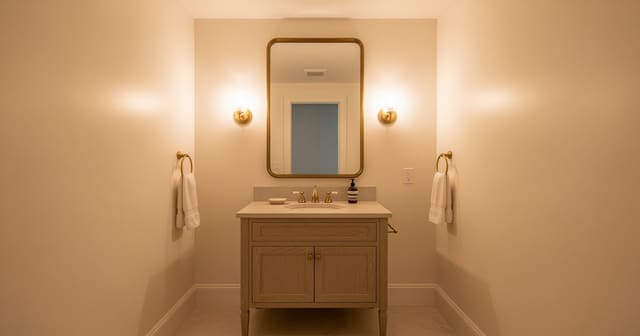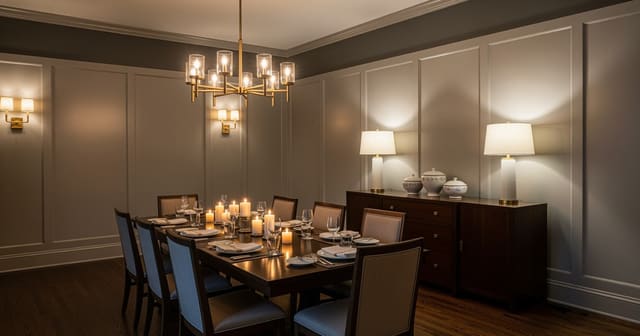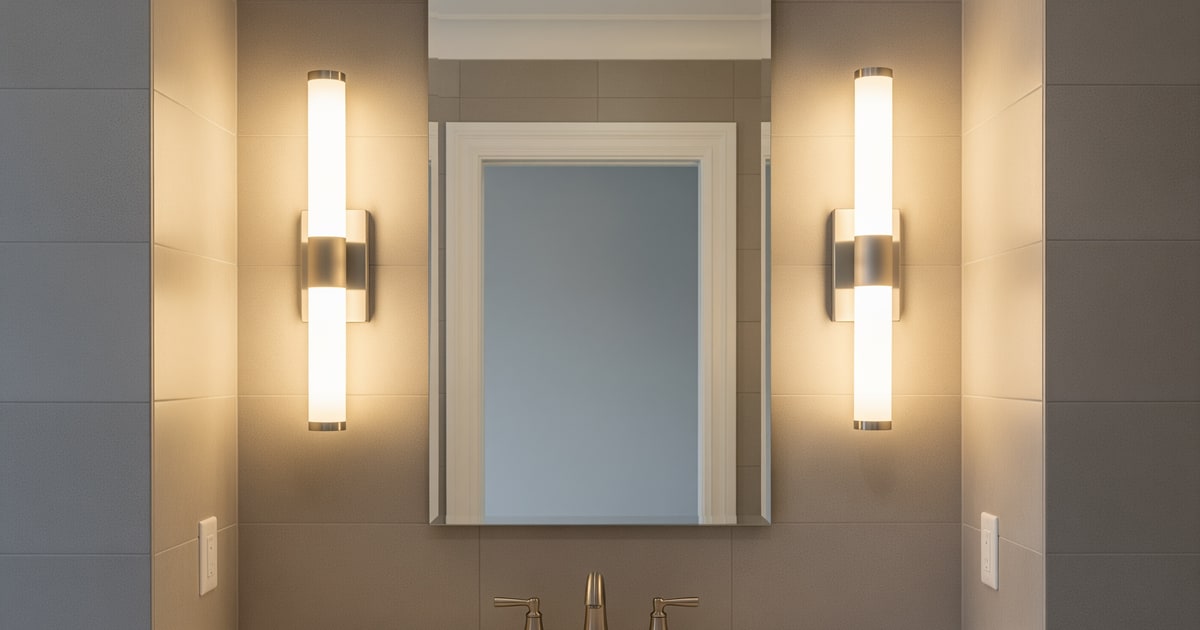
A bathroom mirror lights right when sconces or vertical strip lights flank the mirror at face height (centerline 60 to 65in), the color temperature stays at 3000K with a CRI above 90 so skin reads accurate, and a single overhead light is supplementary rather than primary — overhead-only lighting throws shadows down across the face. Bathroom mirror lighting is the single most consequential lighting decision in any house. Get it right and you look healthier than you actually are; get it wrong and you spend ten minutes every morning second-guessing every grooming choice you're making in the wrong light. The good news: there are only three correct setups and a handful of wrong ones. Pick a right one, mount it at the right height, choose the right Kelvin, and the bathroom delivers the rest of its life.
What is the best mirror lighting for a bathroom?
The best mirror lighting setup for bathrooms is vertical sconces flanking the mirror at face level — 64"–66" off the floor, 28"–36" apart on center — at 2700K–3000K with diffused shades. Every well-lit hotel bathroom uses this setup. Vanity bar lights mounted above the mirror are the second-best option but cast shadow on the face. Recessed cans directly above the mirror are the most common setup and the worst — they shadow every facial feature downward and add ten years to every morning.
Setup 1: Vertical sconces flanking the mirror (the gold standard)
The professional choice. Two sconces, one on each side of the mirror, mounted at face level.
- Height: 64"–66" off the floor (centerline of the fixture). This is face level for most adults. Light hits your face directly with no overhead shadow.
- Width: 28"–36" apart on center. Far enough apart to flank a standard 30"–36" mirror, close enough that the light overlaps on the face.
- Diffused or shaded fixtures only. Bare-bulb sconces spike contrast and create hot spots. Frosted glass, alabaster, or fabric shades distribute the light.
- 2700K–3000K bulbs. 2700K reads warmest and most flattering. 3000K is acceptable if you prefer crisper detail.
- CRI 90+ bulbs. Color Rendering Index. The single most-ignored spec. CRI 90+ shows true skin tones; CRI 80 makes you look gray. ~$1 more per bulb. Always worth it.
Test this on your own room photo with ReDesign before you choose the final direction; keep the doorway, walls, windows, main furniture, lighting, and awkward fixed features visible so the preview solves the room you actually have.
Setup 2: Vanity bar above the mirror (the second-best option)
A horizontal bar light mounted above the mirror. Cleaner install (one box, one switch), slightly less flattering than sconces.
- Width: at least 75% of the mirror width. A 36" mirror gets a 28"–36" vanity bar.
- Mounting height: 78"–80" off the floor (bottom of fixture). Above eye level.
- Diffused only. Avoid the bare-bulb "Hollywood vanity" style unless you accept the heat and glare.
- 2700K–3000K, CRI 90+.
- Trade-off vs. sconces. Casts a slight shadow under the brow and chin. Works fine if you accept it; sconces eliminate it entirely.
Setup 3: Backlit LED mirror (the modern choice)
An LED-perimeter mirror that lights itself. Cleanest visual, fewest fixtures, often the right choice in small or windowless bathrooms.
- Choose a mirror with front-facing LED perimeter, not just rear-glow. The front-facing perimeter lights your face directly; rear-glow only creates ambient mood.
- CCT-tunable models (Kelvin adjustable 2700K–5000K) are worth the extra ~$80. Use 2700K for evening, 4000K for makeup application, 3000K for everyday.
- Anti-fog and dimming features standard on quality units. ~$200–$600 for a 30"–48" model.
- Pair with an ambient ceiling fixture for fill. The mirror alone doesn't light the whole room.
For side sconces, the best second spec is spacing. Put the fixtures 36 to 40 inches apart when the vanity width allows it, with the light source near 64 to 66 inches from the floor. That puts glow on both sides of the face instead of under the brow. Choose damp-rated fixtures with opal glass, linen shades approved for bathrooms, or integrated LEDs with 90+ CRI; clear glass and exposed bulbs are flattering in almost no real bathroom. If the room has no daylight, the broader plan in windowless bathroom ideas should guide bulb temperature and wall color before you pick a mirror shape.
A vanity bar can still work when side sconces do not fit, but it needs depth and diffusion. Look for a bar at least 3 inches deep that throws light forward, not just down the wall. Backlit mirrors are best when they supplement another source; used alone, they make a nice halo and leave shaving or makeup in shadow. Owners should wire the mirror layer separately from the fan or ceiling light. Renters can use a rechargeable over-mirror light or a plug-in sconce on the dry side of the vanity. If the mirror is also trying to enlarge the room, cross-check the tile scale in small bathroom tile ideas so reflection does not double visual noise.
Mirror width should be coordinated with the fixture, not chosen separately. If a 30 inch vanity has a 28 inch mirror, side sconces may crowd the edges; in that case, a 22 to 24 inch mirror with narrow vertical sconces can look more intentional than forcing everything to touch. For a 60 inch double vanity, two mirrors with three sconces often light better than one giant mirror and a single long bar. The goal is even faces at each basin, not the largest possible piece of glass.
Bulb shape is a small detail with a big effect. Frosted G16.5 bulbs, integrated opal LEDs, or tubular bulbs behind a diffuser are safer than clear decorative bulbs. Keep lumen output modest when the fixture is close to the face; too much brightness at eye level makes people avoid the light they need. If the mirror is medicine-cabinet depth, check that sconces project far enough forward to clear the cabinet face, or the light will skim the wall instead of reaching the user.
Common bathroom mirror lighting mistakes
- Recessed can directly above the mirror. Default new-construction setup. Shadows every facial feature downward.
- Single overhead fixture in the middle of the bathroom ceiling. Same problem. Maximum shadow on the face.
- Bare-bulb Hollywood vanity strips. Look glamorous in catalogs. Run hot, glare directly into your eyes when you lean in.
- A single sconce on one side of the mirror only. Side-lit face. Half-shadow. Reads asymmetric in every photo.
- Cool-white bulbs (4000K+). Make you look pale, gray, and tired no matter what fixture they're in.
- CRI 80 bulbs. Cheap. Skin tones read off. Always pay for CRI 90+.
Bulb and fixture specs that matter
- Kelvin: 2700K–3000K. Never higher. The bathroom is the wrong room for daylight bulbs.
- CRI: 90+. Pay for the bulb upgrade.
- Dimmable: yes. Bright for makeup, dim for late-night.
- Beam angle: 90°+ for ambient cans, narrow for accent. Mirror sconces want diffused, not focused.
- Wattage equivalent: 60W per sconce side (LED actual ~9W). More is harsh; less leaves shadow.
- Using clear shades at face height. Clear glass exposes the bulb and creates glare in the mirror. Frosted, opal, or fabric diffusion is usually better for grooming light.
- Assuming a backlit mirror replaces face light. The halo may look expensive, but faces still need light from the front or sides.
Use AI design to preview your bathroom mirror setup
Owners often resist swapping out a vanity bar for sconces because they can't picture the change. AI design lets you photograph the current bathroom and preview both sconce and backlit-mirror versions — alongside the current overhead-only state — in minutes. The before-and-after is what unlocks the $300 fixture swap and the half-day install.
Frequently Asked Questions
Should bathroom mirror lights be above or beside the mirror?
Beside the mirror at face height casts even light across the face with no eye-socket shadows; above-only lighting throws downward shadows across the eyes and aging features. Use the room photo to compare the visible layout and fixed constraints before committing, because door swings, windows, outlets, storage reach, circulation, and existing furniture decide whether the idea survives daily use.
What color temperature is best for a bathroom mirror?
3000K with a CRI above 90 reads warm and accurate for skin and makeup; 4000K or daylight bulbs distort skin tone and chase warmth out of the bathroom. Keep the preview honest by leaving the problem area visible in the frame, then compare one conservative version against one bolder version before you buy lighting, paint, furniture, or storage.
How high should bathroom sconces hang?
Centerline at 60 to 65in above the finished floor, spaced 28 to 36in apart on either side of the mirror; below 60in the sconces hit shoulders, above 70in the light scatters. Check the result against ordinary movement first: drawer clearance, chair pullout, walkway width, glare, switch access, and sightlines matter more than a perfect catalog angle.
Can I get away with a single overhead light?
Only for utility bathrooms — primary bathrooms used for makeup, shaving, and grooming need flanking lights or vertical strips alongside the mirror because overhead-only lights chronically shadow. Use the image to narrow priorities and measurements before ordering anything custom; final purchases still need real dimensions, outlet locations, installation limits, and product clearances.
Are lighted mirrors as good as separate sconces?
Yes when the integrated LED strip is on three sides (top, left, right) and dimmable at 3000K; bottom-strip-only or top-strip-only mirrors throw the same shadows as overhead lights. If the preview invents architecture or hides the awkward feature you need solved, rerun it with stricter instructions so the result remains tied to your actual room.
> Try this: Ready to see this on your own room? Open ReDesign and run the preview.
Three transformations to try
1. Sconces flanking a framed mirror at face height 2. Vertical LED strip lighted mirror with warm 3000K glow 3. Combined sconce plus overhead with dimmer