A Cape Cod is one of the most charming houses you can own and one of the most quietly frustrating to furnish. The honest answer is that the angles are the whole point, so fighting them is a losing strategy. Those sloped ceilings, low knee walls, and tucked-in dormers are what give a Cape its cottage warmth, and the design job is to lean into the geometry rather than pretend you live in a box with flat 9 foot walls.
Most Cape Cod rooms go wrong in the same predictable ways: furniture shoved under the lowest point of a slope, dormers treated as dead zones, and paint choices that chop the room into awkward fragments. Below I walk through the moves that make the second floor of a Cape feel like the best rooms in the house instead of an afterthought under the roofline.
Work with the slope, not against it
The defining feature of a Cape is the ceiling that drops to meet a low knee wall, usually around 3 to 4 feet high, before the roof angles up to a ridge. The instinct is to push a bed or dresser against that low wall, and the instinct is wrong, because you end up cracking your head and burying the one storage opportunity the room hands you for free. Reserve the zone under the slope, anywhere headroom falls below about 5 feet, for things you do not stand beside: the head of a bed, a low bench, a long dresser no taller than the knee wall.
Tall objects belong on the full-height gable wall where you can use their height honestly. A 72 inch wardrobe or a bookcase reads as deliberate against the gable and absurd under the slope, so let the geometry assign each piece its spot. This is the same height-zoning logic that governs any character house, and it rhymes with the approach in ranch house interior design ideas, where the architecture sets the rules and the furniture follows them rather than fighting for dominance. Spend ten minutes mapping the room's headroom before you buy anything, marking where the ceiling drops below 5 feet, and the layout half-solves itself.
Make dormers and knee walls earn their keep
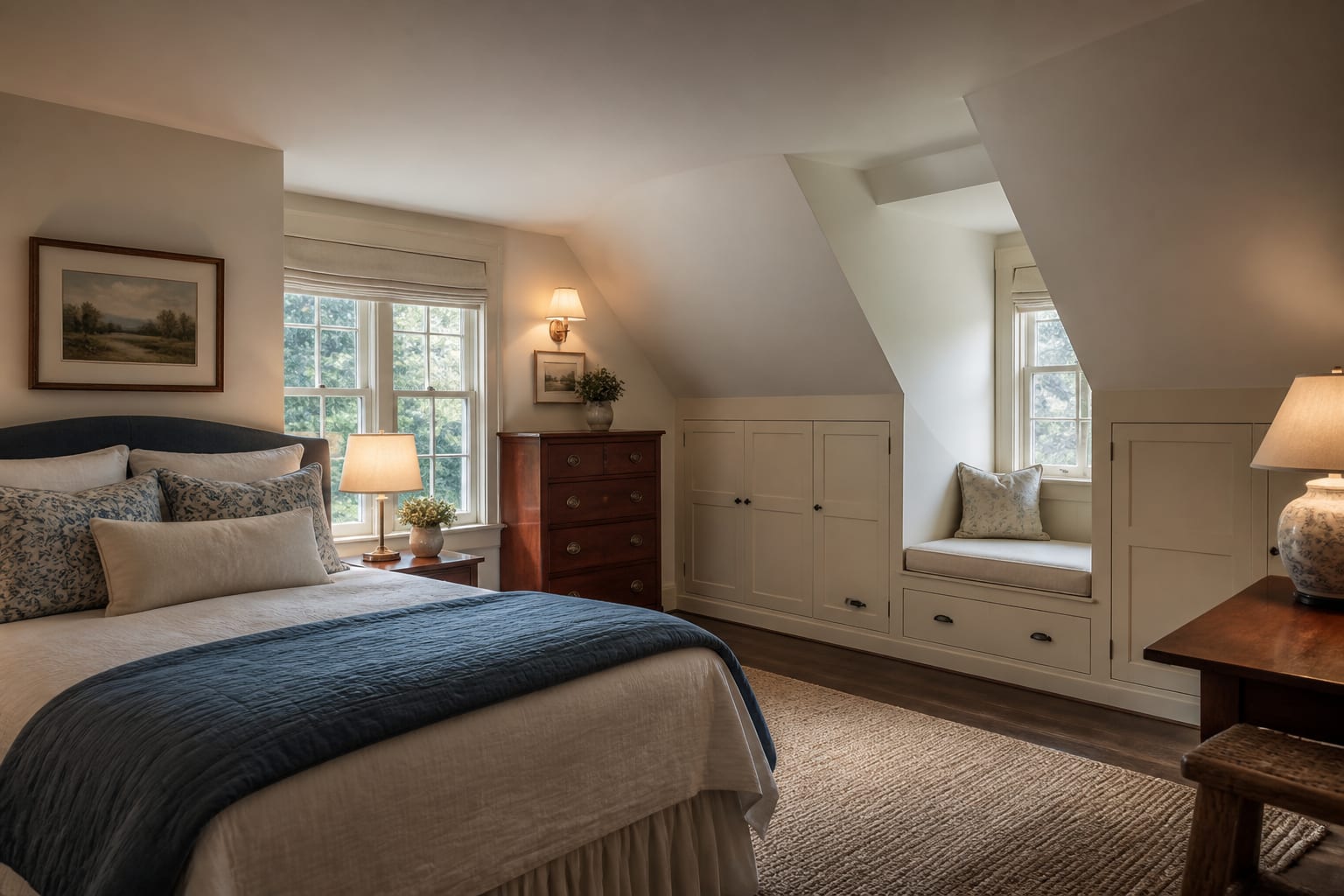
The two features people waste most are dormers and knee walls. A dormer is a gift: it punches a pocket of full-height ceiling and extra daylight into an otherwise low room, usually a 4 to 6 foot wide alcove. Treat it as a dedicated micro-room rather than leftover space. Good uses for a dormer pocket include:
- A built-in window seat with a 16 to 18 inch deep cushion and drawers underneath for linens.
- A compact desk nook that borrows the dormer's daylight for a work-from-home corner.
- A reading chair and a slim floor lamp, making the brightest part of the room the cosiest.
- A dressing zone with a mirror, since dormers often catch the best morning light.
Knee walls are the other overlooked asset. That 3 to 4 foot vertical wall hides a deep triangular void behind it, perfect for custom drawers, low cabinets, or open cubbies. Reclaiming it is the kind of small-footprint thinking that powers good tiny house interior design ideas, where no cubic foot is allowed to go to waste.
Light and color for low, angled rooms
Lighting a sloped room is its own puzzle because you often cannot center a fixture without it hanging into someone's forehead. Skip the single central pendant and build layers instead: recessed lights angled along the slope, wall sconces on the knee wall at about 60 inches, and table or floor lamps to fill the low corners. Warm bulbs around 2700K suit a cottage far better than cold daylight tones, which make the cozy angles feel clinical.
Color is where Capes are won or lost. Painting the walls one shade and the sloped ceiling another draws a hard line that fractures the room and emphasizes how low it is, especially in a space where the ceiling starts at the 3 to 4 foot knee wall. Carry a single light color, walls and ceiling and all, up and over the slope so the eye reads one continuous envelope and the room feels taller and roomier than its dimensions suggest. Soft whites and pale putty tones reflect the light a dormer pulls in and keep the angles feeling airy rather than oppressive, which matters most in north-facing rooms that get little direct sun. If you want to layer eras and finishes inside that calm shell, the cohesion tricks in townhouse interior design ideas translate well, since both house types ask you to make small, characterful rooms feel intentional rather than cramped.
Common mistakes to avoid
The most common mistake is buying standard-height furniture and jamming it under the slope, which leaves a tall headboard or a 72 inch bookshelf colliding with the ceiling at an absurd angle. Measure the headroom at the exact spot the piece will sit, not at the room's high point. A close second is leaving the knee-wall void sealed and empty while complaining the room has no storage; that triangle is the answer staring back at you.
Another frequent error is over-lighting the high ridge and under-lighting the low corners, so the room glares in the middle and gloomers at the edges. Spread the light. People also tend to hang art and curtains at flat-ceiling heights, which looks stranded under a slope; drop your rod and art lower to match the room's real proportions. Finally, resist the urge to wallpaper or accent-paint the sloped ceiling in a busy pattern, because the angle already does plenty of visual work and a loud ceiling just makes a small room feel smaller.
Use AI design to preview Cape Cod interior design ideas before you commit
Sloped ceilings are notoriously hard to picture, which is what makes Re-Design genuinely useful for a Cape. You upload a photo shot toward the slope and the dormer, then ask the AI design to test a built-in window seat in the dormer, a low dresser along the knee wall, and a single continuous paint color carried over the ceiling, all without ordering a custom carpenter's quote first. Seeing the angle furnished correctly tells you in seconds what a tape measure cannot.
I find it especially handy for the paint decision, since the difference between a two-tone ceiling and one continuous color is dramatic and almost impossible to imagine accurately. Upload the room photo, generate a few versions with the slope painted out and the dormer activated, and you can commit to the cottage feel you actually want instead of discovering after two coats that the contrasting ceiling made the room feel like a tent.