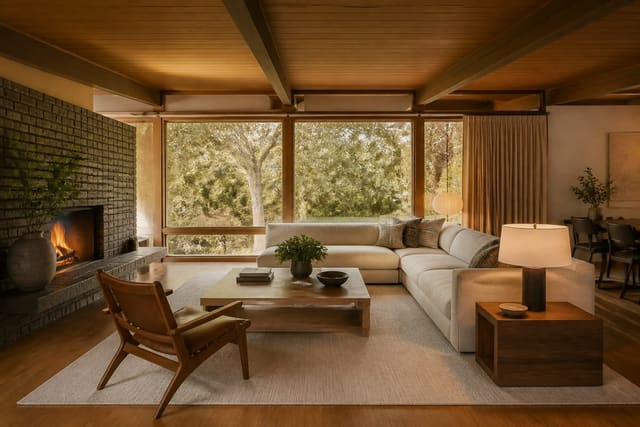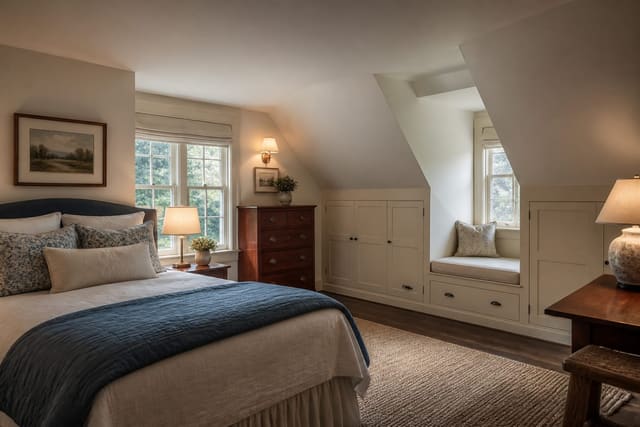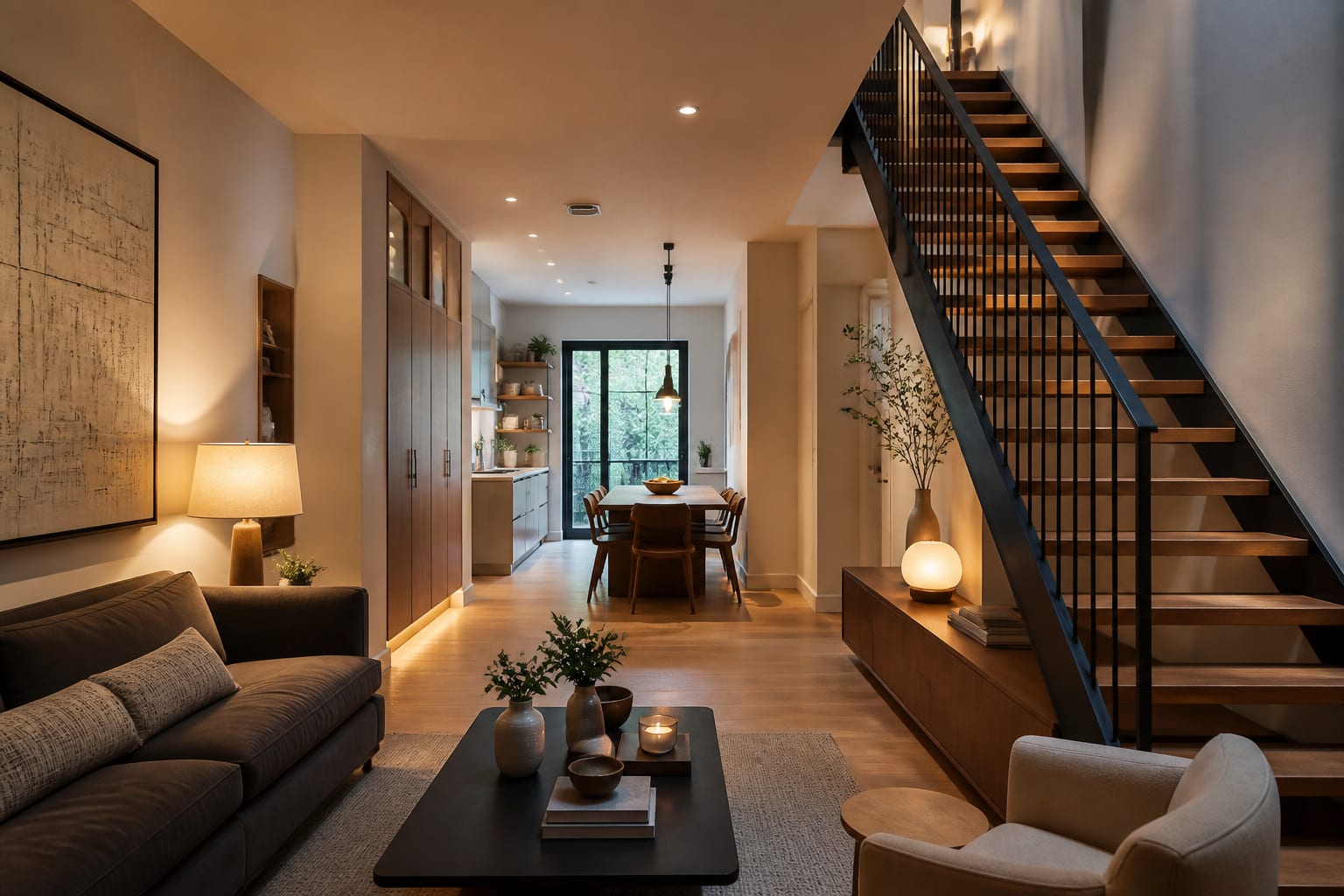
A townhouse is a series of small floors stacked on top of each other, and that's exactly why so many feel disjointed. I think the core mistake is designing each floor as its own project, so you end up with a grey living room, a beige bedroom, and a stairwell that belongs to neither. The narrowness amplifies it: when a room is only 12 feet wide, every inconsistent choice is right in your face.
The honest answer is that townhouse design is less about each room and more about the thread connecting them. Get the palette, the flooring, and the vertical circulation right, and the place reads as one home across three or four levels instead of a stack of unrelated boxes. Here's how I approach it.
A repeated palette is the through-line
The single most effective townhouse move is a restrained, repeated palette. Pick 3 or 4 colors and carry them across every floor, varying which one dominates per room rather than introducing new schemes. A warm white on most walls, one mid-tone accent, and a deeper anchor color give you enough range for four floors without fracture.
Flooring does the same job underfoot. Running the same wood or wood-look floor through the entry, living level, and bedrooms removes the visual break that makes a tall narrow home feel chopped. If you want each floor to have its own personality without breaking the thread, vary texture and accessories instead of base color. The same restraint that makes a single-level ranch house interior feel cohesive works vertically here, just stacked. The consistency is what your eye reads as quality.
There's a daylight argument for the repeated palette too. Townhouses are usually lit from only the front and back, so the middle of each floor sits in shadow, and rooms can be a full step darker than a detached home of the same size. A warm white at around 70% light reflectance value bounces what daylight you get deeper into each floor, while a moody accent wall on the darkest side absorbs it. Keeping the same warm white on most walls across every level also means a single paint code touches up scuffs anywhere in the house, which on four floors of stairwell traffic is not a small thing.
The staircase is a room, not a gap
In a townhouse the stairwell can be 10 to 15% of total floor area, and most people light it with one builder fitting and call it done. Treat the run as designed space. Things worth getting right:
- A consistent handrail finish and baluster style from the bottom flight to the top.
- Wall sconces or a slim pendant per landing instead of a single overhead light.
- A gallery of framed art climbing the wall to draw the eye upward.
- A runner that matches the palette and quiets the sound of foot traffic.
- Storage built into the deepest landing or under the lowest flight.
Landings especially are wasted potential. A 30-inch-deep landing can hold a slim console, a chair, or a bookshelf, turning dead transit space into something the house actually uses.
Safety and proportion both argue for taking the stair seriously. On a tight run, keep at least a 36-inch clear width and don't crowd it with anything that projects past a few inches, a deep sconce at shoulder height becomes a daily bruise. Light each flight so there's no dark step; a string of small wall lights or a continuous handrail LED keeps the whole vertical journey legible. The classic detail that reads as considered in older townhouses, the kind you also see in a well-kept cape cod interior, is a painted stair string and a runner held by stair rods. It costs little and makes the busiest part of the house look finished rather than functional.
Give every floor a job
Narrow homes punish vagueness. When each floor has a defined purpose, decisions about lighting, storage, and furniture depth follow naturally. A typical arrangement puts the kitchen and dining on the entry or garden level, living on the next, and bedrooms above, but the principle is what matters: one floor, one primary function.
This clarity also tells you where to compromise on size. In a room under 13 feet wide, keep sofa and cabinet depths to around 36 inches so you preserve a walkway. Where a floor has to stretch, plan it deliberately rather than letting it drift. The disciplined zoning that defines a tiny house interior pays off on a landing-office or a guest-room-study here too. The townhouse rewards homes that know what each level is for.
Storage planning should follow the same per-floor logic. Each level needs to absorb its own clutter, because nobody carries a vacuum up three flights cheerfully, so a slim closet or a built-in bench on every floor pays for itself. Vertical storage is your friend in a narrow plan: a run of cabinets 12 inches deep and 8 feet tall holds more than a wide low unit and steals no walking room. The goal is that no floor ever has to borrow space from another, because the moment one level overflows, the whole stacked logic of the house starts to feel cramped.
Common mistakes to avoid
The most common mistake is over-furnishing the width. People buy a standard 40-inch-deep sectional for a 12-foot-wide living floor and lose the entire walking path. Measure the room and subtract a 30-inch circulation lane before you shop.
Another frequent error is ignoring the stairwell until the end, when the budget's gone, leaving the one element that ties every floor together looking unfinished. Plan it first. A third mistake is mismatched flooring per level, which is the fastest way to make a tall home feel like separate apartments. And don't forget vertical sightlines: in a narrow home you often see two floors at once through the stair void, so a clashing color on the floor above will read from the floor below.
Use AI design to preview townhouse interior design before you commit
Multi-floor cohesion is genuinely hard to judge in your head, because you experience the floors one at a time. With Re-Design you can upload a photo of each level and render them in the same palette, then compare side by side to check that the thread actually holds from entry to top floor.
AI design is especially useful for the narrow-room furniture call. Upload your living floor and preview a 36-inch-deep sofa against a 40-inch one to see exactly how much walkway each leaves before you order. Testing the whole-house palette across three uploaded rooms takes minutes and saves you from discovering the mismatch after the painters have left.