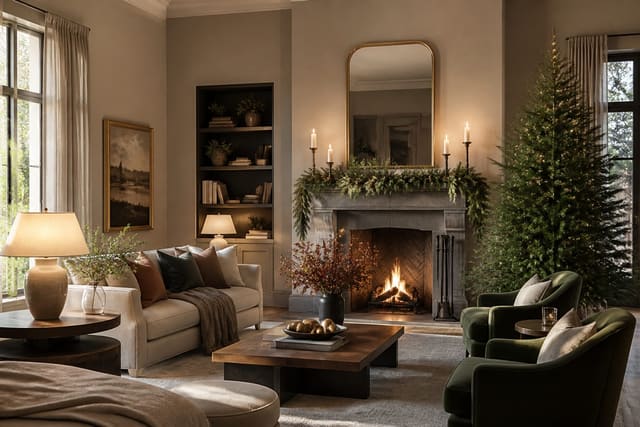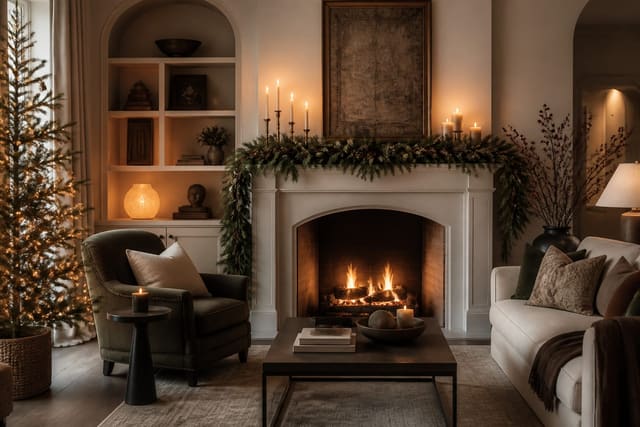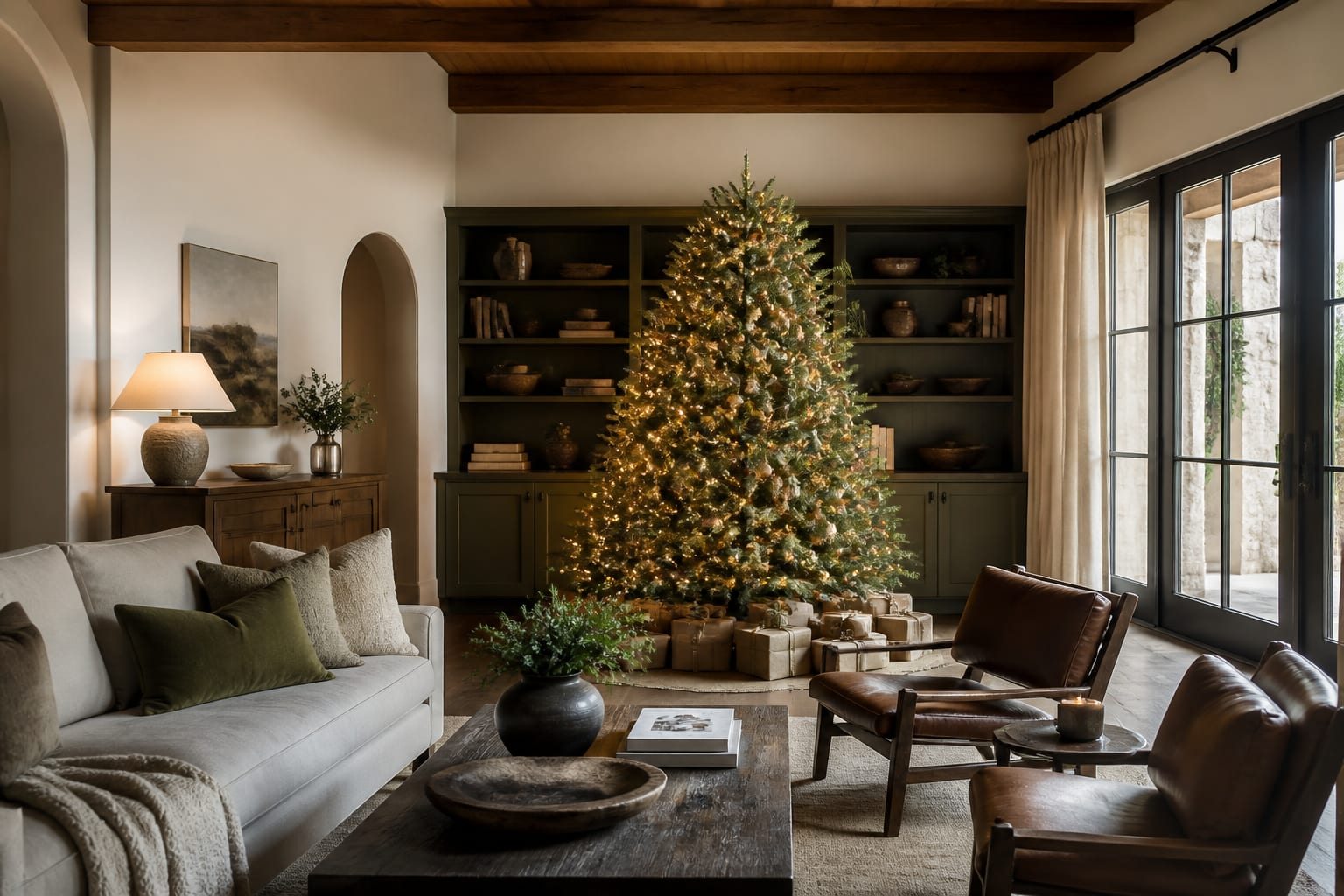
Red and gold is not the only way to dress a tree, and in a modern home it is often the worst way. A Christmas tree is the largest single object you will style all year, so it should answer to your room rather than to a generic holiday template. The most striking trees commit to one clear direction, repeat it from base to tip, and resist the urge to hang every ornament in the box.
Style the Tree to the Room, Not the Calendar
Walk into most living rooms in December and the tree fights the decor. A sleek, neutral space gets a tree dripping in primary red; a warm, layered room gets cold silver and blue. The fix is to treat the tree as a piece of furniture you are styling for the season, not as a separate holiday zone with its own rules.
Choose your direction before you buy a thing. A minimalist tree might use only matte white, brass, and natural wood ornaments with plenty of visible branch. A monochrome tree picks one color, say blush or forest green, and runs it across glass, velvet, and paper finishes for richness without contrast. A maximalist tree goes the other way, deliberately layering pattern and texture until it is gloriously full, which only works if the room behind it can hold that energy.
The tree itself is part of the decision, not just a green backdrop. A slim pencil tree reads modern and suits a tight corner or a narrow city apartment, while a wide, dense fir wants a maximalist treatment that can fill its volume. Flocked trees lean snowy and Scandinavian, and a bare or twig-style tree painted white or charcoal pushes hard toward the contemporary end. Match the silhouette to the direction you chose, and the styling that follows will feel inevitable rather than forced onto the wrong shape.
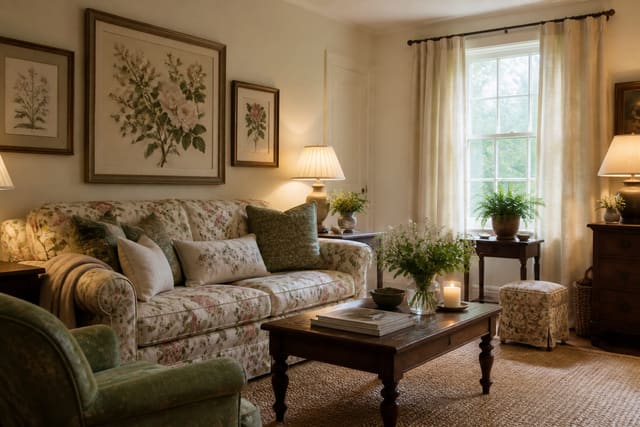
Whatever the direction, it should echo the space. If your living room already leans cozy and collected, the tree can pull from the same well; the soft textures and gathered greenery in cottagecore living styling translate to a tree that feels foraged rather than bought.
Christmas Tree Styling Ideas Beyond Red and Gold
Use these to build a tree with a point of view. Pick a lane and follow it from the topper to the lowest branch.
- Choose a two-color palette such as bone and bronze, or sage and cream, and buy every ornament within it so nothing fights for attention.
- Layer ornaments at three depths: a few pushed deep against the trunk, a middle layer, and the showpieces on the outer tips for genuine dimension.
- Replace a star or angel with an unexpected topper, like a loose cluster of dried wheat, a oversized velvet bow, or a spray of bare branches shooting upward.
- Weave wide wired ribbon vertically from top to bottom rather than wrapping it in horizontal stripes, which feels fresher and guides the eye up.
- Add non-ornament texture with bundles of dried citrus, cinnamon sticks, paper stars, or felted wool shapes to break the glass-ball monotony.
- Tuck floral picks or feathers into gaps the way a florist fills a bouquet, softening the silhouette and hiding any sparse spots.
- Skip tinsel entirely and let warm-white lights sit deep in the branches so the tree glows from within instead of sparkling on the surface.
The connecting idea is intention. Every one of these moves reduces randomness and replaces it with a deliberate choice, which is precisely why the result looks styled rather than merely decorated. Work top to bottom in one pass, settling the topper and ribbon first so they set the rhythm, then hang ornaments, then fill gaps with picks and texture last. Trying to do it all at once is how trees end up lopsided, with the showpieces clustered wherever your hand happened to reach first.
Building Dimension and a Cohesive Glow
A flat tree is the most common failure, and it comes from hanging every ornament on the outermost branch tips. Depth is what separates a designer tree from a store-bought one. Place your largest or most matte ornaments deep near the trunk where they read as shadow, then graduate outward to the shiniest pieces on the tips. The tree gains a sense of three dimensions the moment light hits those interior baubles.
Light is the other half of the equation. Skip multicolor strands for a modern look and use warm-white lights at roughly 100 bulbs per vertical foot of tree, woven in close to the trunk and then back out along each branch. That depth of lighting is what produces a glow rather than a glare. Pull the whole scene together with the room's other surfaces, since a tree never stands alone; coordinating it with the holiday mantel styling nearby keeps the palette consistent across the room and stops the tree from feeling like a marooned island of decoration.
The base deserves as much thought as the branches, because a plastic stand peeking out undoes all the work above it. Wrap the stand in a woven basket, a length of linen, or a velvet tree collar in a color that ties back to your scheme. Skirt the floor with a few wrapped boxes in matching paper, kept to the same two or three tones, and the tree reads as finished from the floor to the topper. For the rest of the room, the cushions, throws, and surface styling that surround the tree set its frame; pulling them into the same palette as part of your holiday living room scheme is what makes a single decorated tree feel like a whole designed space rather than an ornament dropped into an ordinary room.
Preview Your Tree Styling in Re-Design
Frequently Asked Questions
How do I style a Christmas tree in a modern home?
Pick one clear direction, such as minimalist, monochrome, or maximalist, and buy ornaments only within that brief. Use a two- or three-color palette, layer ornaments at varying depths for dimension, and choose warm-white lights woven deep into the branches. Coordinate the tree with the rest of the room so it reads as part of the space.
What colors look good on a Christmas tree besides red and gold?
Plenty. Bone and bronze, sage and cream, blush monochrome, or forest green with brass all look current and sophisticated. The key is restraint: limit yourself to two or three finishes and repeat them throughout so the tree reads as deliberate rather than mismatched.
How many ornaments do I need for a full tree?
For a balanced look, plan on roughly 20 to 30 ornaments per vertical foot of tree, split across three depth layers. A 7-foot tree therefore wants somewhere around 150 to 200 pieces. Buying in fewer colors but greater quantity gives a fuller, more cohesive result than a wide mix.