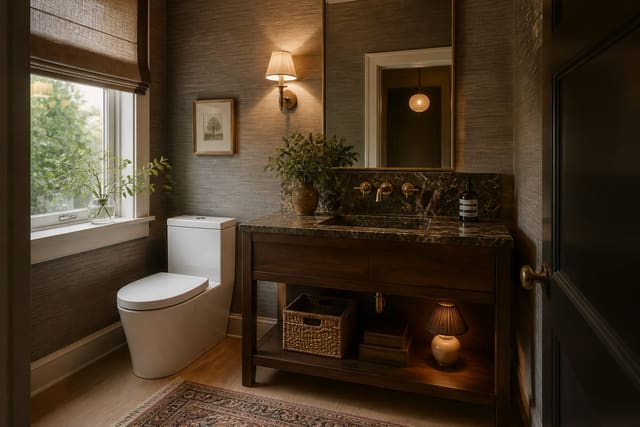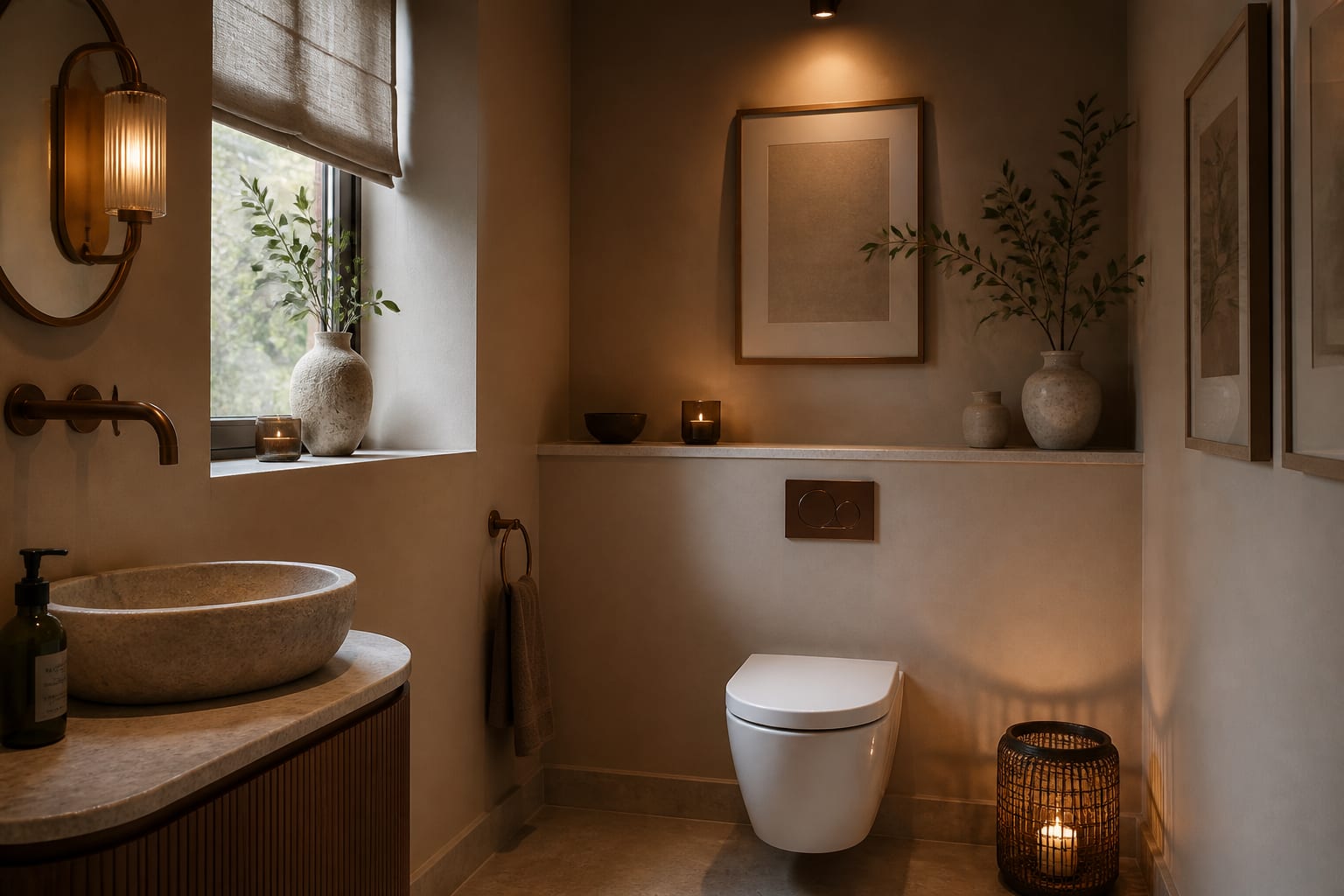
The instinct with a cloakroom is to play it safe and small: white walls, a pedestal basin, nothing that draws attention to how cramped it is. That is exactly the wrong move. A cloakroom is usually the one room in the house with no natural-light requirement, no need for a tub, and no daily-grooming function, which makes it the perfect place to be bold. Because you spend so little time in there, a dark, dramatic, slightly theatrical scheme that would overwhelm a bedroom feels witty and confident in a 25-square-foot loo. The trick is choosing fittings sized for the space so the drama never costs you function.
Get the layout and clearances right first
Before any color or tile decision, the room has to function, and a cloakroom lives or dies by a handful of clearance numbers. Building guidance generally calls for at least 21 inches of clear space in front of the toilet pan so you can stand and turn comfortably, and roughly 30 inches of width to sit without your knees pressing the opposite wall. The smallest workable footprint lands around 30 by 60 inches, though you will be happier with a touch more. Watch the door swing: an inward-opening door that collides with the basin or the person inside is the most common cloakroom planning error, and an outward swing or a sliding pocket door usually solves it.
Position the WC against the wall carrying the soil pipe to keep plumbing runs short, then tuck the basin into the corner or along the adjacent wall. In an awkward under-stairs space with a sloping ceiling, set the toilet where the head height is greatest and let the slope fall over the basin, where you stand closer to the wall anyway. Many of the same tight-footprint tactics that work in a powder room translate directly here, since both rooms ask a half-bath to perform in almost no square footage.
Be bold with color and pattern
This is the room to take the risk you would not take anywhere else. Because nobody lingers in a cloakroom, a saturated, enveloping color that might feel oppressive in a living space becomes a small, delightful surprise instead. Deep inky blues, forest greens, oxblood, and near-black charcoals all make a tiny loo feel intentional and rich rather than apologetic. Painting the ceiling the same dark tone as the walls actually blurs the room's edges and can make it feel larger and more cocooning, the opposite of what most people assume.
Pattern works for the same reason. A bold botanical or geometric wallpaper that would dominate a bedroom becomes a feature you get to enjoy in short bursts. To keep the scheme from tipping into a cave, pair the dark drama with a few crisp counterpoints: a white basin, a polished brass or chrome tap, a good mirror, and reflective surfaces that bounce what light there is. If you are weighing tones and finishes, working through a focused set of bathroom color directions before you commit will stop you buying a paint that looks moody on the chip and muddy on the wall.
Cloakroom ideas that earn their square footage
With the layout sorted, these are the moves that make a small loo punch above its size. Choose the handful that suit your footprint: - Hang the basin and the toilet off the wall so the floor reads continuous, which makes the room look bigger and far quicker to mop. - Fit a compact corner or semi-recessed basin 14 to 18 inches wide rather than forcing in a full vanity that eats turning room. - Choose a concealed cistern behind a half-height stud wall, then use the resulting 8-inch-deep shelf for soap, a plant, and a folded towel. - Run a large mirror across most of one wall to double the perceived space and reflect the light source. - Add a wall-mounted or recessed light beside the mirror at face height so the room is lit for handwashing, not just from a single overhead. - Lay the same tile or finish up the wall behind the basin as a practical splashback that also adds a band of texture. - Pick a slimline back-to-wall toilet pan, which projects only about 19 to 23 inches and reclaims precious inches in a shallow room.
Light it like a jewel box, store like a minimalist
A single bare bulb overhead is the fastest way to make a small dark room feel like a cupboard. Layer the light instead. Combine a soft overhead source with a wall light or a backlit mirror at roughly face height, around 60 to 66 inches, so handwashing and a quick mirror check are properly lit. In a dark scheme especially, warm 2700K bulbs keep the inky walls feeling cozy rather than gloomy, and a dimmer lets you soften it further for guests.
Storage in a cloakroom is an exercise in restraint, because there is simply no room for much. You need a spot for hand soap, a hand towel, and a discreet stash of spare loo roll, and not a great deal else. A concealed cistern wall gives you a ready-made shelf; a slim wall cabinet or a single floating shelf handles the rest. Resist the urge to add open shelving crammed with bottles, which makes a tight room feel chaotic. The same edited, every-item-earns-its-place discipline that keeps a primary bathroom calm matters even more when the entire floor plan is the size of a closet.
Preview your bold cloakroom in Re-Design before you paint
Committing to oxblood walls or a busy wallpaper in a tiny windowless room is exactly the kind of decision that feels terrifying on a paint chip. Take the guesswork out of it: upload a photo of your cloakroom into Re-Design and preview the dark scheme, the wall-hung basin, and the brass tap against your actual walls and door position before you buy anything. You can test a deep green against a near-black, see whether a large mirror genuinely opens the space up, and judge how the fittings sit in your real footprint. Seeing the dramatic version rendered in your own room is what gives you the confidence to be brave with a color you would otherwise talk yourself out of.
Frequently Asked Questions
What is the smallest a cloakroom can be?
The smallest practical footprint is around 30 by 60 inches, giving room for a compact toilet and a small basin. You need at least 21 inches of clear space in front of the WC to stand and turn, and the door must swing without hitting the basin or the user. An outward-opening or sliding pocket door is the usual fix when an inward swing will not fit.
Should a small cloakroom be painted a dark color?
Dark colors work surprisingly well in a cloakroom precisely because you only use the room briefly. A deep blue, green, or charcoal reads as confident and rich rather than cramped, and painting the ceiling the same tone blurs the edges so the space feels more enveloping. Just balance the drama with a white basin, a reflective mirror, and warm 2700K lighting so it never feels like a cave.
How do you fit a basin into a tiny cloakroom?
Use a compact basin 14 to 18 inches wide, or a corner or semi-recessed model that tucks into otherwise dead space. Wall-hung basins free up the floor and make the room feel bigger and easier to clean. You do not need a full vanity here; a slim wall-mounted basin with a single tap covers everything a cloakroom is actually used for.
Where does the toilet go in an under-stairs cloakroom?
Place the toilet where the ceiling is highest, usually toward the tall side of the staircase, so you have head height where you stand and sit. Let the sloping section fall over the basin, where you naturally stand closer to the wall. Siting the pan against the wall that carries the soil pipe also keeps the plumbing simple and the installation cheaper.