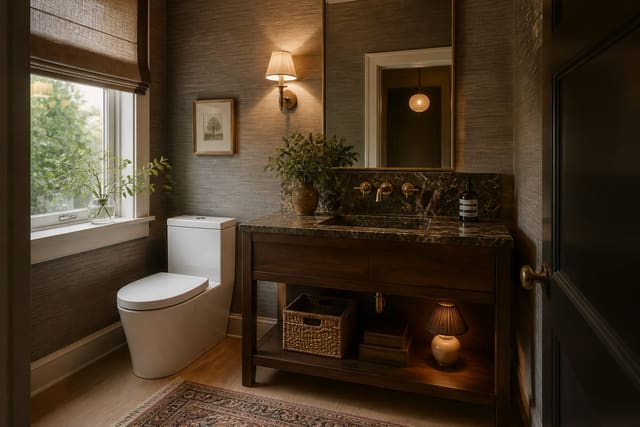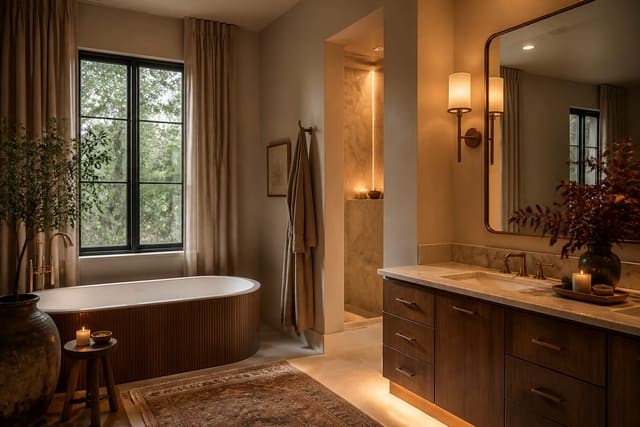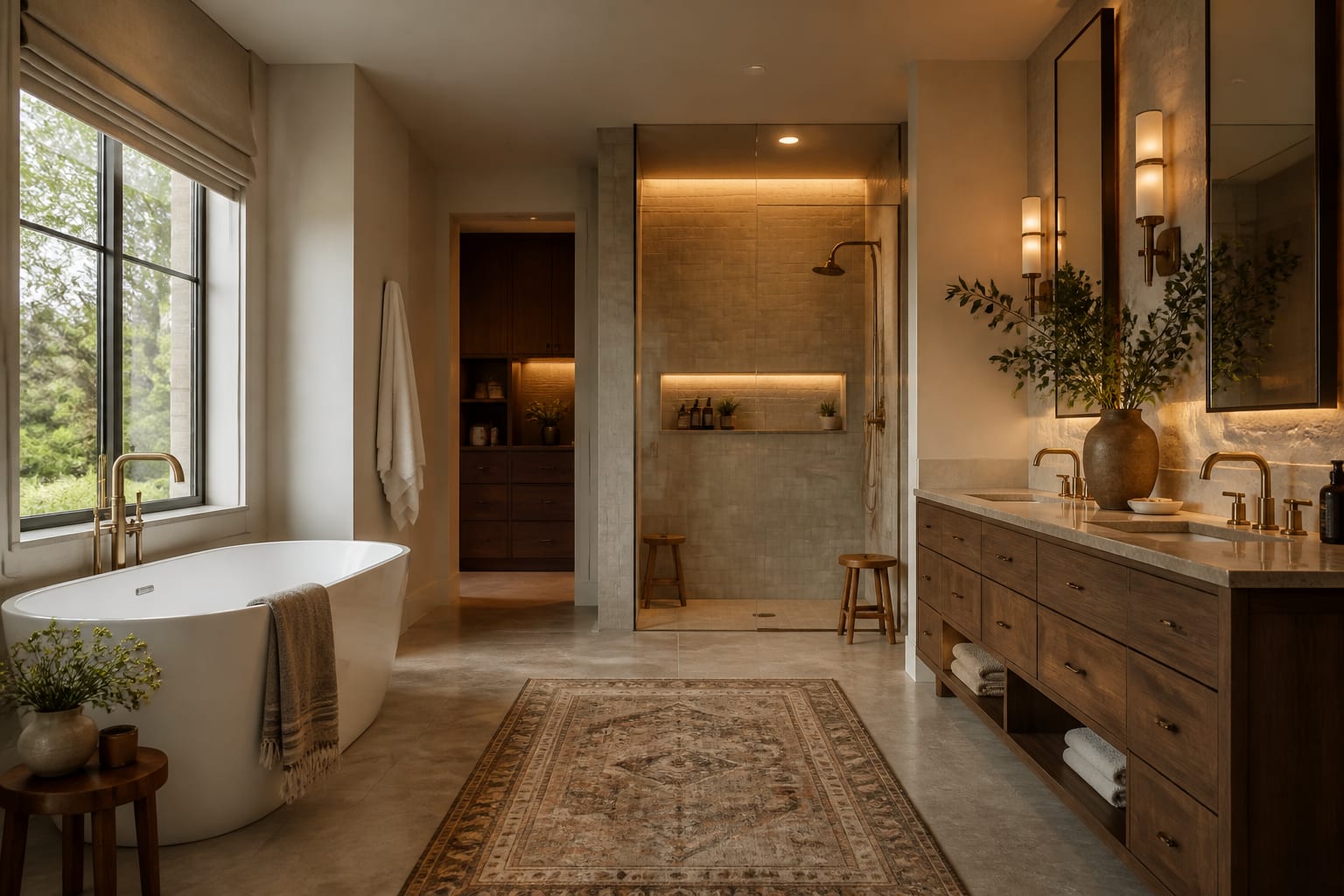
A primary bathroom should function like a private spa you happen to own, not a glorified hallway with a toilet. The best ones earn that feeling through deliberate planning: two people moving through their routines without colliding, surfaces that wipe clean, and lighting that flatters at 6 a.m. and 9 p.m. alike.
That means committing early to the big decisions — vanity count, whether the tub and shower live separately, where towels and bottles actually go. These primary bathroom ideas focus on the choices that change how the room feels and works every single day, not just how it photographs the week it is finished.
Double Vanity and Daily Flow
If two people share the room, a double vanity is the single change that improves mornings most. Give each person roughly 36 inches of counter and their own basin, drawers, and outlet so nobody waits on a hair dryer or fights for elbow room. A 72-inch cabinet comfortably holds two sinks with a usable strip of counter between them; below 60 inches the basins crowd and the layout stops working.
Think in zones rather than symmetry for its own sake. One side can lean toward grooming with shallow drawers and a tilt-out tray for brushes, while the other holds taller bottles and a charging drawer. Drawers beat doors here because you can see and reach everything without crouching.
Leave a clear 30-inch path in front of the vanity so two people can pass behind each other without turning sideways. If the footprint is tight, a single extra-wide vanity with one large basin and generous counter still beats two cramped stations. The goal is calm, parallel routines — each person finishing without narrating their next move — and that comes from honest spacing more than from matching faucets. Wall-mounted faucets free up the deck and make wiping the counter a five-second job rather than a chore around three fixtures. Pair the vanity height to the users; a 36-inch comfort-height cabinet suits most adults better than the older 32-inch standard and saves your back at the sink every morning.
See also our guide to Powder Room Ideas for more on primary bathroom ideas.
Separate Shower and Tub
The combination tub-shower is a space saver, not a luxury, and a primary bath is the room to graduate past it. Giving the shower and the tub separate homes lets each one be the right size: a roomy walk-in shower with a bench, and a tub you actually soak in rather than step over to rinse off.
A comfortable shower starts around 36 by 48 inches; push to 42 by 60 inches and you can add a bench and a second showerhead without feeling boxed in. The tub then becomes a sculptural element instead of a utilitarian one — a freestanding soaker under a window, or a built-in deck tub framed in the same stone as the counter.
If the room cannot give up the floor area for both, prioritize the shower, since that is what most people use daily, and skip the tub rather than shrinking both into mediocrity. When you do keep both, place the tub away from the main traffic path so a filling tub never blocks the vanity or toilet. A half-wall of glass or a single fixed panel keeps the shower open and the sightlines long, which makes the whole suite read larger than its square footage suggests. Finish the tub and shower in a common material — the same stone surround or tile family — so the two read as a designed pair rather than two unrelated objects competing for attention. That visual continuity is what makes a separate tub and shower feel like a deliberate suite instead of a fixture you could not bear to delete.
For a related angle on primary bathroom ideas, read Bathroom Color Ideas.
Storage That Hides the Clutter
A spa feeling collapses the moment the counter fills with bottles, so storage has to absorb daily clutter before it lands on a surface. Plan three tiers: drawers in the vanity for grooming gear, a recessed wall niche or medicine cabinet for the products you reach for hourly, and a tall linen cabinet or closet for towels, paper, and backstock.
Inside the vanity, fit drawer organizers and an outlet so flat irons and toothbrushes charge out of sight. A 12-inch-deep wall cabinet between studs costs almost no floor space and swallows skincare, medication, and cotton rounds. For towels, a linen tower or a 24-inch closet near the shower means a dry towel is always one reach away rather than draped over a door.
Do not forget the shower itself. A tiled recessed niche, roughly 12 by 24 inches set at chest height, holds shampoo and soap without a single suction caddy sliding down the wall. In the toilet zone, a slim cabinet or a recessed roll holder keeps paper handy and the floor clear for cleaning. The discipline is simple: every category of stuff gets a closed, assigned home, and the only things left on the counter are the soap pump and maybe a small plant. That restraint is what separates a hotel-grade bath from a busy family one, and it costs nothing once the storage is planned in from the start.
Materials, Lighting, and Spa Calm
The spa feeling people chase is mostly material and light, not square footage. Warm, low-contrast surfaces read as restful: honed stone over polished, large matte porcelain tile over busy patterns, and a wood vanity or stool to break up all the hard surfaces. A muted palette — soft greige, warm white, a single deeper accent — lets the textures do the talking instead of the colors competing.
Lighting is where most baths fall short. Overhead cans alone throw shadows under the eyes, so flank the mirror with sconces or vertical fixtures at roughly 66 inches to light the face evenly. Add a separate dimmable circuit for the tub and shower zone so a late soak runs at fifteen percent while the vanity stays bright for grooming. Aim for warm bulbs around 2700K to 3000K; cooler than that and the room feels clinical rather than calming.
Layout ties it together. Keep the toilet out of the direct sightline from the door, ideally tucked behind a half-wall or in its own compartment. Put the tub or a window at the end of the longest sightline so the eye lands on something beautiful on the way in. Heated floors, a towel warmer, and a fog-free mirror are small upgrades that punch far above their cost in how the room feels. None of these moves require more space — only better decisions about the space you already have.
- Run a 72-inch double vanity with two basins and a charging drawer so mornings stop overlapping.
- Separate the soaking tub and walk-in shower so neither one has to compromise on size.
- Recess a 12-by-24-inch shower niche at chest height for bottles instead of suction caddies.
- Flank the mirror with sconces near eye level to erase the shadows overhead cans create.
- Choose honed stone, matte porcelain, and warm wood for a restful, low-contrast spa palette.
- Add a tall linen cabinet near the shower so a dry towel is always one reach away.
- Put the tub or a window at the end of the longest sightline for an instant calm focal point.
- Tuck the toilet behind a half-wall or into its own compartment, out of the door's direct view.
Bring the look home with Re-Design
Before you commit to a 72-inch vanity or move the tub, upload a photo of your current bathroom to Re-Design and preview the suite with new fixtures, tile, and lighting in place. Seeing a separate shower and tub, a warmer stone palette, or a different vanity layout in your actual room makes it far easier to judge scale and flow than reading dimensions on a plan, so you avoid expensive second-guessing mid-renovation.
Frequently Asked Questions
How wide should a double vanity be?
Aim for at least 60 inches and ideally 72 inches so each basin gets a usable counter and drawer zone. Below 60 inches the two sinks crowd, the faucets sit awkwardly close, and you lose the elbow room that makes a shared vanity worth installing in the first place.
Do I need both a tub and a separate shower?
Not always. If you rarely soak, a generous walk-in shower with a bench serves daily use better than splitting space between two cramped fixtures. Keep both only when the room can give each one its proper size; otherwise prioritize the shower and skip the tub rather than shrinking both.
What lighting makes a primary bathroom feel spa-like?
Layer it. Use overhead lights for general brightness, sconces beside the mirror around eye level to flatter the face, and a separate dimmable circuit for the tub zone. Stick to warm bulbs near 2700K so the room reads calm and inviting rather than cold and clinical at night.