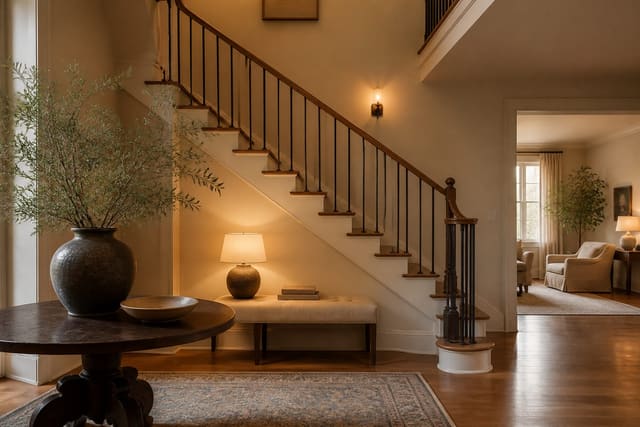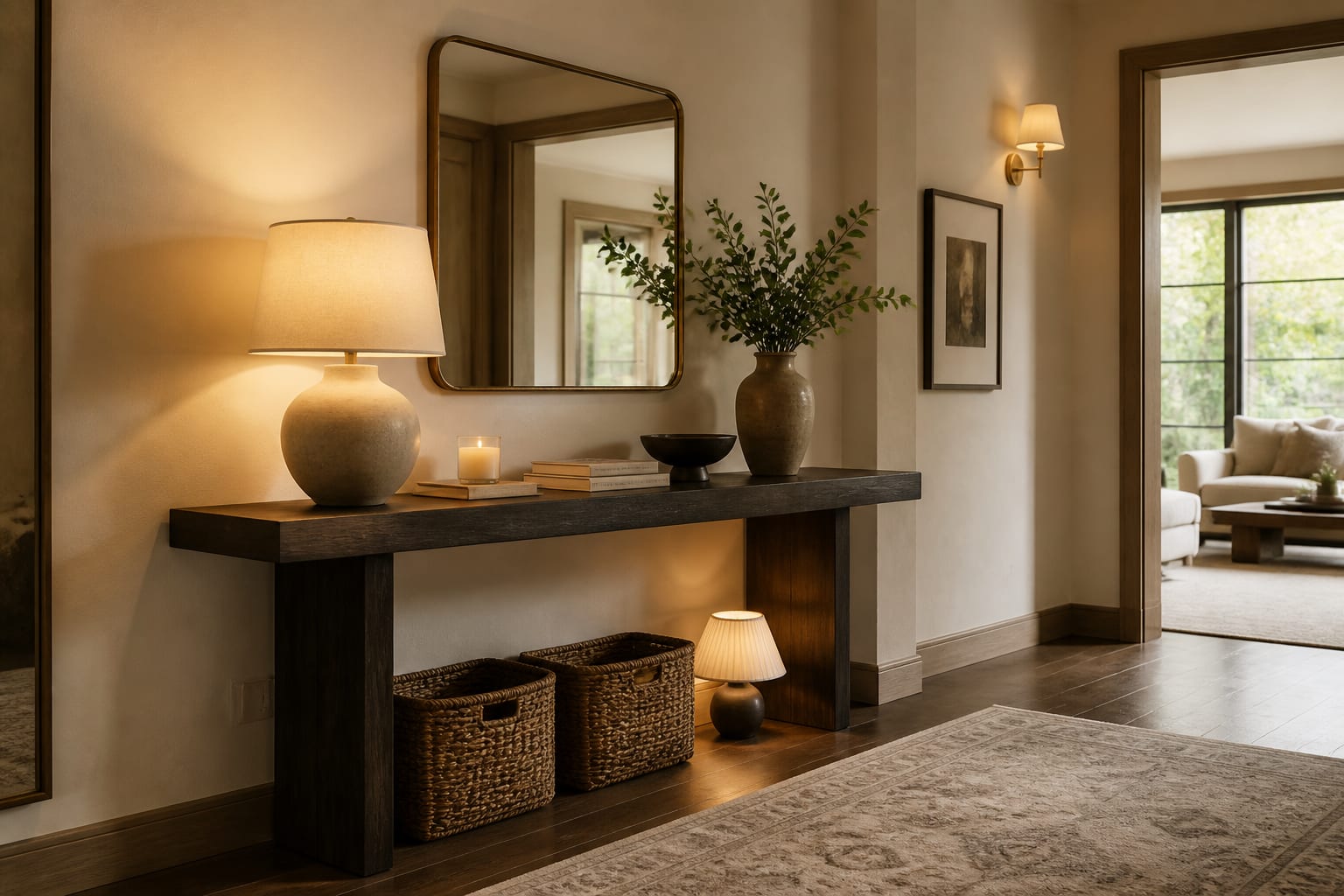
A console table fails when it becomes a dumping ground and succeeds when it works as a composed vignette that also catches keys and mail. The mistake most people make is buying the table first and styling it last, which leaves a surface at the wrong height, too shallow for a lamp, and crowded with objects that compete instead of cooperate. The better move is to plan the table around three jobs at once: a landing zone for daily clutter, a vertical anchor like a mirror, and a styled layer of objects in clear tiers. Do those three together and a narrow hallway gains a focal point.
How tall and deep should a console table be?
Height is the first spec to lock because it controls whether the table feels like part of the entry or a stranded piece of furniture. Aim for 30 to 34 inches, which puts the surface near hip height for most adults and matches the scale of a standard interior door beside it. Go much lower and a lamp on top reads as oversized; go taller and the table starts to feel like a bar. If you are pairing the console with a bench below for pulling on shoes, hold the table at 32 inches so the bench seat at 18 inches still slides under with clearance.
Depth matters even more in a hallway, where every inch you give the table is an inch stolen from the walkway. A depth of 12 to 16 inches is the sweet spot: deep enough to hold a lamp base, a catch-all tray, and a small stack of books, but shallow enough to preserve a 36-inch clear path. In a tight corridor under 40 inches wide, drop to a 10- to 12-inch demilune or a wall-mounted shelf console so nobody clips a hip on the corner. Match the table length to the wall by filling 50 to 75 percent of the available run, which keeps it proportional rather than marooned in the center.
For a connected approach to vertical circulation, see our staircase design ideas when the console sits at the foot of the stairs.
How do you style the surface in layers?
The difference between a styled console and a cluttered one is height variation. Build the surface in three zones so the eye climbs and descends instead of scanning a flat line of stuff. The tall zone is your anchor: a table lamp around 24 to 28 inches, a leaning piece of art, or a sculptural vase tall enough to read from across the room. Place it off-center, roughly one-third in from one end, so the arrangement feels relaxed rather than symmetrical and stiff.
The mid zone fills the visual gap between the tall anchor and the tabletop. A stack of two or three coffee-table books, a 12-inch covered box, or a cluster of framed photos at 8 by 10 inches all work here. The low zone hugs the surface: a flat tray to corral keys, a small bowl, a low candle, or a trailing plant in a 6-inch pot. Group objects in odd numbers, since threes and fives compose more naturally than even pairs, and let some pieces overlap slightly so the grouping reads as one vignette rather than scattered items spaced like a museum case.
A tray is the single most useful styling object on a console. A 9-by-14-inch tray gives daily clutter a defined home, so keys, sunglasses, and mail land inside its border instead of creeping across the whole top. That border is what keeps the table looking intentional on a Tuesday morning, not just in a staged photo.
Mirror, art, and lighting above the table
A console almost always needs something on the wall above it, because a bare wall makes even a well-styled surface look unfinished. A mirror is the classic choice and the practical one in an entry, where a last-look reflection earns its place. Size the mirror or art to span 50 to 75 percent of the table width, and hang it so the bottom edge floats 5 to 8 inches above the tabletop. That tight gap visually fuses the wall piece and the surface into a single composition; leave a foot of empty wall and the two elements drift apart.
Lighting sets the mood and the function. A single table lamp at 24 to 28 inches throws a warm pool of light and reads as the tall anchor in your layered arrangement. If the hallway is dim, choose a bulb around 2700K to 3000K for a soft glow rather than a clinical white. Symmetry lovers can run a pair of matching lamps on a wider 60-inch console, flanking a central mirror, which suits a formal foyer. For a hallway that doubles as a gallery, swap the lamp for a pair of wall sconces hung 60 to 66 inches off the floor and let a piece of art take the center of the wall.
The console at the base of a staircase deserves special attention, since it sets the tone for the whole climb. Our staircase makeover ideas pair well with an entry console that echoes the stair's railing or runner.
Common mistakes to avoid
- Floating a console under 28 inches tall so it sinks below the light switches and reads as a stray coffee table.
- Centering the mirror on the wall instead of on the table, which throws the whole vignette off-axis.
- Crowding the top with loose trinkets rather than grouping them into two or three deliberate clusters.
- Pushing a deep 18-inch console into a 36-inch hallway, where it steals the clearance people need to pass.
The most common console mistakes all trace back to ignoring proportion and function. The first is buying a table that is too short, under 28 inches, so it floats below the light switches and looks like a misplaced coffee table. The second is overcrowding: when every square inch holds an object, the surface reads as storage, not styling. Aim to leave about 40 percent of the top empty so the vignette has room to breathe and you still have somewhere to set the mail.
A third mistake is the flat arrangement, where everything sits at the same 6- to 10-inch height and the eye has nothing to climb. Without a tall anchor, even nice objects look like a lineup. The fourth is the floating mirror hung too high, a foot or more above the table, which severs the visual link between wall and surface. The fifth is forgetting the walkway: a 20-inch-deep console in a 38-inch hall is an anti-pattern that turns a passage into an obstacle course. Measure the clear path before you measure the table, and keep at least 36 inches open for daily traffic. The last is ignoring the cord; run the lamp cord down a back leg and into the nearest outlet, or the whole composed look unravels at the floor.
See it first in Re-Design
Proportion is hard to judge from a product page, which is exactly where Re-Design earns its keep. Upload a photo of your entryway or hallway and re-design the wall with a console at 32 inches, a mirror floating just above it, and a lamp anchoring one end, so you can read the scale against your real door frame and floor before anything ships. You can test a 48-inch console versus a slim demilune, or a single statement lamp versus a symmetrical pair, and watch how each option changes the walkway and the focal weight of the wall. Seeing the layered vignette rendered in your own space tells you whether the table length fills the wall or leaves it looking sparse, long before you commit to a purchase.
Frequently Asked Questions
How long should a console table be relative to the wall?
Fill 50 to 75 percent of the available wall run. A console that spans much less looks marooned, while one that fills nearly the whole wall crowds adjacent doors and switches. On a 6-foot wall, a 36- to 54-inch table reads as deliberate and proportional to the space around it.
What goes on a console table besides a lamp?
Build three height zones: a tall anchor such as a lamp or leaning art, a mid layer of stacked books or a box, and low objects like a tray, bowl, or short plant. A 9-by-14-inch tray corrals keys and mail, and grouping objects in odd numbers keeps the arrangement from looking rigid.
How high should a mirror hang above a console?
Float the bottom edge 5 to 8 inches above the tabletop so the mirror and surface read as one composition. Size the mirror to cover 50 to 75 percent of the table width, and center it on the table rather than the wall if the two are not aligned.
Can a console table work in a narrow hallway?
Yes, if you keep the depth to 10 to 14 inches and preserve a 36-inch clear walkway. A demilune or wall-mounted shelf console works best in corridors under 40 inches wide, giving you a styled surface and a catch-all without forcing people to turn sideways to pass.