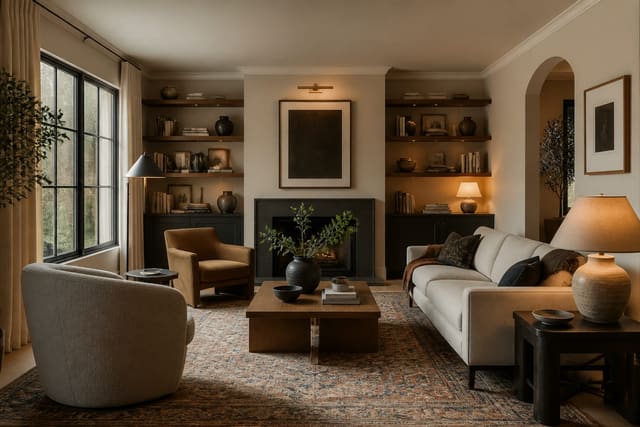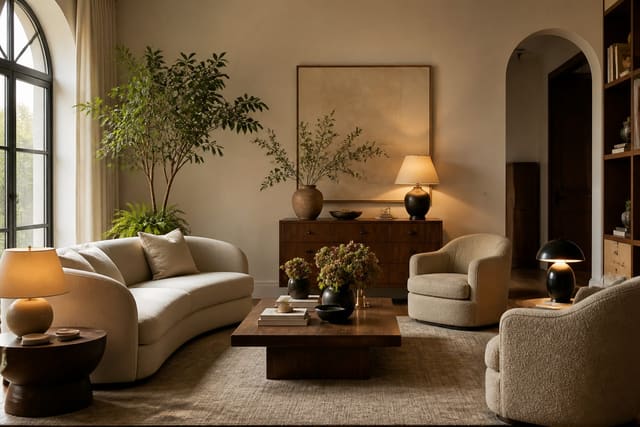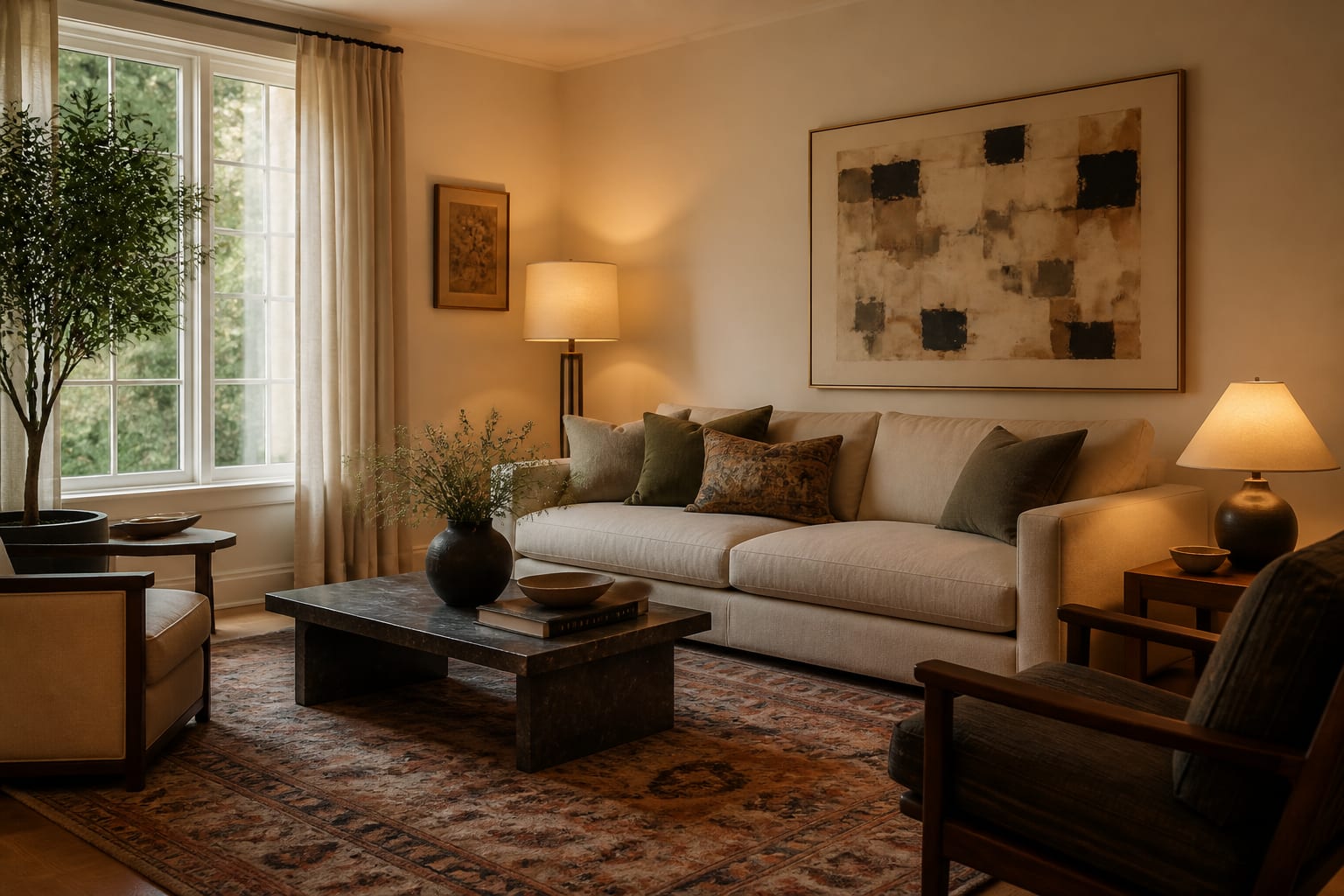
The honest answer to what it costs to redecorate a living room is that the range is enormous on purpose—and the number you land on depends almost entirely on whether you keep your big upholstery. A redecoration that reuses the sofa and sticks to paint, lighting, art, and textiles lands around $1,500 to $4,000. The moment a new sofa and rug enter the plan, you are closer to $5,000 to $12,000. Decide which project you are doing before you price anything, because mixing the two budgets is how living rooms get half-finished.
What drives the cost of redecorating a living room
Square footage matters less than you would think; the furniture you choose to replace matters most. An average living room runs about 14 by 18 feet, or 250 square feet, and the walls and ceiling are a fixed, modest cost. It is the seating that swings the total by thousands.
Break the budget into tiers. A refresh keeps the existing sofa and spends on the envelope: $300 to $700 for paint, $400 to $1,200 for lighting, $500 to $1,500 for a rug and textiles, and $300 to $800 for art and accessories. That is a genuinely different room for $1,500 to $4,000. A redecoration replaces the anchor pieces: a sofa at $1,200 to $4,500, a media console at $300 to $900, an accent chair or two at $400 to $1,200, and a rug at $300 to $1,500. Add the envelope costs on top and the total climbs to $5,000 to $12,000.
For the full piece-by-piece accounting of seating, tables, and storage, the living room furniture cost guide breaks down each category. If your project crosses into moving walls or replacing flooring, that is no longer redecorating—the living room renovation real costs cover the structural side.
Quality tier matters as much as the category. A flat-pack sofa at $600 and a hardwood-frame sofa at $2,400 occupy the same footprint but live on completely different timelines—the budget piece sags within two or three years while the mid-range one holds its shape for a decade. On the anchor pieces you sit on daily, paying once for a better frame usually costs less per year than replacing a cheap one twice. The reverse is true for trend-driven accessories: buy the throw pillows, art, and accent objects at the budget tier, because those are the items you will want to swap when your taste shifts.
Labor is the quiet variable that decides whether a redecoration stays a redecoration. Hanging curtains, mounting a television, assembling flat-pack furniture, and painting are all jobs you can do yourself for the cost of tools, or hand off for $300 to $1,500 total. Doing the assembly and painting yourself is often the single largest savings available, and it is the difference between a $5,400 plan and a $4,200 one without changing a single piece you actually keep.
A line-item budget you can copy
Here is a realistic mid-range redecoration for a 250-square-foot living room, the kind most homeowners actually run:
- Paint, two coats, walls and trim: $500 with a painter, $120 doing it yourself.
- Lighting—one floor lamp, two table lamps, warm 2700K bulbs: $350.
- Sofa, mid-range from a quality brand: $2,200.
- Wool-blend 8x10 area rug: $900.
- Coffee table and media console: $700.
- Curtains, two panel pairs plus hardware: $300.
- Art, mirrors, and accessories: $450.
That totals about $5,400, with the sofa alone accounting for 40 percent. Trim it to a refresh by keeping the sofa and console and you are near $2,500. The layout you choose also affects how much furniture you actually need—an open, well-flowing arrangement following the principles in the feng shui living room guide often means fewer pieces, not more.
Sequence the spend so the room is usable at every stage rather than half-finished for months. Paint first, because it is the messiest job and you want it done before anything soft moves in. Lighting second, since a single warm lamp changes how every later purchase looks under it. The rug third, because it sets the scale every other piece is measured against. Furniture and art come last, chosen against a room that is already painted and lit. Run the order backward—sofa first, paint someday—and the redecoration stalls at the most expensive and least finished point.
A useful gut-check before you commit: list the three things a guest would notice first when they walk in. For most living rooms those are the wall color, the seating, and whether the room feels lit or gloomy. If your budget covers those three convincingly, the room will read as redecorated even if the side tables and accessories stay exactly as they were. Spreading the same money evenly across ten small upgrades almost never produces that effect.
Common mistakes to avoid
The biggest mistake is buying the sofa first and discovering there is no budget left for the rug, lighting, and art that make the sofa look intentional. Price the whole room, then buy in priority order.
A second common mistake is under-measuring the rug. A rug that floats in the middle with furniture legs off it makes a room feel smaller and cheaper; for a 14x18 room you almost always need an 8x10 or 9x12, which costs more than the 5x8 most people reach for. The third mistake is treating lighting as an afterthought—one overhead fixture flattens even an expensive room, while $350 in layered lamps transforms it. The fourth is matching everything from one store collection, which reads like a showroom floor rather than a home.
See the redecoration before you spend in Re-Design
Frequently Asked Questions
How much does it cost to redecorate a living room? A refresh that keeps your sofa and updates paint, lighting, rug, and art runs about $1,500 to $4,000. A full redecoration with new seating runs $5,000 to $12,000 for an average 250-square-foot room. The sofa is the line item that decides which tier you are in.
What is the most expensive part of redecorating a living room? Seating. A quality sofa runs $1,200 to $4,500 and usually accounts for a third to nearly half of a full redecoration budget. If you can reuse your existing sofa, the total drops dramatically.
Should I redecorate or renovate my living room? Redecorate when the layout works and you want a new look—paint, furniture, lighting, and textiles. Renovate when you need to move walls, replace flooring, or change windows. Renovation costs several times more and involves trades and permits.