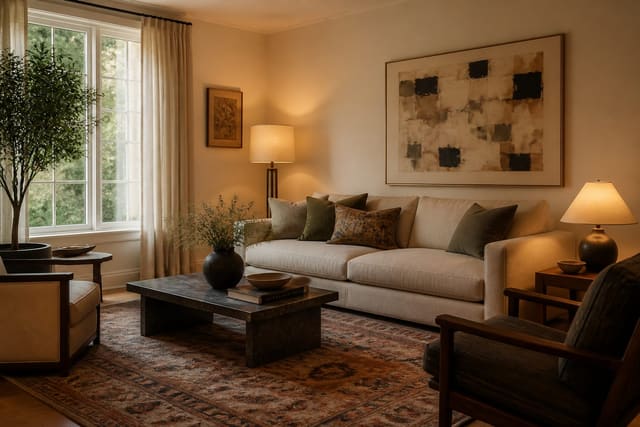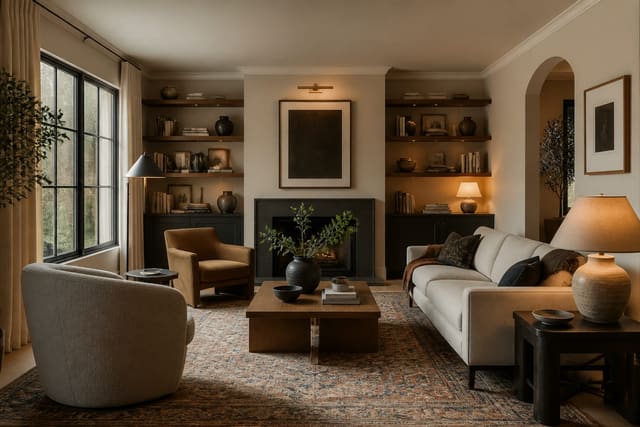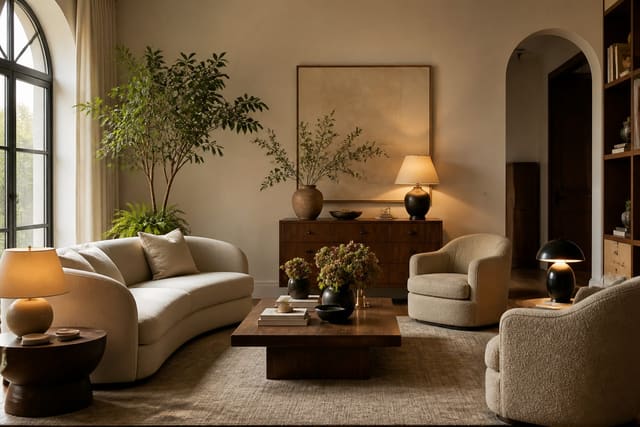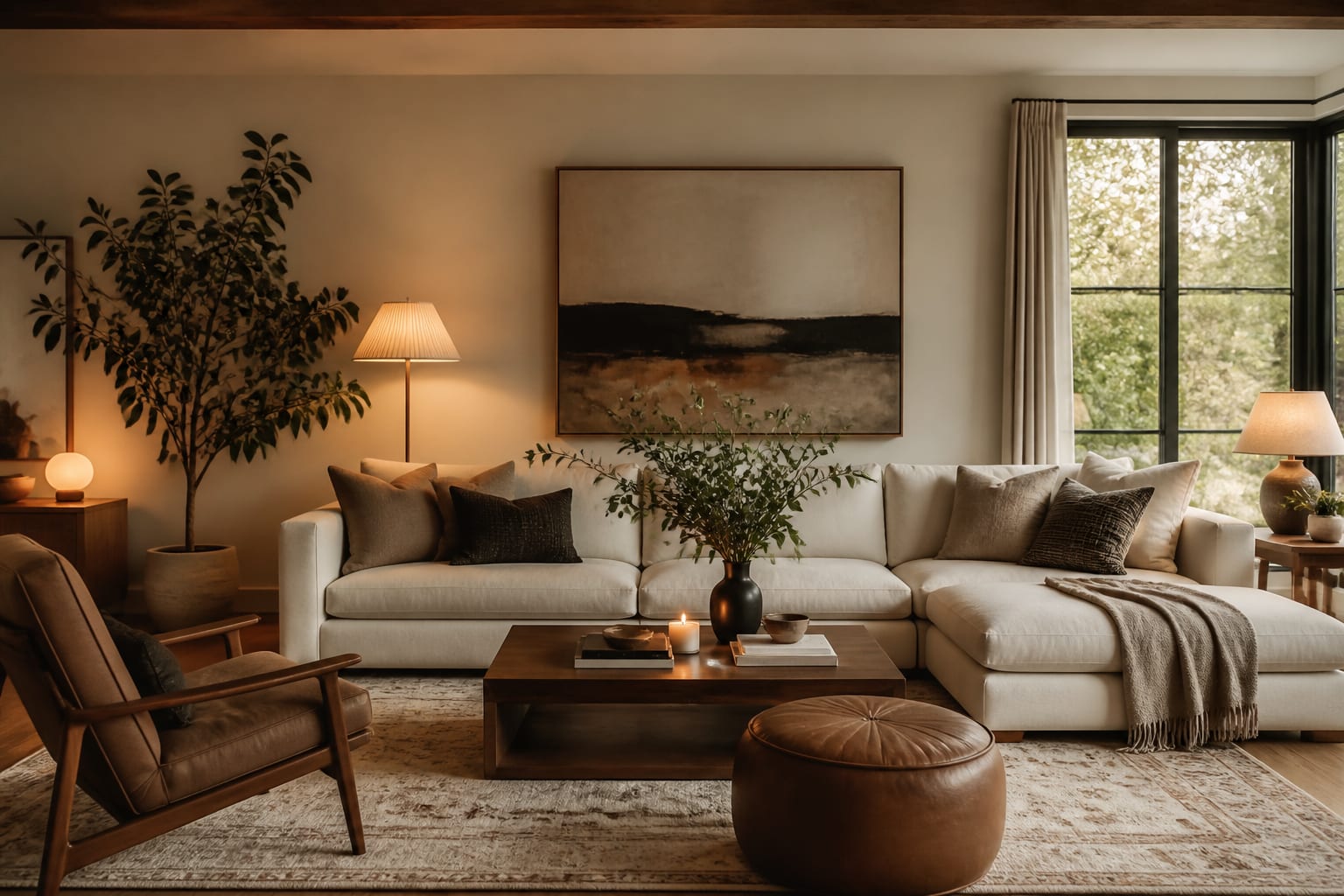
Spend the money on the sofa and the rug, and go cheap almost everywhere else. Those two pieces carry the room visually and physically, and they are the ones you sit on, walk on, and keep for a decade. The coffee table, the lamps, and the accent chairs can be inexpensive without anyone noticing, but a sagging cushion or a thin polyester rug telegraphs a tight budget instantly. Furnishing a living room well is mostly about putting your dollars where your body actually meets the furniture.
Where the money goes in a living room
The sofa dominates the budget and the room, so it deserves the largest share. A flat-pack or entry-level sofa starts around $800 and will look fine for two or three years before the cushions flatten. A mid-range sofa at $1,500 to $2,500 with a kiln-dried hardwood frame and high-resiliency foam holds its shape far longer, and a quality piece with eight-way hand-tied springs runs $3,000 to $4,500 and can last fifteen years or more. This is the one place where paying double genuinely buys you double the lifespan.
The rug is the second anchor. People consistently buy rugs too small, then wonder why the room feels disjointed; the front legs of every seating piece should sit on it. For a typical living room that means an 8-by-10 or 9-by-12, which runs $200 for a machine-made polypropylene rug up to $1,500 or more for a hand-knotted wool one. Wool costs more but resists crushing and cleans up after a decade of foot traffic, while a cheap synthetic mats down within a year or two in front of the sofa. After those two, the spending drops off sharply.
Why concentrate the budget this way? The sofa and rug are the pieces your body touches constantly, so wear and comfort show up fastest there, and they also occupy the most visual real estate in any photo of the room. A worn cushion or a thin rug undercuts everything else you put around it. The remaining pieces are supporting cast: a coffee table holds a few books, a console parks the television, and a lamp throws light. None of those jobs demands premium construction, which is why a $200 secondhand console can do exactly what an $800 new one does without a single guest noticing the difference. The way pieces relate to each other and to the walls also matters, and the principles in this feng shui living room guide help you place the anchors before you buy a single accent.
A realistic living room budget, line by line
Here is what to expect for a complete room, using mid-range numbers you can scale up or down.
- Sofa: $1,500 to $2,500 for a quality mid-range piece you will keep for a decade.
- Area rug (8-by-10): $200 to $1,500 depending on material and construction.
- Coffee table: $150 to $600, an easy place to save with a solid budget find.
- Two side tables: $80 to $250 each, often fine at the lower end.
- Media console: $200 to $800, where particleboard versus solid wood sets the price.
- One or two accent chairs: $300 to $900 each, the second-tier splurge if the budget allows.
- Lighting (two to three lamps): $60 to $300 each, the highest impact per dollar.
Add it up and a sensible, durable living room lands around $4,000 to $7,000. You can dip under $3,000 by buying the sofa on sale and the tables secondhand, or climb past $12,000 with designer upholstery and a hand-knotted rug. The framework holds at any level: the sofa and rug take the lion's share, and the small pieces fill in cheaply. If your budget is fixed, start by deciding the sofa tier first, because it sets the ceiling for everything else; a $2,200 sofa and a $600 rug leave a different amount for tables and lamps than an $800 sofa and a $200 rug do. Build the rest of the list down from that single decision rather than spreading the money evenly and ending up with a mediocre version of every piece. If you want the full picture beyond furniture, this breakdown of the real costs of a living room renovation covers paint, flooring, and the rest of the spend.
Common mistakes to avoid
The most expensive error is buying the cheapest sofa to save now and replacing it in three years. Two $800 sofas over six years cost more than one $2,200 sofa that outlasts them both, and you live with worse comfort the whole time. If the budget is tight, buy one good piece and wait on the rest.
The second mistake is undersizing the rug. A 5-by-7 floating in the middle of a 14-foot room makes the furniture look like it is huddling, and no amount of styling fixes it. Measure the seating zone and buy a rug large enough that the chair and sofa legs land on it; in most rooms that means going up at least one size from the rug you first reach for. A rug that feels almost too big in the store is usually right at home, since showrooms are cavernous and dwarf everything in them. The third trap is overspending on trend pieces, the bouclé accent chair or the fluted console that will read as dated in five years, while skimping on the everyday workhorses. If you are unsure how a piece will look in your space before you commit, this rundown of redecorating a living room and its costs helps you plan the order of purchases so you are not stuck with a mismatched half-finished room.
Preview your living room furniture in Re-Design
Frequently Asked Questions
How much should I budget for living room furniture?
A complete, durable living room typically runs $3,000 to $12,000, with most people landing around $4,000 to $7,000. The sofa is the biggest line at $1,500 to $2,500 for a quality mid-range piece, followed by the rug. The small tables and lamps fill in for a few hundred dollars total.
Is it worth spending more on a sofa?
Yes, it is the one piece where price tracks lifespan closely. An $800 sofa flattens in a few years, while a $2,500 piece with a hardwood frame and high-resiliency foam holds up for a decade. Buying twice cheap usually costs more than buying once well.
Where can I save without it showing?
The coffee table, side tables, and media console are the safe places to economize, since secondhand or budget versions look nearly identical in use. Lighting also delivers a lot for $60 to $300 a lamp. Keep your spending concentrated on the sofa and a properly sized rug.