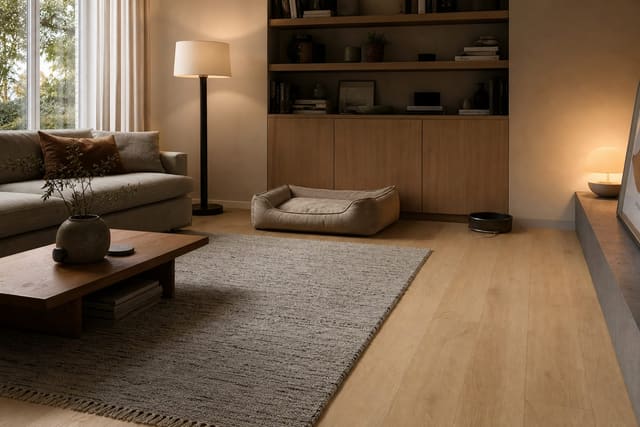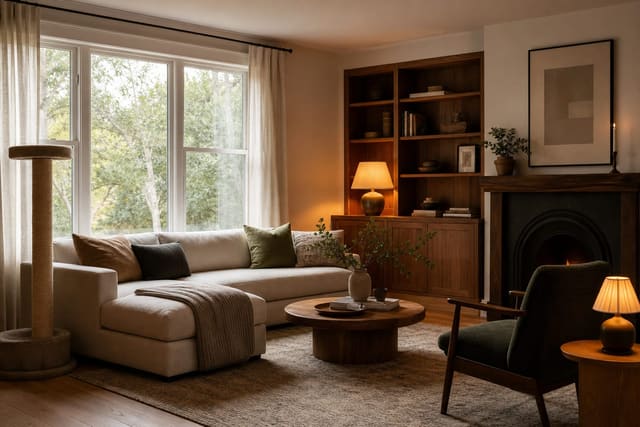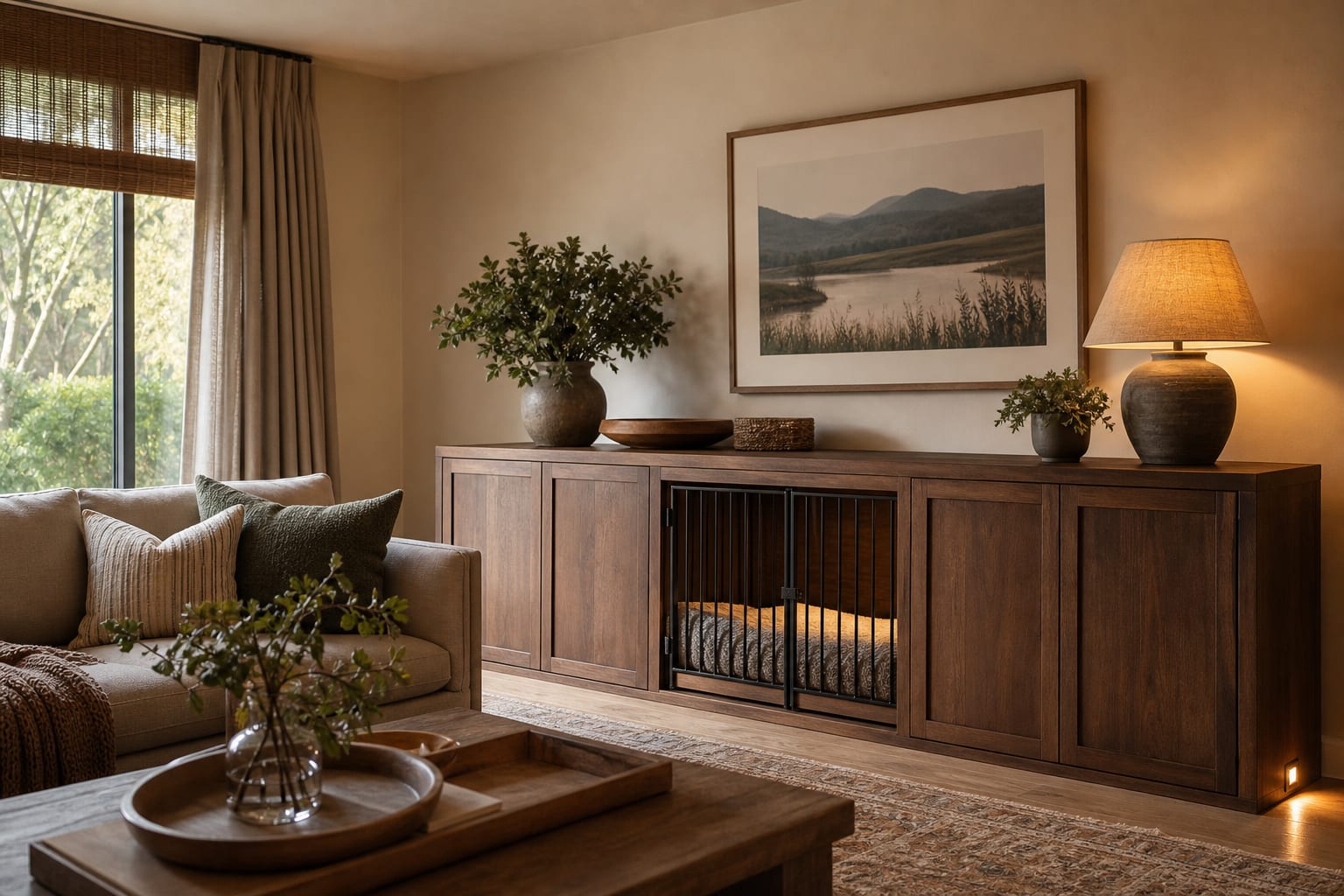
Dog crates become furniture when they're housed inside a credenza, end table, or bench with a solid top, ventilated sides, and a finish that matches the room's palette. A crate in the living room isn't automatically ugly — careless placement is. Match its finish to a nearby piece, give it real clearance, and style the top like a console instead of draping it in a blanket.
How do you make a dog crate look like furniture?
Borrow a finish already in the room — oak, black metal, cane, walnut, painted white, or brass. A black metal crate beside a pale oak coffee table looks deliberate; the same crate under a gray fleece cover looks like you gave up.
Ventilation is not optional. Leave slatted panels, wire mesh, or perforated doors open so air moves, and never enclose all sides in solid cabinetry. Most dogs need interior space roughly 2 to 4 inches taller than shoulder height and 4 to 6 inches longer than nose-to-tail-base.
The top surface decides whether the disguise works. Beside a sofa, style it like an end table: one lamp, one tray, maybe a closed box for leashes. Behind a sofa or along a wall, treat it like a console — art above, lamp at one end, 30 to 36 inches of clear walking space in front.
Which crate-furniture format fits your living room?
| Format | Best for | Key spec or tip |
|---|---|---|
| Side table | Small/medium dogs beside a sofa or chair | Finished height within 2-4 inches of the sofa arm |
| Console | Long blank wall or media-adjacent zone | Top depth 14-20 inches; two openings can look like one sideboard |
| Built-in | Permanent placement, owned home | Plan the door swing — a 24-inch door into a narrow path is a nuisance |
| Soft cover | Renters, temporary setups | Canvas or washable cotton, fitted close, two sides ventilated, stops above the floor |
If the sofa fabric is already fighting fur and claws, apply the same logic from the pet-friendly sofa fabric guide: tight weaves, wipeable finishes, forgiving colors.
If toys, throws, and treat bags cluster around the crate, solve that storage separately — the crate looks worse when every dog object sits visible beside it. See living room storage without chaos for the fix.
Test this on your own room photo with ReDesign before buying; keep the doorway, windows, main furniture, and awkward fixed features in frame so the preview solves the room you actually have.
How should you size and style the crate so the dog still likes it?
Don't shrink the crate to make the furniture prettier — a dog that can't stand and turn will avoid it, scratch at it, and the whole plan will feel cruel. Place it where the dog can see household activity without sitting in the busiest lane: a corner of the seating area or the end of a sofa wall, away from vents, radiators, and bright afternoon windows.
Leave the door path clear. A folding door needs room to avoid the sofa leg; a swinging door needs at least 30 inches of open floor.
Style the top with restraint: one lamp with a clipped cord, one lidded box, one tray, one vertical piece like art or a mirror. Skip stacking plants, books, and loose toys on a surface that vibrates every time the dog moves.
Add a washable flatweave or indoor-outdoor rug in front for traction, leaving 6 to 12 inches of rug visible beyond the crate width — a tiny mat makes it read as a pet station, a larger rug folds it into the seating group. Near a bay window, keep the crate at one end of the composition rather than blocking the light; the circulation logic in bay window furniture arrangement applies directly.
Common dog crate furniture mistakes
- Too small a cabinet. Measure the dog first; a cramped box gets rejected regardless of finish.
- Sealed on all sides. Solid panels trap heat and odor — use wire, slats, cane, or mesh, and wash bedding regularly.
- No shared finish. A white crate among walnut and black shouts; repeat one finish nearby (hardware, wood tone, or weave) so it belongs.
- Over-styled top. One lamp and one tray read as furniture; seven accessories read as a cover story.
- Ignored sound. Rubber feet, felt pads, and a fitted mat stop wire rattle and tag clatter on hard floors.
Use AI design to preview the crate before you buy
Scale is the hard part — a crate that looks subtle online can dominate a real wall. Upload a photo of the actual crate zone and test side-table, console, built-in, and covered versions before ordering heavy cabinetry.
Photograph the room from the entrance guests use most, including the sofa, rug, windows, floor, and crate location. Try one crate matched to the coffee table's wood tone, one black-framed crate tied to existing lighting, one under a console behind the sofa, and one built into a low storage wall — keeping the sofa and rug consistent across versions.
Use the best preview to build a checklist: interior dimensions, door swing, ventilation, cord routes, washable bedding, and top height. If the version you love only works with custom millwork you can't afford, translate it into a simpler move — a better cover, a matching top panel, or closed storage beside the crate.
The best hidden crate isn't invisible — it's useful, correctly scaled, and calm enough that nobody stares at it.
Frequently Asked Questions
Are crate-furniture pieces actually functional for dogs?
Yes. Well-designed crate furniture matches a wire crate's interior dimensions, includes ventilated panels, and offers a removable bottom for cleaning, so the dog reads it as a den rather than a cage.
Should I buy crate furniture or DIY?
Off-the-shelf pieces (Crown Pet Products, Carlson, New Age) run $150-400 and ship ready to use. DIY adds custom sizing and finish at higher labor cost, worth it only when no stock unit fits the dog's size or the room.
Where should the crate furniture sit in the room?
Beside the primary seating wall, against a wall rather than floating in the middle of the floor, and out of direct sun. Positioning it like an end table is what makes it read as furniture instead of pet gear.
What size dog can fit in crate furniture?
Furniture-style crates typically fit small dogs (under 30 lb), medium dogs (30-50 lb), and large dogs (50-70 lb). Giant breeds usually need a custom build or a reinforced stand-alone crate.
Does AI preview crate furniture in my room?
Yes. Upload a room photo and preview end-table-style and credenza-style crates against your existing sofa and TV wall before you purchase anything.
> Try this: Ready to see this on your own room? Open ReDesign and run the preview.
Three transformations to try
1. End-table crate beside sofa 2. Credenza crate under TV wall 3. Bench crate at window with cushion