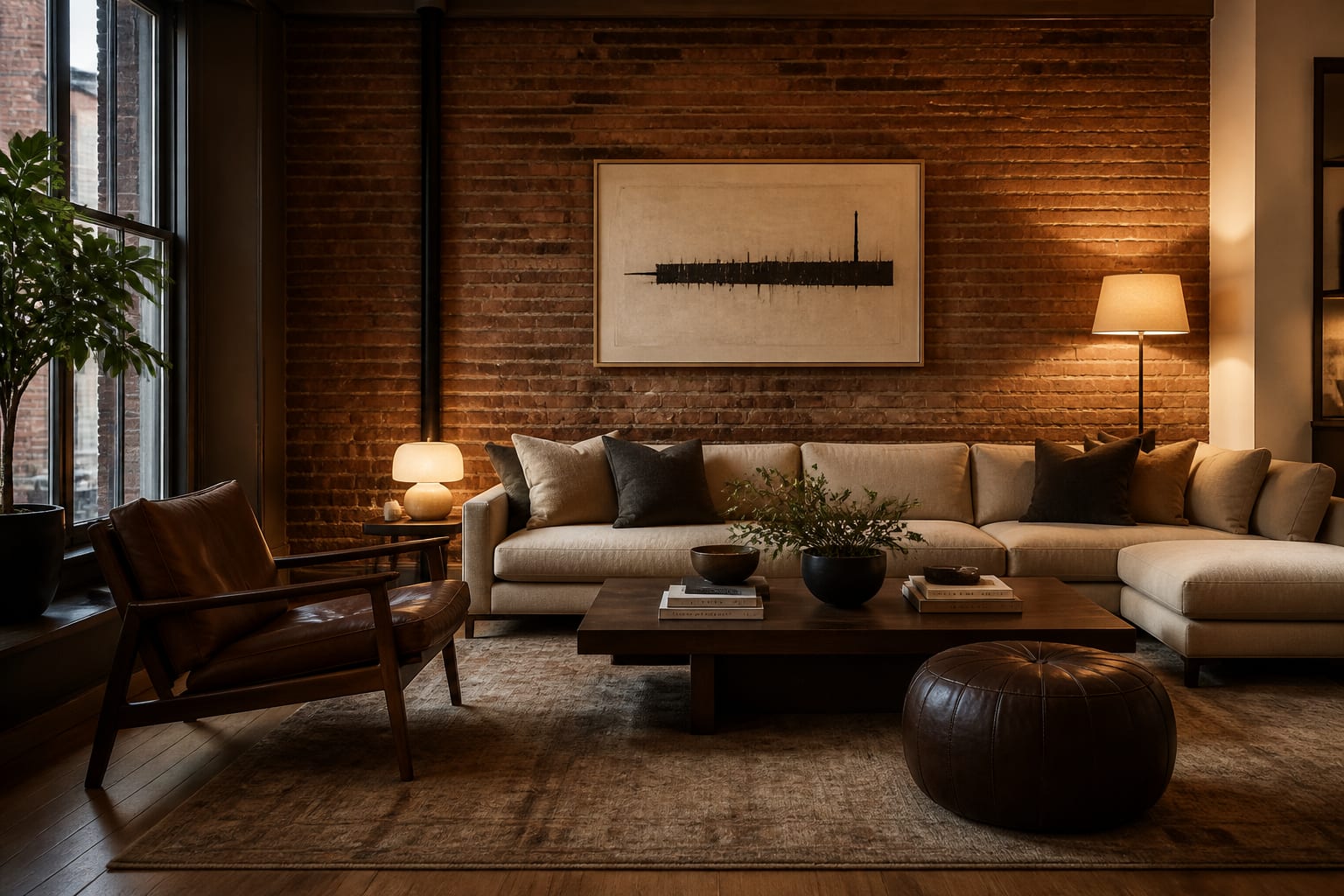
Style an exposed brick wall by sealing it with a matte penetrating sealer, grazing it with warm 2700K light 6 to 12 inches off the face, and pulling furniture a few inches away so the texture reads as a deliberate feature. Limewash or German schmear can soften red brick without hiding its texture, while masonry-appropriate anchors let you hang art safely in the mortar joints.
How do you seal and finish interior exposed brick?
Raw brick sheds fine red dust and absorbs spills, so sealing comes before any other styling decision. A matte penetrating sealer soaks into the masonry and locks the surface without the glossy film a topical sealer leaves behind. Apply two thin coats with a brush or low-pressure sprayer, let each dry 4 to 6 hours, and test a 12 by 12 inch patch first since most sealers darken red brick by a shade or two.
If the wall is cosmetically rough, repoint any crumbling mortar before sealing to stabilize it and sharpen the joint lines. For a wall that looks too busy or too orange, a whitewash thinned to roughly 1:1 paint-to-water lets the texture show through a soft veil of color. The goal is a surface that stays put when brushed and a tone you can live with under daily light.
For a related take on raw material as a finish, see Concrete Interior Design Ideas.
How should you light an exposed brick wall?
Grazing light is what makes brick texture come alive. Mount adjustable spotlights or a linear LED strip 6 to 12 inches out from the wall, aimed at a shallow angle so the beam skims across the face. That raking light catches every bump and mortar recess, casting shadows that read as depth; light hitting the wall straight on flattens it into a featureless plane.
Keep the color temperature warm, 2700K to 3000K, since cool white light makes red brick look dull and gray. For a single accent wall, two or three picture lights or track heads spaced 30 to 36 inches apart wash the surface evenly. Put brick lighting on its own dimmer for a low evening glow, when shadowed texture looks most dramatic; a floor-standing uplight works as a drill-free renter alternative.
What paint and texture finishes work on brick?
Limewash is the most forgiving option: a breathable mineral wash applied heavily for near-full coverage or wiped back wet for a mottled, weathered patina. It dries chalky matte, suits farmhouse and soft-industrial rooms, and bonds chemically to masonry so it ages gracefully instead of peeling.
German schmear drags a thin mortar layer across the brick so some bricks show through and others vanish under a rough white skim, ideal for a fireplace surround or kitchen accent wall. For a clean modern look, a flat or matte paint at 2 to 5 percent sheen covers fully while keeping joint relief visible; skip glossier finishes, which highlight imperfections. For an unfussy industrial palette, leaving brick bare alongside other honest materials often reads best, as in Plywood Interior Design Ideas. Always prime with a masonry-specific primer so the topcoat bonds and mortar alkalinity doesn't bleed through.
How do you decorate and furnish around brick?
Brick is a busy texture, so furnishings should give it room to breathe rather than compete. Pull sofas, consoles, and beds 2 to 4 inches off the face so a shadow line separates furniture from wall. Against red or warm brick, lean on contrast: black metal, walnut or oak wood tones, and cream or oatmeal upholstery let the brick stay the loudest element.
Drill into the mortar joint rather than the brick face whenever possible, since mortar is softer, easier to patch, and less likely to crack. Use a hammer drill with a masonry bit and anchors rated for the weight, and hang pictures at the standard 57 to 60 inch center height. A few concrete moves pull the look together:
- Float a single oversized abstract canvas and graze it with a warm picture light above.
- Mount black metal-and-wood open shelving 18 inches off the brick for books and ceramics.
- Lean a tall framed mirror against the wall to bounce window light across the texture.
- Run a leather or oxblood sofa parallel to the wall, pulled 3 inches off the face.
- Limewash a busy red wall to soft chalky white behind a colorful gallery wall.
- Drape warm Edison-style pendants at 2700K in front of the brick to graze it from above.
- Style a narrow console with table lamps so light rakes up the lower third of the wall.
See it first in Re-Design
Sealing, limewashing, or German-schmearing a brick wall is hard to undo, so testing the look first saves you from an expensive regret. Upload a photo of your brick wall to Re-Design and preview it sealed and bare, limewashed to a chalky white, or covered in flat matte paint, all against your actual furniture and window light. You can also try different lighting angles and furniture placements before you rent a hammer drill or buy a gallon of mineral wash.
Frequently Asked Questions
Do I need to seal interior exposed brick?
Yes, in most cases. Raw brick sheds fine dust and absorbs spills, so a matte penetrating sealer locks the surface without adding gloss. Apply two thin coats and test a small patch first, since sealer typically darkens red brick by a shade or two as it soaks in.
How do you light a brick wall to show off the texture?
Use grazing light: mount spotlights or an LED strip 6 to 12 inches off the wall so the beam skims across the face at a shallow angle. This casts small shadows in the mortar joints that read as depth. Keep the color temperature warm at 2700K to 3000K so red brick doesn't look gray.
Can I paint exposed brick, and what finish is best?
Yes. Limewash gives a breathable, chalky patina that ages well, while flat or matte paint at 2 to 5 percent sheen gives full, modern coverage with joint relief still visible. German schmear drags mortar across the face for an old-world look. Always use a masonry primer first so the finish bonds properly.
How do you hang art on a brick wall without cracking it?
Drill into the mortar joint rather than the brick face, using a hammer drill with a masonry bit and anchors rated for the weight. Mortar is softer, easier to patch later, and far less likely to crack than the brick itself. Hang pictures at the standard 57 to 60 inch center height.