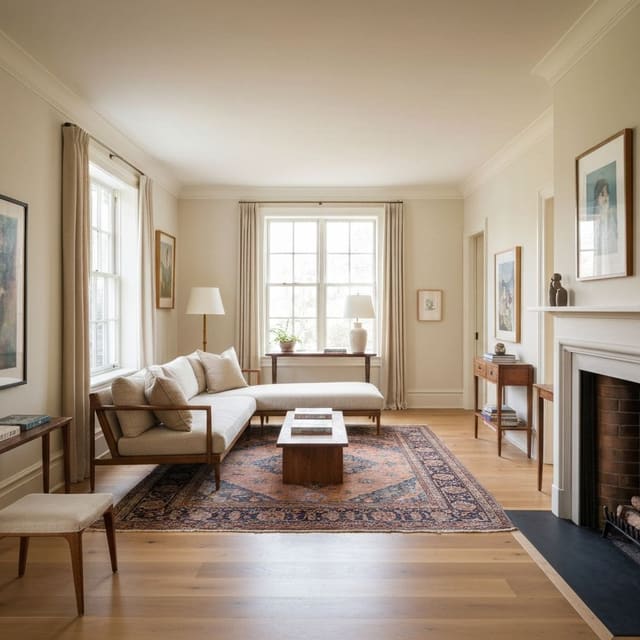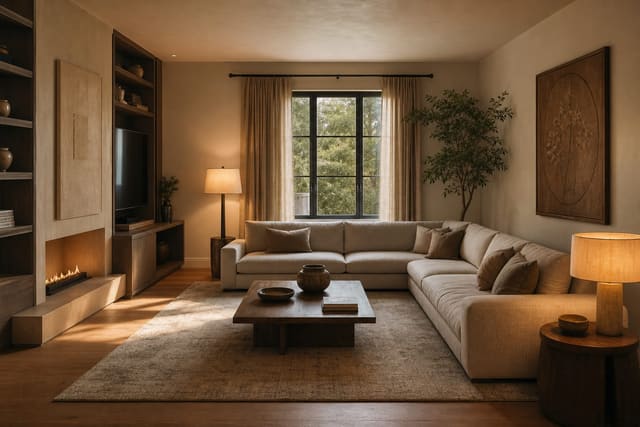
A fireplace wall organizes the living room when the sofa faces the fireplace at 6 to 8ft (close enough to feel the warmth, far enough to clear safety), the TV mounts above the mantel or in a flanking built-in (not opposing the fireplace), and the rug is sized to extend at least 12in past every seating piece — fragmenting the seating across two focal points wastes both. A fireplace is the strongest visual anchor in any room, and the single most common reason living rooms get arranged badly. Most owners default to a single sofa pointed at the fireplace, two chairs angled in, and a coffee table marooned in the middle — a layout that reads like a hotel lobby and ignores both the way the room is actually used and the way humans naturally talk to each other. The good news: fireplace layouts have a small set of repeatable rules. Get those rules right and the same room becomes warmer, more useful, and visually stronger.
How do you arrange furniture in a living room with a fireplace?
Anchor the longest piece of seating perpendicular to the fireplace, not facing it. Place a second seating piece across from the first. Treat the fireplace as one of two focal points (TV or art being the other), not the sole one. Use a rug large enough to ground every piece of furniture. This layout is conversational by default, leaves the fireplace as a visual anchor, and works for any room that's not a pure home theater.
The four fireplace layouts that actually work
1. The conversation layout (most common)
- Sofa perpendicular to the fireplace wall, with one end pointing toward the hearth.
- Two chairs facing the sofa across a coffee table.
- A rug at least 8'x10' that anchors all three pieces (every front leg on the rug).
- The fireplace sits at the head of the seating group, visible from every seat, but not directly faced.
Why it works: humans look at each other while talking, not at the fire. The fireplace adds warmth and visual interest without forcing the room into rigid symmetry. This is the gold standard for any 12'x16' or larger living room.
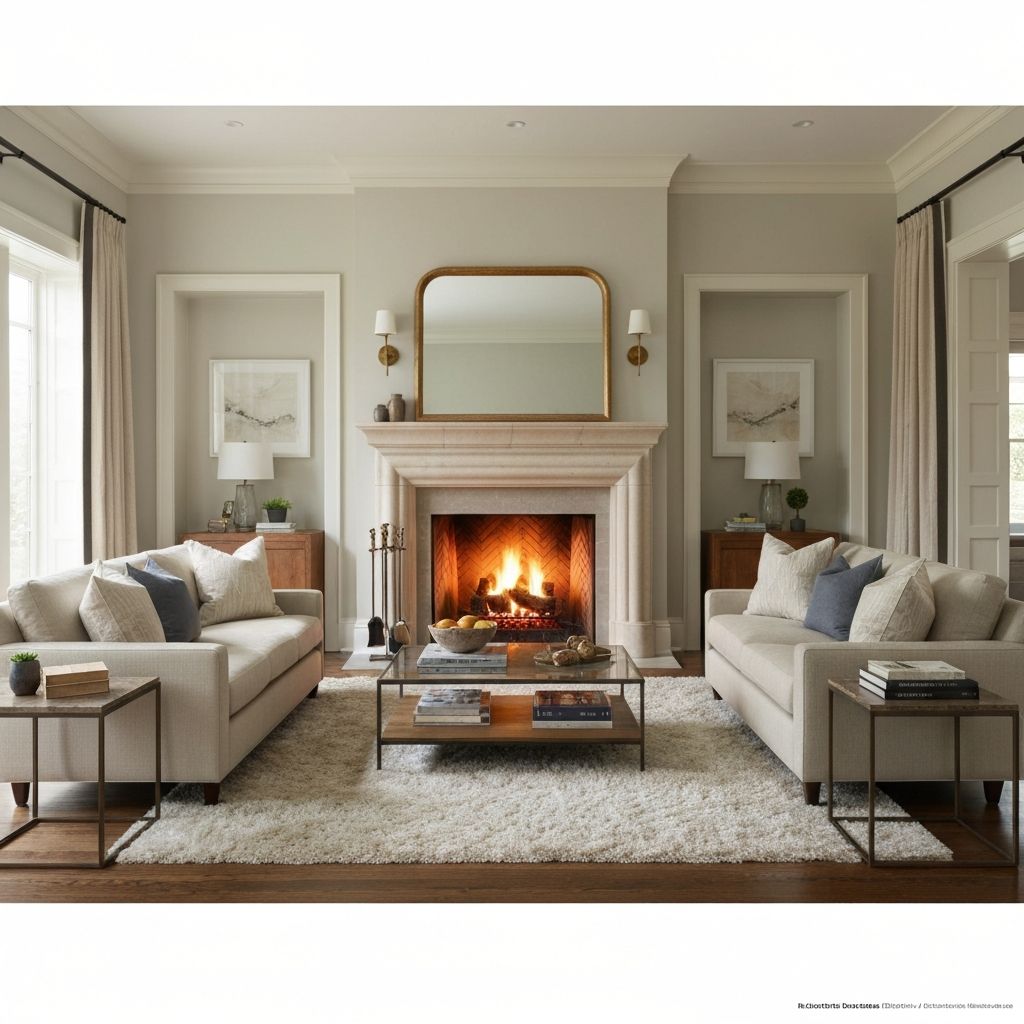
2. The flanking layout (for symmetrical rooms)
- Two matching sofas facing each other, perpendicular to the fireplace.
- A coffee table between them.
- A pair of small accent chairs at the open end opposite the fireplace.
- A rug large enough for all front legs.
Why it works: maximizes seating in narrow or formal rooms. Reads as architectural and traditional. The fireplace becomes a literal focal point at the head of the room.
3. The L-shape with sectional
- A sectional sofa with the long side perpendicular to the fireplace and the short side along the back wall.
- One accent chair across from the sectional, optionally angled toward the fireplace.
- A large rug under the entire sectional and the coffee table.
Why it works: handles families and casual entertaining better than separate sofas. The sectional naturally directs attention to the fireplace from one end and a TV or media wall from the other.
4. The split-focus layout (TV and fireplace on perpendicular walls)
- Sofa positioned to see both the fireplace (perpendicular) and the TV (across).
- One chair angled to bridge both focal points.
- A swivel chair is the secret weapon here — lets the sitter turn toward whichever focal point matters at the moment.
Why it works: solves the TV-versus-fireplace problem without forcing one above the other. Avoids the dreaded "TV mounted over fireplace" mistake (which produces both bad ergonomics and heat damage to the TV).
The TV-over-fireplace question
The short answer: don't, if you can avoid it.
- Why people do it. Single wall, limited options, builder default.
- Why it doesn't work. The TV is too high for comfortable viewing (neck strain after 30 minutes). The heat damages most TVs over time. Both objects fight for the same focal-point status, and the room reads as a media room rather than a living room.
- Better options. Mount the TV on a perpendicular wall, build it into a media cabinet flanking the fireplace, or recess it into the wall above with a deep TV niche and gas-fireplace-only setup (no chimney heat).
- If you absolutely must. Use a tilting mount, keep the TV at least 12" above the mantel, and never run a wood-burning fireplace below it.
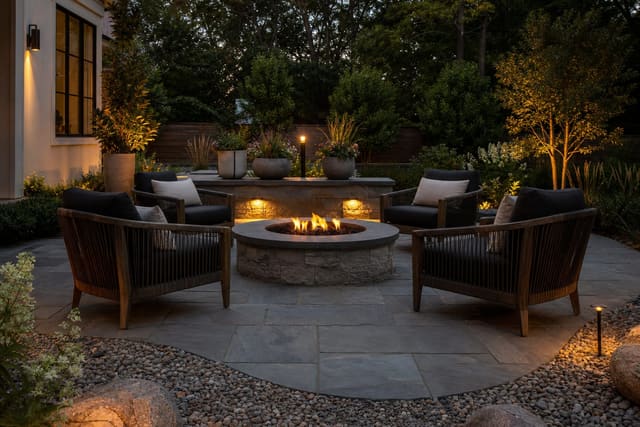
For a useful room-planning comparison, keep How to Fix an Awkward Living Room Layout (With AI), Corner Sofa Square Room: Does a Wraparound Sofa Work?, and Fire Pit Ideas: The Outdoor Feature That Extends Your Season nearby so this retrofit stays connected to the adjacent lighting, storage, scale, and layout decisions in the same photo-led workflow.
Test this on your own room photo with ReDesign before you choose the final direction; keep the doorway, walls, windows, main furniture, lighting, and awkward fixed features visible so the preview solves the room you actually have.
Sizing the rug correctly
A too-small rug is the single most common living-room mistake.
- All front legs on the rug, minimum. A 6'x9' rug under a typical sofa-and-chairs setup is almost always too small. Go 8'x10' as your baseline, 9'x12' for larger rooms.
- The rug should extend at least 6" past every seating piece on the sides.
- Pull the rug 12"–18" away from the fireplace hearth to leave a clean buffer. Never run the rug up against the hearth itself.
Mantel styling that doesn't fight the layout
- Anchor with one large piece of art or a mirror. Goes above the mantel, sized to roughly two-thirds the mantel width.
- One asymmetrical horizontal element. A pair of candlesticks of different heights, a small stack of books with a vessel on top, or a single sculptural object placed off-center. Symmetry on mantels reads dated; asymmetry reads designed.
- Negative space. A clean mantel with three objects beats a cluttered mantel with twelve.
- Skip the family-photo gallery. Save those for a hallway or stairwell wall.
Common fireplace-room mistakes
- Sofa pushed flat against the wall facing the fireplace. Creates a stiff, formal layout nobody actually uses.
- Coffee table marooned in the middle of the room. Should be 14"–18" from the front of the sofa, not 36".
- TV mounted directly above the fireplace. Ergonomic and thermal disaster.
- Too-small rug. Six legs on the floor instead of on the rug.
- A pair of matching chairs facing the fireplace and no third seat. Reads as a museum diorama, not a living room.
- Mantel crammed with twelve small objects. Reads as clutter. Three large objects beats twelve small ones.
Use AI design to preview your fireplace layout
Furniture is heavy, expensive, and a pain to return. AI design lets you photograph your existing room and preview three or four layouts — conversation, flanking, L-shape, split-focus — before moving anything. Walk into the project knowing which layout actually works in your specific room before lifting a single sofa.
Frequently Asked Questions
Should the sofa face the fireplace or the TV?
Face the fireplace and put the TV above the mantel or in a built-in adjacent to the fireplace; sectionals or L-shaped seating let one wing face fire and the other face TV without picking sides. Use the room photo to compare the visible layout and fixed constraints before committing, because door swings, windows, outlets, storage reach, circulation, and existing furniture decide whether the idea survives daily use.
How close should the sofa be to the fireplace?
6 to 8ft for warmth and conversational scale; closer than 5ft is too hot for active fires, farther than 10ft turns the fire into wallpaper. Keep the preview honest by leaving the problem area visible in the frame, then compare one conservative version against one bolder version before you buy lighting, paint, furniture, or storage.
Can a TV go above the fireplace?
Yes when the mantel is 56in or higher off the floor and the TV center lands at 65 to 70in for normal seated viewing; lower mantels force the TV too high for comfortable sightlines. Check the result against ordinary movement first: drawer clearance, chair pullout, walkway width, glare, switch access, and sightlines matter more than a perfect catalog angle.
What chairs work flanking a fireplace?
Two swivel club chairs at 30 to 36in wide flank the fireplace and turn between fire and conversation; deep accent chairs lock into one direction and fight the dual focal point. Use the image to narrow priorities and measurements before ordering anything custom; final purchases still need real dimensions, outlet locations, installation limits, and product clearances.
How big a rug fits in front of a fireplace?
8x10 minimum for a standard sofa-plus-chair group, 9x12 for a sectional; the rug should sit 6 to 12in off the hearth and extend under the front legs of every seating piece. If the preview invents architecture or hides the awkward feature you need solved, rerun it with stricter instructions so the result remains tied to your actual room.
> Try this: Ready to see this on your own room? Open ReDesign and run the preview.
Three transformations to try
1. Sofa facing fireplace with TV above the mantel 2. Flanking club chairs with sofa perpendicular 3. Sectional with one wing to fire and one to TV