Refinish when boards still have at least 3/32 in. of sandable wood, no widespread water damage, and a species worth keeping. Replace when boards are below the sand limit, cupped, or damaged across more than 15% of the floor. A 600 sq ft room runs $1,800 to $4,800 to refinish versus $4,800 to $15,000 to replace — the real question is how much wood you have left to work with.
Should you refinish or replace old hardwood floors?
Pull a floor vent or transition piece and check the board edge: you need at least 3/32 in. of wood above the tongue or above any nail. Less than that, a full sand will hit fasteners or break through. If the floor has already been refinished twice, a screen-and-recoat — a light abrasion plus fresh top coat that adds 5 to 8 years without removing material — is safer and runs $1.50 to $3 per sq ft.
Refinishing wins when boards have sand life left, the species is white oak, red oak, maple, or walnut, and damage is cosmetic. Pet stains that soaked into the wood need board replacement before sanding, but a single 4 ft swap plus a full refinish still beats a tear-out by half. For a broader cost comparison against other renovation moves, see the what does AI interior design cost breakdown.
Replacement wins when boards are cupped above 1/16 in., subfloor moisture reads over 12%, more than 15% of the floor has water damage, or the species is low-value (gum, soft pine, anything thinner than 3/4 in. solid). It also wins on resale when the existing floor is a hated species — orange-toned 1990s red oak in a modern flip, for example.
Refinish vs replace: cost, timeline, and disruption compared
Numbers are 2025 mid-market US averages, labor and materials included, not upgrades like custom stain matching or rift-cut species.
| Decision factor | Refinish | Replace |
|---|---|---|
| Cost per sq ft | $3 to $8 | $8 to $25 |
| Timeline (600 sq ft) | 3 to 5 days plus 24 to 72 hr cure | 5 to 10 days |
| Dust and disruption | High during sanding; livable after day 2 | Demo dust day 1; livable after day 4 |
| Lifespan added | 8 to 12 years per refinish | 25 to 80 years for new floor |
| Resale recovery | 70% to 100% | 70% to 80% |
| Board waste | Minimal | Full tear-out |
| Best for | Cosmetic wear, faded stain, scratches | Cupping, water damage, dated species |
Three things shift a refinish bid more than homeowners expect:
- Stair treads: $40 to $90 per tread in hand-sand labor; a 14-tread staircase adds roughly $700.
- Closet and pantry corners: edgers can't reach 90-degree insets, so budget $100 to $200 per tight room for hand-scraping.
- Finish coats: a standard 2-coat polyurethane lasts 7 to 10 years; a 3-coat commercial waterborne adds $1.50 per sq ft and lasts 12 to 18 years.
The coffered ceiling diy cost breakdown shows the same labor-share pattern: sanding labor is two-thirds of a refinish bid, while replacement splits roughly evenly between materials and demo.
Preview a refinished vs replaced floor in your own room photo before signing a contract — comparing a natural matte refinish against a herringbone replacement on your actual walls is the cheapest second opinion available.
What mistakes cost the most in a hardwood refinish?
The biggest mistake is sanding a floor with no wood left to give. A drum sander burns through 3/64 in. in two passes; on a floor already refinished twice, that exposes nails and ends its life early. Always measure board thickness at the vent first.
The second is choosing the wrong sheen. High-gloss finish shows every scratch within 6 months; matte or satin hides wear for the full cycle, and the matte premium ($0.30 to $0.50 per sq ft) is worth it.
The third is rushing cure time. Oil-based polyurethane needs 24 hours between coats and 72 before furniture; waterborne needs 4 hours between coats and 48 before furniture. Walking on it early leaves a permanent imprint and voids the warranty.
The fourth is replacing over an unsolved moisture problem. Cupping over a slab usually signals subfloor moisture; test with a pin meter, and if it reads over 12%, fix the source before installing new wood. The temporary wallpaper brand review covers the same principle — never install a finished surface over an unsolved substrate.
The last is forgetting transitions. New hardwood meeting tile, vinyl, or carpet needs a transition strip, often left off the bid, at $20 to $60 each; a typical 1,500 sq ft home needs 6 to 10.
How can you preview refinished vs replaced floors before committing?
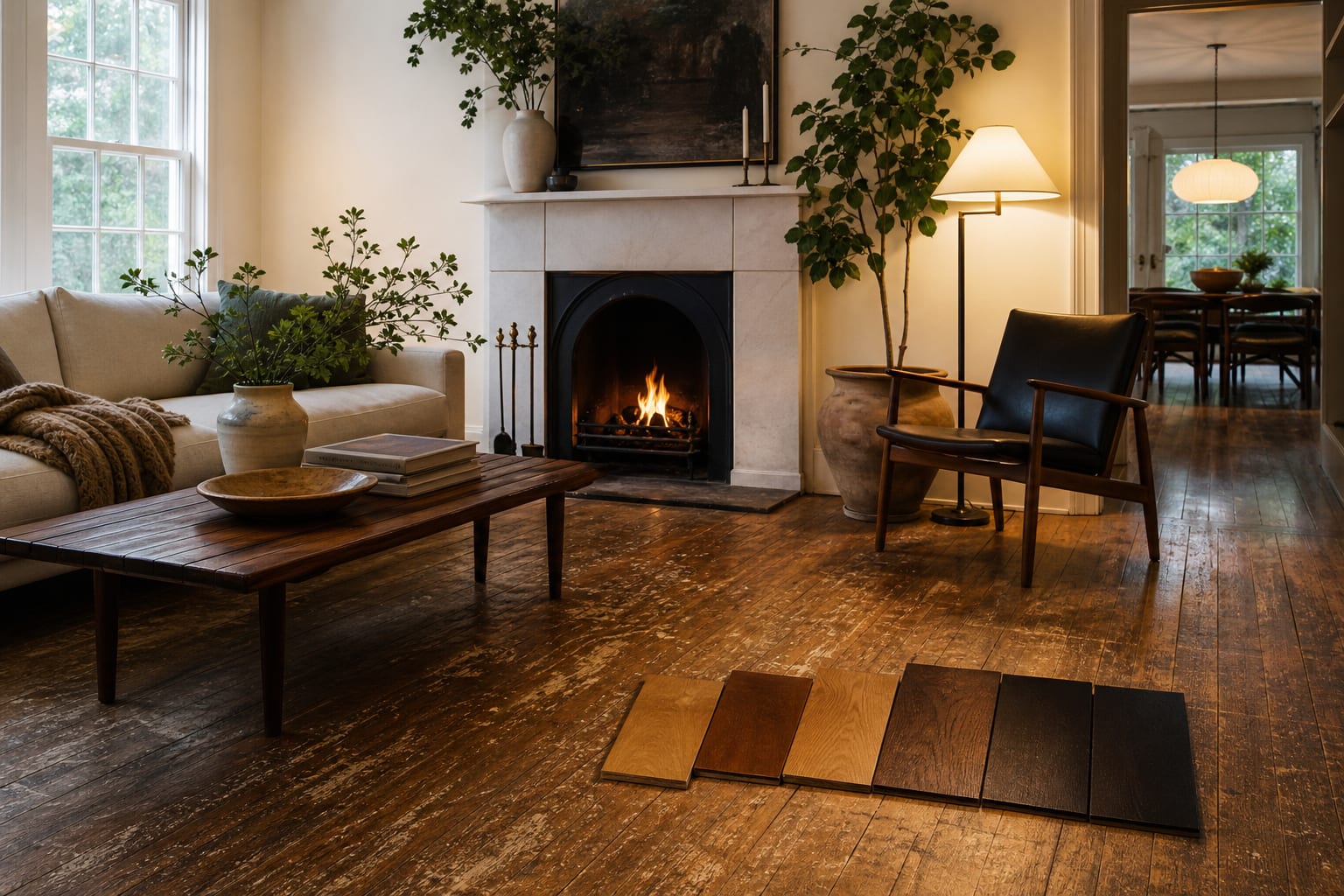
Stain samples on a scrap of oak don't show how a floor reads against your actual cabinets and trim. Upload a straight-on daylight photo showing cabinets, baseboards, and adjacent walls, then render a natural matte refinish, a dark walnut refinish, and a herringbone or wide-plank replacement on the same floor.
Be specific: ask for 3.25 in. red oak refinished with a natural waterborne matte, a dark walnut stain at 25% reduction, or 7 in. white oak engineered herringbone. If natural matte makes cabinets read orange, that's a real signal you need a different stain or a cabinet refresh in the same scope.
Frequently Asked Questions
How many times can hardwood be refinished?
Solid 3/4 in. hardwood can be refinished 3 to 5 times over its life, roughly every 8 to 12 years. Engineered hardwood with a 2 mm to 4 mm wear layer takes 1 to 2 full refinishes; under 2 mm, only a screen-and-recoat works. Prior sand depth matters — aggressive earlier refinishes can leave only one cycle on even solid wood.
Is engineered hardwood refinishable?
Yes, if the wear layer is 2 mm or thicker. A 4 mm layer allows 1 to 2 light refinishes; 6 mm and up behaves like solid wood for 2 to 3 cycles. Below 2 mm, stick to a screen-and-recoat. Check the product spec sheet or pull a transition strip to measure rather than trusting a visual estimate.
Can I refinish over pet stains?
Deep pet stains soak into the wood and won't sand out. Cut and replace the stained boards first, typically $30 to $60 per board in labor and material, then apply a tying-in stain and full refinish to hide the repair. Light surface stains often sand out during a standard refinish pass.
How disruptive is refinishing vs replacement?
Refinishing is dustier but faster: 3 to 5 days plus 24 to 72 hours of cure, during which the room is unusable. Replacement is louder and longer at 5 to 10 days but produces less airborne dust. Refinishing one floor at a time lets you stay in the house; a whole-house replacement usually means moving out for a week.
Does refinishing add resale value?
Yes — refinishing a worn but salvageable floor recovers 70% to 100% of cost at resale per Remodeling Magazine's cost-vs-value data, versus 70% to 80% for replacement. Condition still matters: a refinished floor in a hated species or color may not move the appraisal, but clean, even floors photograph better and shorten time on market.