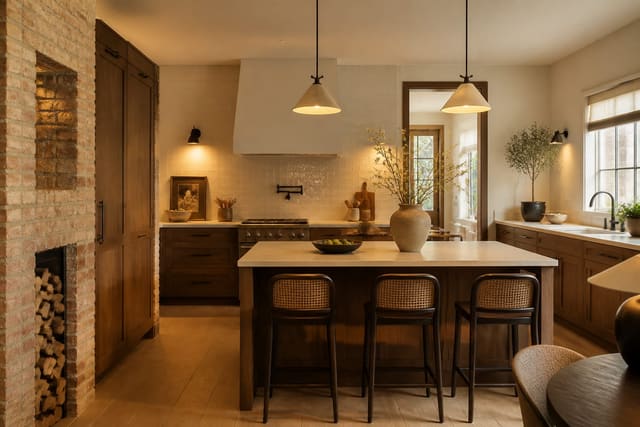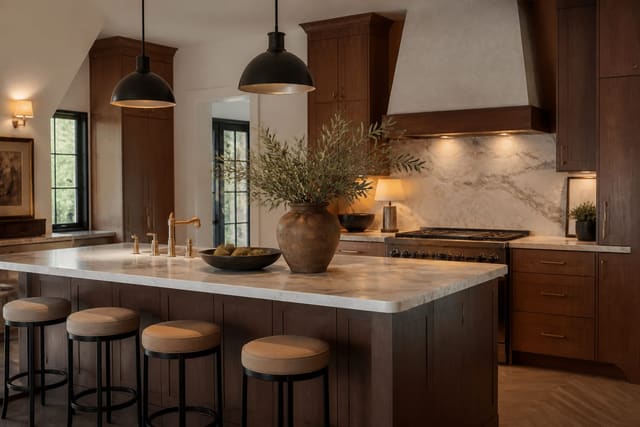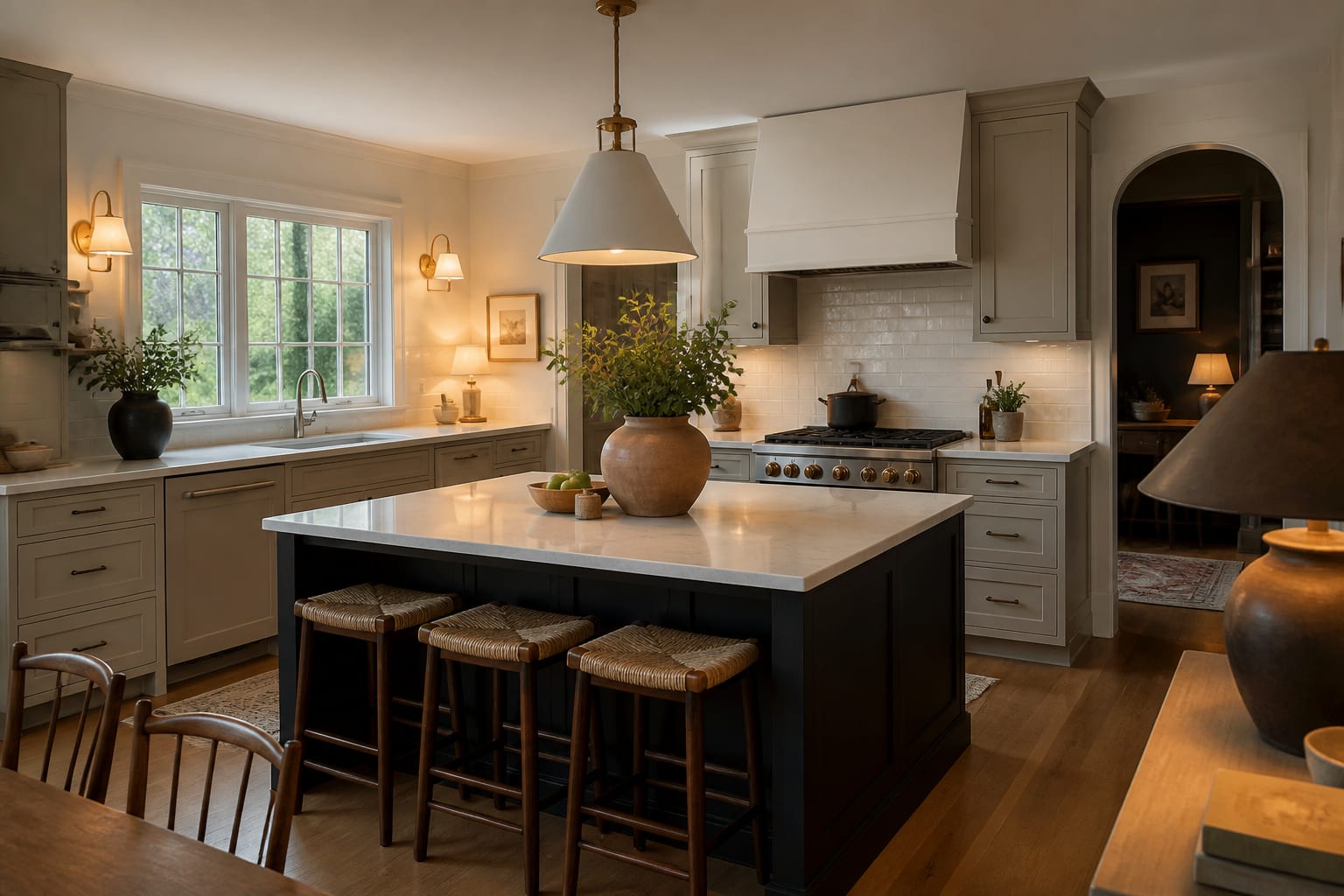
Most kitchen remodel budgets blow up for one reason: cabinets. They are 30 to 40 percent of nearly every kitchen project, so the smartest cost decision you make is whether to replace them, reface them, or simply repaint them. Get that single call right and the rest of the budget falls into place. A minor remodel that keeps the cabinet boxes runs $15,000 to $30,000; a full gut with new cabinets, counters, and appliances runs $40,000 to $80,000 for an average kitchen.
Where kitchen remodel money goes
A typical kitchen is around 200 square feet with 25 to 30 linear feet of cabinet runs. Plot the budget against that and the proportions are remarkably consistent. Cabinets take 30 to 40 percent, labor takes 20 to 35 percent, appliances 10 to 15 percent, countertops 10 percent, and the remainder covers flooring, lighting, plumbing fixtures, and finishes.
Cabinets are where the tiers separate. Repainting existing boxes runs $1,000 to $3,000. Refacing with new doors and veneer runs $4,000 to $10,000. Stock new cabinets run $5,000 to $15,000, and semi-custom or custom climb to $15,000 to $35,000. The smartest move is to decide early which of these you are doing, because everything downstream is priced against it. The kitchen layout guide helps you confirm whether the existing footprint works before you spend a dollar relocating it.
Countertops are the next decision. Laminate runs $20 to $40 per square foot installed, butcher block $40 to $70, quartz $60 to $120, and natural stone $70 to $175. For a kitchen with 40 square feet of counter, that is the difference between $1,200 and $7,000. The countertop edge profile guide covers how the edge detail affects both price and how finished the counter reads.
Labor is the line item homeowners consistently underestimate, because a kitchen touches more trades than any other room. A full remodel coordinates demolition, plumbing, electrical, cabinet installation, countertop templating and fabrication, tile, flooring, and finish carpentry, and each trade carries its own minimum and its own schedule. That is why labor lands at 20 to 35 percent of the total even when you supply the materials yourself, and why the same cabinet and counter package can cost noticeably more in a high-wage metro than a rural market.
The hidden costs sit behind the walls. Once the cabinets come off, old wiring that does not meet current code, galvanized supply lines, or a soffit hiding ductwork all surface at once, and bringing them up to code is rarely optional. Budget a 10 to 20 percent contingency on any gut remodel specifically for these surprises, because a kitchen opened to the studs almost always reveals at least one. Pricing the project without that cushion is how a $46,000 remodel becomes a $54,000 one halfway through, after the cabinets are already ordered.
A line-item remodel budget
Here is a realistic mid-range remodel for a 200-square-foot kitchen that keeps the existing layout:
- Semi-custom shaker cabinets, 28 linear feet: $18,000.
- Quartz countertops, 40 square feet installed: $3,600.
- Appliance package (range, refrigerator, dishwasher, hood): $6,500.
- Tile backsplash, 30 square feet installed: $1,500.
- Sink, faucet, and plumbing fixtures: $1,200.
- Flooring, luxury vinyl plank, 200 square feet: $2,000.
- Lighting—recessed plus under-cabinet plus one pendant run: $1,800.
- Labor, install and finish across trades: $12,000.
That totals about $46,600, squarely in major-remodel territory, with cabinets at roughly 38 percent. Repaint the existing cabinets instead of replacing them and the same kitchen drops near $25,000. The door style drives both cost and look—the shaker cabinet design guide explains why shaker stays the safe resale choice.
Notice how much of that total never changes the cooking experience. Two kitchens with identical layouts and appliances can differ by $20,000 purely on cabinet tier and countertop material, while functioning exactly the same day to day. That is the lever to pull when a quote comes back high: drop from custom to semi-custom cabinets, swap natural stone for quartz, and keep the appliances mid-range, and you can often cut a third off the total without anyone noticing in five years. The structural decisions—layout, plumbing locations, electrical—are where it pays to spend, because those are the parts you cannot cheaply change later.
Return on investment also belongs in the math, especially in a home you may sell. A minor kitchen remodel reliably recovers a larger share of its cost at resale than a high-end overhaul, because buyers rarely pay a premium for top-tier finishes in a mid-priced home. If resale is on the horizon within a few years, a $25,000 refresh that keeps the boxes and updates counters, hardware, and paint is usually the smarter financial call than a $60,000 gut that you will only partly recoup.
Common mistakes to avoid
The most expensive mistake is moving the sink, range, or refrigerator out of their existing positions. Relocating plumbing and gas lines adds $5,000 to $20,000 and rarely improves the kitchen enough to justify it; a smarter layout usually works within the existing connections.
A second mistake is over-investing in cabinets for a starter home you will sell in a few years—semi-custom is plenty, and custom rarely returns its cost. The third is forgetting the 10 to 20 percent contingency that gut remodels almost always need once walls open up. The fourth is choosing appliances last, after the cabinets are designed, which leads to expensive filler panels and resized openings.
Preview your kitchen remodel in Re-Design
Frequently Asked Questions
How much does a kitchen remodel cost? A minor remodel that keeps the cabinet boxes runs $15,000 to $30,000. A major remodel with new cabinets, countertops, and appliances runs $40,000 to $80,000 for an average 200-square-foot kitchen. Cabinets alone are 30 to 40 percent of the total.
What is the most expensive part of a kitchen remodel? Cabinets, consistently. They account for 30 to 40 percent of nearly every kitchen budget. Whether you repaint, reface, or replace them is the single decision that most affects your total.
Is it cheaper to reface or replace kitchen cabinets? Refacing runs $4,000 to $10,000 and reuses the existing boxes, while new cabinets run $5,000 to $35,000. Refacing makes sense when the boxes are solid and the layout works; replace when boxes are damaged or you are changing the footprint.