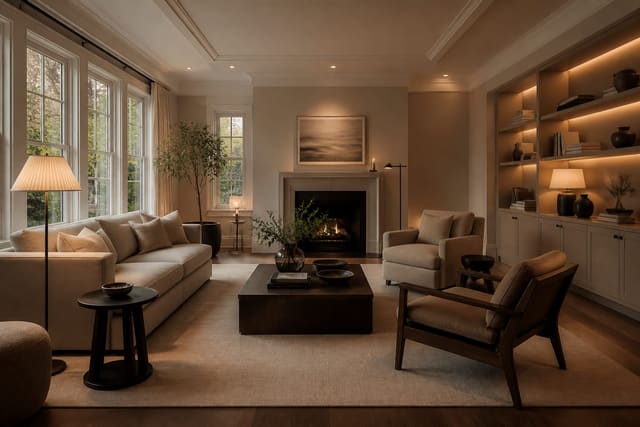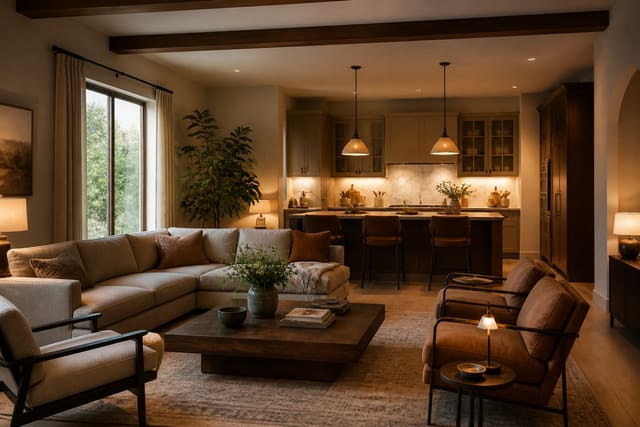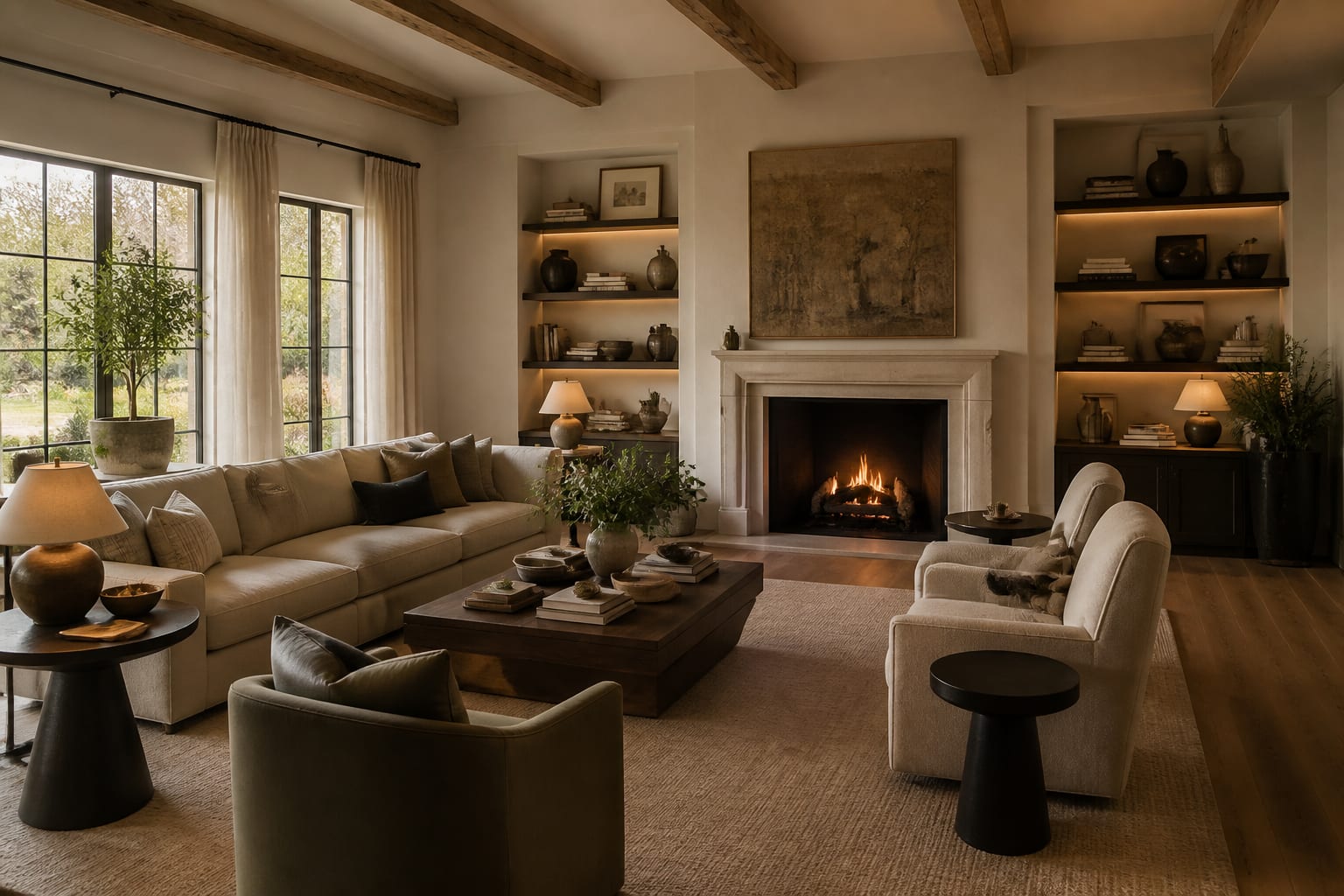
A large living room is supposed to feel like a luxury, but most of them feel like a waiting room. The reason is almost always the same: every piece of furniture is shoved against the walls, leaving a vast, useless lake of open floor in the middle. The better move is to stop treating the perimeter as the only place furniture can go. Pull the seating inward, break one enormous room into two or three smaller zones, and size everything up so the room reads as full and intentional rather than sparse and echoing. Scale and zoning do the heavy lifting here.
Why pushing furniture to the walls fails
The instinct in a big room is to line the walls with furniture, as if the goal were to maximize open floor. That layout works in a small room where space is tight, but in a large one it creates a hollow middle and forces people to shout across an eight-foot gap to talk. The conversation area is too spread out to feel social, and the room reads as underfurnished even when it holds plenty of pieces.
The fix is to float the seating. Pull the sofa and chairs inward so they form a tight group around a coffee table, with the backs of pieces facing the open floor beyond. A sofa floated four or five feet off the wall, with a console table behind it, defines the seating zone and uses the space behind it for circulation or a second function. Suddenly the room has structure: a defined room-within-a-room where people actually sit close enough to talk, and breathing space around it that feels intentional rather than empty.
A large rug is what holds a floated group together. In a big room, go at least 8 by 10 feet, and ideally 9 by 12, so the rug reaches under the front legs of the sofa and all the chairs. A rug that only sits under the coffee table looks like a postage stamp and makes the furniture float apart. The rug visually binds the seating into one island, which is exactly what a cavernous room needs. For the broader logic of arranging a big footprint, our guide to living room layout ideas walks through floating versus wall-hugging plans.
How do you zone a large living room?
The most powerful idea for a big room is to stop thinking of it as one room. A space over roughly 300 square feet can comfortably hold two or three distinct zones, each with its own purpose, and filling those zones is what makes the room feel complete. The primary zone is the main seating group around the coffee table and the television or fireplace. The secondary zone is whatever the leftover floor suggests: a reading corner with a chair and a floor lamp, a game or puzzle table with four chairs, a small desk, or a window-side bench.
Define each zone with its own anchor. A rug under the main seating, a different smaller rug or a round table to mark the reading nook, and a console or low bookcase acting as a divider between the two. You are not building walls; you are using furniture and rugs to suggest boundaries so the eye reads several cozy areas instead of one barren expanse. A large room handled as an open-plan space borrows the same logic, and our notes on open-plan living and kitchen ideas cover dividing a big footprint into working zones.
Orient each zone toward a focal point. The main group faces the fireplace or the best view; the reading corner turns toward the window light. When every zone has a clear job and a clear focus, the room stops feeling like leftover square footage and starts feeling like a series of rooms you would actually want to use, which is the whole point of having the space.
What scale of furniture does a big room need?
Undersized furniture is the second great failure of large rooms. A 72-inch loveseat and a tiny coffee table look lost in a room with 10-foot ceilings; the pieces shrink against the volume and the room reads sparse. Big rooms want big furniture. Reach for a sofa 90 inches or longer, or better, a generous sectional that fills a corner. Pair it with a substantial coffee table around 50 to 54 inches and chairs with real presence rather than spindly accent seats.
Height matters as much as footprint, because a large room usually comes with tall ceilings and empty vertical space. Draw the eye up with tall elements:
- Floor-to-ceiling drapery hung close to the ceiling, which adds height and softens hard walls.
- A tall bookcase or pair of cabinets that reach toward 7 or 8 feet rather than stopping at hip height.
- An oversized piece of art or a grid of frames scaled to fill a big blank wall, not a single small print.
- A floor lamp or tall plant in each zone to carry the eye upward and fill the corners.
- A statement light fixture sized to the room, often 30 inches or wider, instead of a builder-grade flush mount.
Layering large anchors beats scattering small accents. A few substantial pieces give the eye places to land and make the room feel furnished; a dozen tiny objects only highlight how much open floor surrounds them. When in doubt in a big room, go larger.
Common mistakes to avoid
Large rooms fail in predictable ways, and almost all of them trace back to treating a big space like a small one. The anti-patterns to avoid:
- Lining every wall with furniture and leaving a dead zone of open floor in the center.
- Using a rug under 8 by 10 feet, which floats too small and disconnects the seating group.
- Buying apartment-scale furniture: a short loveseat and a tiny table that vanish against tall walls.
- Leaving the room as one undivided space instead of carving out two or three purposeful zones.
- Hanging a single small print on a wall that needs art three feet wide or a full gallery grouping.
- Ignoring the vertical volume, so the bottom four feet are furnished and everything above feels barren.
There is also a budget reality. Furnishing a large room well costs more than a small one, often $5,000 to $12,000 for a quality seating group, rug, and lighting, simply because the pieces are bigger and you need more of them. Spreading a small-room budget across a big room is what produces that thin, unfinished look, so it is better to furnish one zone completely than to spread thin pieces across the whole floor.
See it in Re-Design before you buy
Scale is nearly impossible to judge in a large empty room, where a 90-inch sofa can look modest against a 10-foot wall and a small one looks fine until it arrives and disappears. Upload a photo of your living room into Re-Design and test floated layouts, oversized sectionals, and multi-zone arrangements to see how each fills the actual volume of your space. You can preview a single large rug versus a too-small one, try the seating pulled off the walls, and check whether a reading corner reads as a real zone or dead space. Watching the room fill out on screen takes the gamble out of buying furniture big enough to suit the room.
Frequently Asked Questions
How do you make a large living room feel cozy?
Float the seating off the walls into a tight group around a rug, then break the leftover space into smaller zones like a reading corner or game table. Cozy comes from intimacy, so pull chairs close enough to talk and anchor each area with its own rug and focal point. A big room feels warm when it reads as several defined areas rather than one open expanse.
Where should furniture go in a big room?
Not against the walls. Pull the main seating inward, four or five feet off the wall if needed, to form a defined group around the coffee table, with a console behind the sofa. Use the space beyond for a second zone. Floating the furniture creates structure and circulation, while wall-hugging leaves a hollow, echoing center that makes the room feel empty.
What size rug for a large living room?
Go at least 8 by 10 feet, and ideally 9 by 12, so the rug reaches under the front legs of the sofa and all the surrounding chairs. A rug that only sits under the coffee table looks undersized and lets the furniture drift apart. A generous rug binds the seating group into one cohesive island, which is exactly what a cavernous room needs.
How do you fill empty space in a large living room?
Add a second or third zone rather than spreading the main group thinner. A reading corner with a chair and floor lamp, a game table with four seats, or a small desk fills leftover floor with purpose. Use tall elements, floor-to-ceiling drapes, a tall bookcase, oversized art, to fill the vertical volume that big rooms always leave empty.