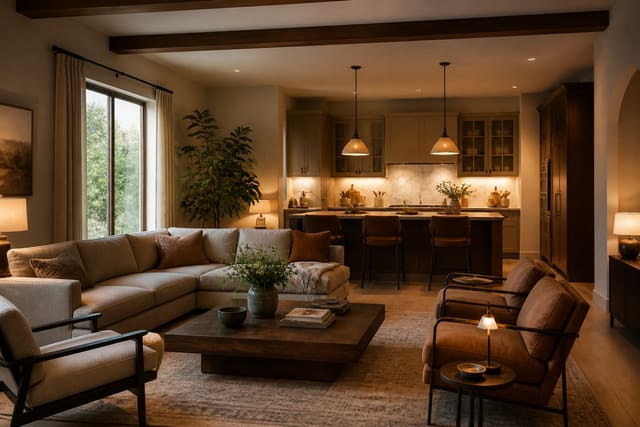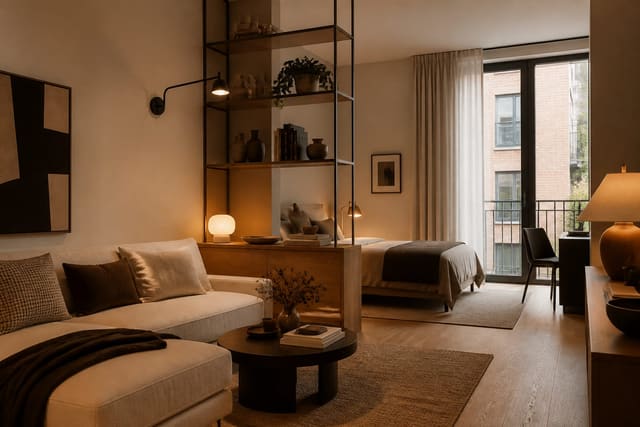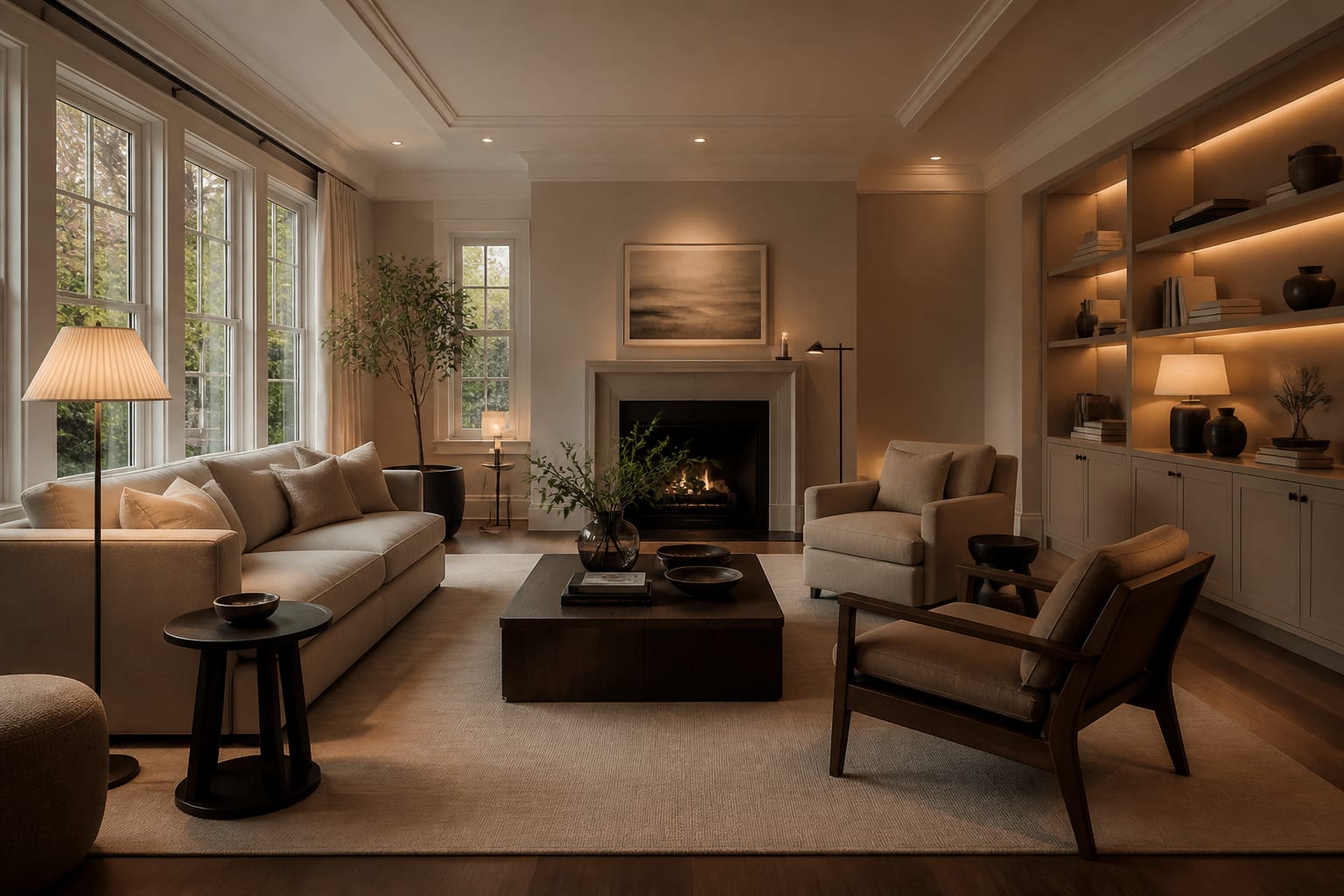
The sofa against the wall is almost never the right move, regardless of how small your room feels. Pulling furniture 12 to 18 inches off the perimeter and anchoring it with a defined rug creates a conversation zone that makes the room feel intentional rather than leftover.
Good layout is mostly arithmetic: clearance widths, rug sizes, and sightlines to the TV. Once you know the numbers, every room shape — square, long rectangle, L-shaped — has a reliable solution that you can adapt rather than invent from scratch.
How to Anchor a Seating Arrangement
Every strong layout starts with the rug, not the sofa. Choose a rug large enough that the front two legs of every major seating piece rest on it — for most living rooms that means a 9 by 12 foot rug at minimum. The rug defines the conversation zone before a single chair is moved.
Once the rug is placed, position the sofa facing the room's focal point, whether that's a fireplace, a TV wall, or a large window. The back of the sofa should be roughly 12 to 18 inches off any wall it faces away from, giving the room visual breathing room and allowing a console table behind it.
Finish the grouping with two accent chairs set at slight angles — no more than 30 degrees off parallel with the sofa. This keeps sightlines open and conversation natural without forcing a rigid face-to-face standoff.
See also our guide to Open Plan Living Kitchen Ideas for more on living room layout ideas.
Solving the Long Rectangular Room
A long rectangular room punishes single-zone layouts. If you push one sofa toward one end and a TV toward the other, you end up with a bowling-alley feeling and no place to land in the middle. The fix is to treat the room as two distinct zones with a clear visual break between them.
Zone one handles media and main seating: sofa, coffee table, and TV wall, ideally contained within 12 to 14 feet of length. Zone two can serve as a reading corner, a desk alcove, or a secondary conversation spot. A console table, a change in rug, or a pair of pendants overhead signals the transition without needing a wall.
Leave at least 36 inches of walkway through the middle of the room so neither zone feels blocked. Traffic flow is the invisible structure of any layout — get it wrong and the room feels congested no matter how good it looks in photos.
For a related angle on living room layout ideas, read Studio Apartment Living Ideas.
Working with Square and Awkward Rooms
Square rooms seem easier than rectangles but they create a different trap: the temptation to push everything to the corners and leave a dead center. Floating a sofa and two chairs inward, with the front legs on a centered rug, immediately solves the emptiness and makes the room feel curated instead of abandoned.
L-shaped rooms need an anchor piece at the inside corner of the L — usually a sectional or a sofa and chaise that traces the bend. This turns what feels like a layout liability into a natural cradle for the TV or fireplace opposite. Avoid placing the TV on the inside corner wall, where viewing angles from the far end of the L become unworkable past about 10 feet.
For rooms with awkward features like a door that swings into the space or a window at an odd height, treat the obstacle as a fixed constraint first and build the layout around it. Trying to hide or ignore it always produces a worse result than acknowledging it from the start.
TV Placement and Sightline Rules
Screen height is consistently underestimated as a layout variable. The center of the TV screen should sit at approximately 42 to 48 inches from the floor when viewers are seated, which for most wall-mounted TVs means the bottom of the set at roughly 26 to 30 inches. Mounting higher — a common choice to clear furniture — forces neck strain over long viewing sessions.
Distance from screen to seating follows a loose formula: multiply the screen's diagonal measurement in inches by 1.5 to get the minimum comfortable viewing distance in inches. A 65-inch screen works well with seating between 8 and 12 feet away. Beyond 12 feet, detail in standard content begins to soften.
If the room's only viable TV wall gets afternoon sun, budget for either a matte-finish screen or blackout shades on the adjacent windows. Glare ruins any layout that looks perfect in the evening but is unwatchable at 3 p.m. on a clear day.
Here are the common mistakes to avoid: - Placing a rug that is too small, leaving seating legs floating off the edge entirely. - Pushing every piece against the walls, which creates a waiting-room feel with dead center space. - Mounting the TV above the fireplace, which forces viewers to crane their necks past 48 inches. - Choosing a coffee table with less than 16 inches of clearance from the sofa, making it unreachable.
Bring the look home with Re-Design
Before rearranging every piece of furniture in your living room, Re-Design lets you upload a photo of your existing space and preview dozens of layout configurations with AI. You can test whether a floating sofa or a two-zone rectangle arrangement actually works in your specific room — with your dimensions, your windows, your light — without moving anything heavier than your phone.
Frequently Asked Questions
How much space should be between a sofa and coffee table?
Aim for 16 to 18 inches between the sofa cushions and the near edge of the coffee table. Less than 14 inches makes it hard to stand up comfortably; more than 20 inches and the table starts to feel disconnected from the seating group. This range keeps the table within easy reach without being a shin hazard.
What is the right rug size for a living room?
For most living rooms, a 9 by 12 foot rug is the reliable starting point. The rule is that front legs of every major seating piece should rest on the rug. An 8 by 10 foot rug often works in a tighter room as long as all seating still makes contact with it, but an undersized rug is one of the most common layout mistakes.
Should I float furniture away from the walls?
Yes, in almost every case. Pulling the sofa 12 to 18 inches from the wall it faces away from creates depth and makes the room feel larger, not smaller. The only exception is a very narrow room under about 11 feet wide, where floating furniture reduces walkway clearance below the comfortable minimum of 36 inches.