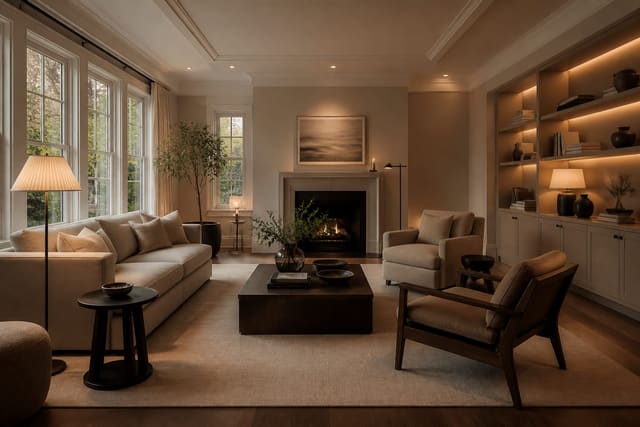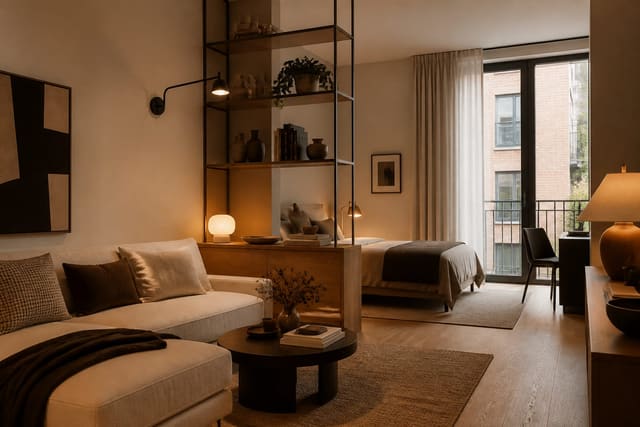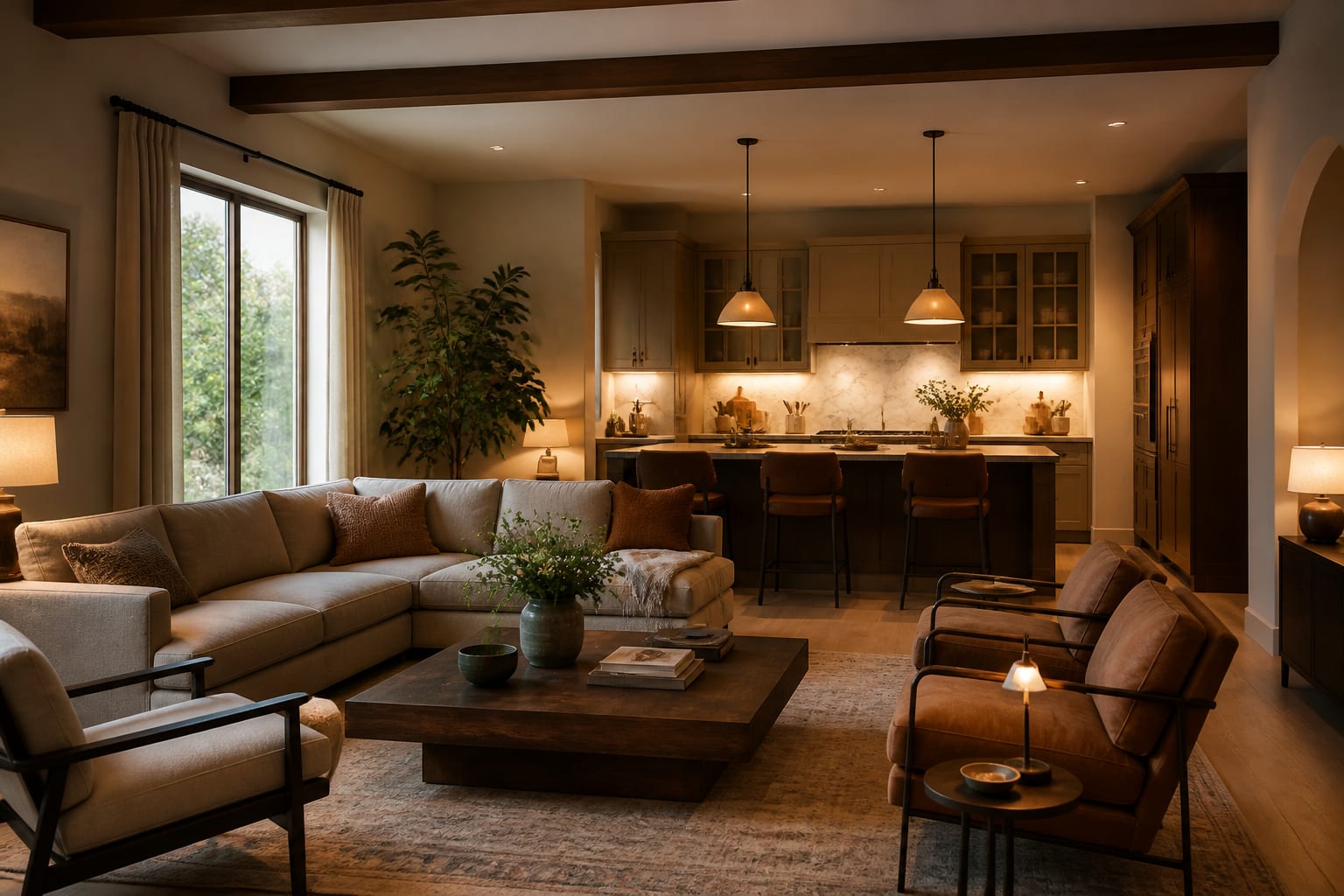
An open-plan kitchen and living room is only as successful as the zoning strategy behind it. Without defined zones, the combined space reads as one large, undifferentiated room where nothing feels like it belongs.
The best open plan living room kitchen ideas don't rely on walls or partitions — they use rugs, lighting levels, ceiling treatments, and furniture orientation to signal transitions. Each zone needs its own anchor point, its own light source, and a clear boundary the eye recognizes without needing signage.
Defining Zones Without Walls
The sofa is the most powerful zoning tool in an open-plan space because it creates a visual back wall where no structural wall exists. Orienting the sofa so its back faces the kitchen — positioned roughly 28 to 34 inches from the kitchen island or peninsula — creates a clear signal that the living zone begins here. It also gives the cook a natural view into the living area rather than staring at a sofa back from 3 feet away.
A rug anchors the living zone in the same way it does in a closed room, but its placement at the transition point is even more important here. The rug should stop at least 6 to 12 inches before the hard-floor kitchen zone, making the material change visible and intentional. A rug that bleeds past the kitchen boundary blurs the zoning logic you're trying to establish.
Bookcases, half-height cabinets, and open shelving units placed perpendicular to the flow of the room can delineate zones without blocking sightlines. A 60-inch-tall open unit lets light and conversation pass while still reading as a boundary from a seated position.
See also our guide to Living Room Layout Ideas for more on open plan living room kitchen ideas.
Lighting Each Zone Independently
Kitchen and living zones need different light temperatures and intensities. Kitchen task lighting typically runs at 3000K to 4000K — a cleaner, brighter white that makes food preparation and surface cleaning easier. Living-area lighting should sit at 2700K to create warmth and contrast with the kitchen's harder light. The difference in color temperature is one of the most reliable cues the brain uses to read two zones as distinct even without a wall between them.
Pendants over the island or dining area should hang 30 to 36 inches above the counter surface. This height provides task illumination without blocking sightlines from the kitchen into the living room. Fixtures hung lower than 28 inches become an obstacle; higher than 40 inches and they lose most of their focused light effect.
In the living zone, keep ceiling fixtures to a minimum and rely on floor and table lamps at seated eye level. This contrast — bright, directed kitchen overhead light versus warm, low living-area lamps — physically and visually separates the two zones even in a fully open plan.
For a related angle on open plan living room kitchen ideas, read Studio Apartment Living Ideas.
Furniture Scale and Sightlines
Oversized furniture in an open-plan space is a common mistake because the volume of the combined room makes people think everything needs to be bigger. A sectional that fills a closed living room will choke an open-plan living zone and eliminate the breathing room that makes the layout work. Scale each piece to the living zone only, not to the entire square footage.
The ideal living-zone rug in an open-plan space is usually one size smaller than you'd use in a closed room of the same area. An 8 by 10 foot rug often works better than a 9 by 12 because it leaves a visible floor boundary between the rug's edge and the kitchen zone. The exposed floor between zones is a feature, not wasted space.
Sightlines from the kitchen work area to the living zone matter if the cook wants to stay connected to conversation or a TV screen. Place the TV on the wall the cook faces naturally from the stove or island position. A 45-degree offset is workable; a 90-degree turn means no one at the island can see the screen without rotating their chair.
Color and Material Consistency Across Both Zones
An open-plan space that uses completely different color palettes in the kitchen versus the living area looks like two rooms were pushed together rather than designed as one. The fix is a shared dominant color — usually a wall paint, a flooring tone, or a material like white oak cabinetry — that runs through both zones and unifies them visually.
Within that shared base, variation comes through texture and secondary color, following the 60/30/10 ratio applied across the whole combined space. The kitchen gets its character from cabinet hardware, tile backsplash, and countertop material. The living zone layers in softness through upholstery, rugs, and curtains. Neither zone competes; each contributes a distinct texture to the same palette.
Natural light distribution across an open plan is uneven — the kitchen at the back often gets less window light than the living area facing the garden or street. Balance this with under-cabinet task lighting in the kitchen and resist the urge to compensate with a brighter bulb color temperature in the living zone, which would undermine the warmth you're trying to build there.
Here are the common mistakes to avoid: - Using identical light temperatures in both zones, which removes the strongest visual cue separating kitchen from living area. - Choosing a sectional scaled to the full open-plan square footage rather than just the living zone's footprint. - Placing the rug so it extends past the kitchen floor boundary, blurring the zone transition you need to define. - Running completely different color palettes in each zone, making the open plan feel like two mismatched rooms joined together.
Bring the look home with Re-Design
Zoning an open-plan kitchen and living room is genuinely hard to visualize from a floor plan alone. Re-Design lets you upload a photo of your combined space and preview how different furniture orientations, rug placements, and lighting setups actually read in your room — with AI generating realistic previews before you move a single piece or order anything. Test the sofa-as-zone-divider idea in your specific layout first.
Frequently Asked Questions
How do you separate a living room from a kitchen in an open-plan space?
Use the back of the sofa as a visual divider by orienting it so it faces away from the kitchen, roughly 30 inches from the island. A rug that stops at the kitchen floor line reinforces the boundary. Different light temperatures — 2700K in the living zone, 3000K to 4000K in the kitchen — do the rest of the perceptual work.
What rug size works best in an open-plan living room?
In an open-plan space, an 8 by 10 foot rug often outperforms the larger 9 by 12 because it leaves visible floor between the living zone and the kitchen zone. That exposed gap reads as an intentional boundary. Size the rug to the living zone footprint specifically, not to the entire square footage of the combined room.
Should kitchen and living room have the same color scheme in an open plan?
They should share a dominant base color — wall paint, flooring tone, or a primary material — to read as one coherent space. Within that shared base, each zone earns its identity through texture and secondary color: cabinet hardware and tile in the kitchen, upholstery and soft furnishings in the living area. Completely different palettes make the space feel unplanned rather than designed.