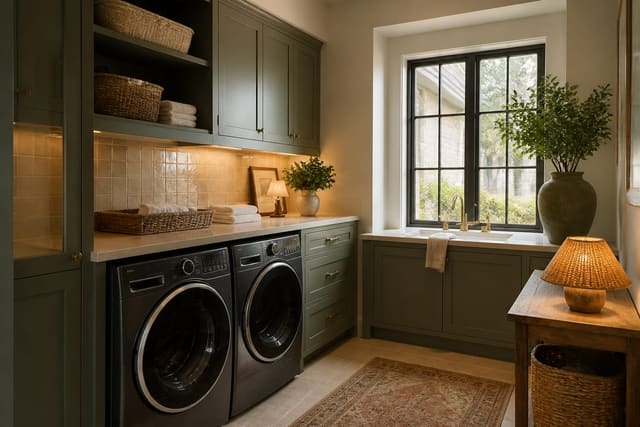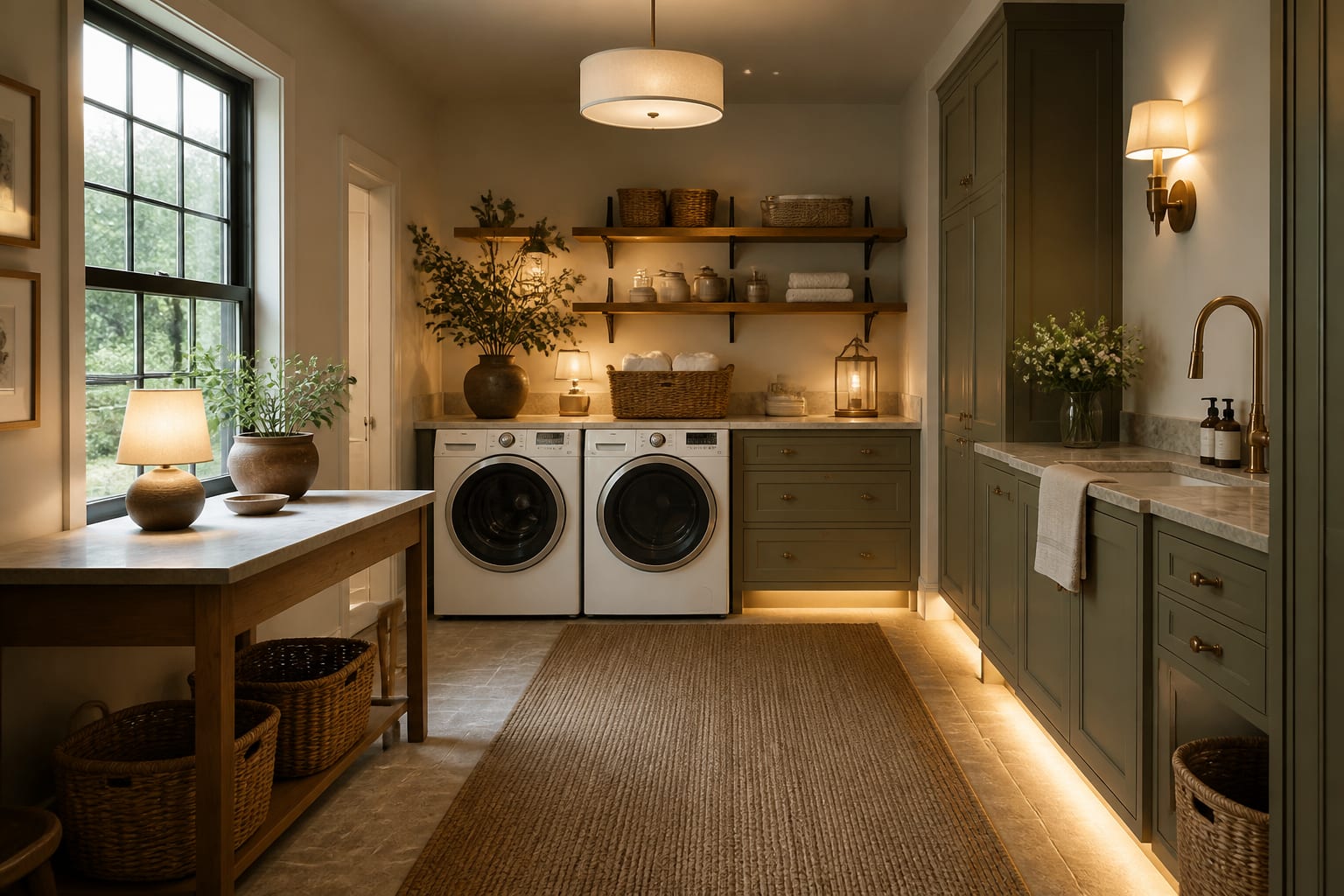
The best laundry room ideas for a smarter workspace organize the room around the actual chore: sort, wash, dry, fold, and put away. Add a counter over front-loading machines, a hanging rod for air-dry items, enclosed storage for supplies, and a utility sink. Together these fixes turn a cramped utility space into a room that works with you instead of against you.
How Should You Design the Room Around the Laundry Workflow?
Every laundry room follows the same five-step rhythm: sort, wash, dry, fold, and put away. Rooms that feel effortless arrange stations in that order, sorting bins near the entry, machines central, folding and hanging zones on the far side, so you never backtrack hunting for what you need.
A counter spanning front-loading machines is the upgrade people feel most. It gives you a flat workspace right where clothes exit the dryer, eliminating trips to a bed or table. Top-loaders can get the same benefit from a wall-mounted drop-leaf counter or a rolling cart that folds away when not in use.
Hanging is the step most rooms forget. A wall-mounted rod, retractable clothesline, or a few hooks near the dryer let wet items transfer in one motion instead of draping over doors. Leave a few feet of clearance in front of the machines so the dryer door swings fully and you can load comfortably.
See also our guide to Laundry Room Color Ideas for more on laundry room ideas.
How Do You Keep Laundry Supplies Within Reach?
Detergents, softeners, stain sticks, dryer sheets, mesh bags, and stray socks land on top of the machines without dedicated storage, turning a tidy room into chaos. Enclosed storage sized to what you actually keep on hand solves it.
- Upper cabinets above the machines hide bulky bottles while keeping them within arm's reach.
- Open floating shelves work if supplies are corralled into matching jars or baskets so they read intentional, not cluttered.
- A narrow pull-out cabinet in the gap beside the machines swallows tall detergent bottles in space that would otherwise sit empty.
- A small drawer or magnetic strip keeps stain pens and scissors handy.
- A wall-mounted basket holds orphan socks until their match turns up.
- A pull-out hamper or tilt-out bin keeps dirty laundry sorted and off the floor.
Give every laundry item a specific home so nothing migrates onto the folding counter. Good storage is what keeps the room functional long after the initial organizing burst fades, and it costs far less than people assume.
For a related angle on laundry room ideas, read Utility Laundry Room Design Ideas.
What Extra Features Make a Laundry Room More Functional?
A deep utility sink lets you soak stained items, hand-wash delicates, rinse muddy gear, and fill buckets without commandeering the kitchen sink. Pair it with a sprayer faucet for flexibility.
Not everything belongs in the dryer, so plan real drying options:
- A wall-mounted rack that folds flat when unused
- A ceiling-mounted pulley rack
- A retractable line over the sink
- A drying rod with hangers for shirts straight out of the wash
- A stretch of countertop set aside for flat-drying knits
A few workhorse details round out the room. Task lighting over the folding counter, ideally a warm-to-neutral 3000K, helps you spot stains and match socks. A wall-mounted ironing board frees floor space, a water-resistant floor or drying mat protects against leaks, and a pet-washing station or boot-rinse spray earns its keep in an active household.
How Do You Make a Laundry Room Feel Good, Not Just Work?
You visit this room constantly, so it deserves styling attention, and a pleasant space genuinely makes the chore less grim. A fresh paint color, cheerful wallpaper on one wall, or a bold backsplash behind the machines adds personality for very little money.
Flooring and surfaces should look good and survive water. Patterned tile hides the dust and lint laundry rooms generate while shrugging off spills, and a quartz or laminate counter wipes clean after detergent splashes.
Small comforts complete the space: a cushioned runner underfoot, a few real or faux plants, framed art or a simple sign, and a Bluetooth speaker to pass the time. In a larger room, a comfortable chair or a window view turns folding into a quieter moment rather than a grind.
Bring the Look Home with Re-Design
It's hard to know if cabinets, a counter, and a hanging rod will all fit around your machines. With Re-Design, upload a photo of your laundry room and preview upper cabinets, a folding counter, a utility sink, or a fresh paint color in your actual space before spending a dollar. Test a few layouts and finishes at once so you commit to the arrangement that genuinely improves the workflow instead of guessing from a catalog.
Frequently Asked Questions
What makes a laundry room more functional?
Designing around the workflow of sort, wash, dry, fold, and put away makes the biggest difference. Place sorting bins near the entry, a folding counter by the dryer, and a hanging rod for air-dry items. Add enclosed storage for supplies and a utility sink for soaking and hand-washing. Each station in sequence cuts the backtracking that makes laundry feel endless.
Where should I put a folding counter in a laundry room?
Directly over front-loading machines is ideal, since clothes come straight out of the dryer onto the surface with no extra trip. If you have top-loaders, a wall-mounted drop-leaf counter or a rolling cart gives the same workspace and tucks away afterward. Add task lighting overhead so you can spot stains and match socks easily.
Do I really need a sink in the laundry room?
A utility sink is one of the most useful additions if you have the plumbing and space for it. A deep basin lets you soak stains, hand-wash delicates, rinse muddy boots, and fill buckets without tying up the kitchen sink. Pair it with a sprayer faucet for extra flexibility. In an active household with kids or pets, it quickly becomes indispensable.
How much clearance do I need in front of the washer and dryer?
Leave a few feet of open space in front of both machines so doors swing fully open and you can stand comfortably to load and unload. Tight clearance is one of the most common laundry room mistakes, since it makes even simple loading feel cramped. Plan this distance before installing counters, cabinets, or a folding station nearby.