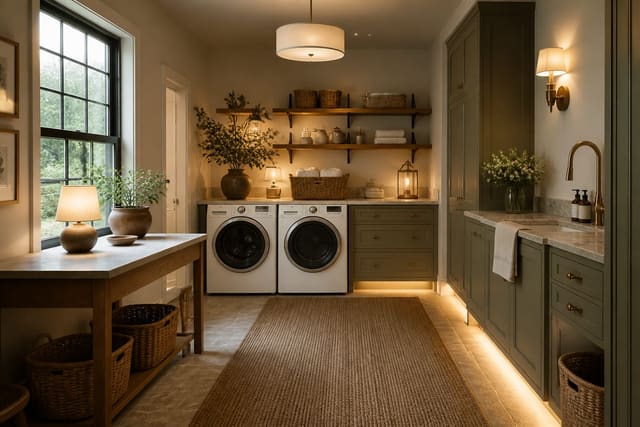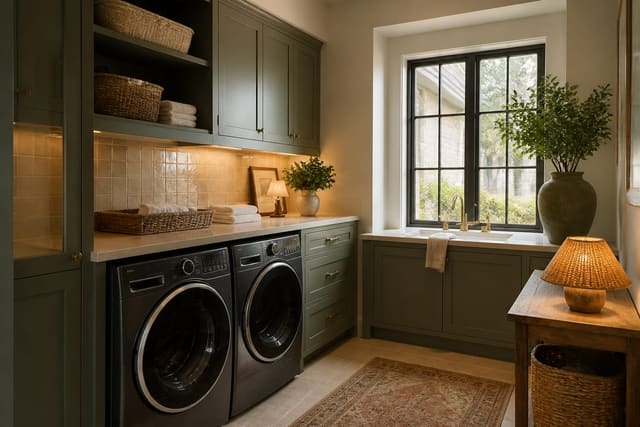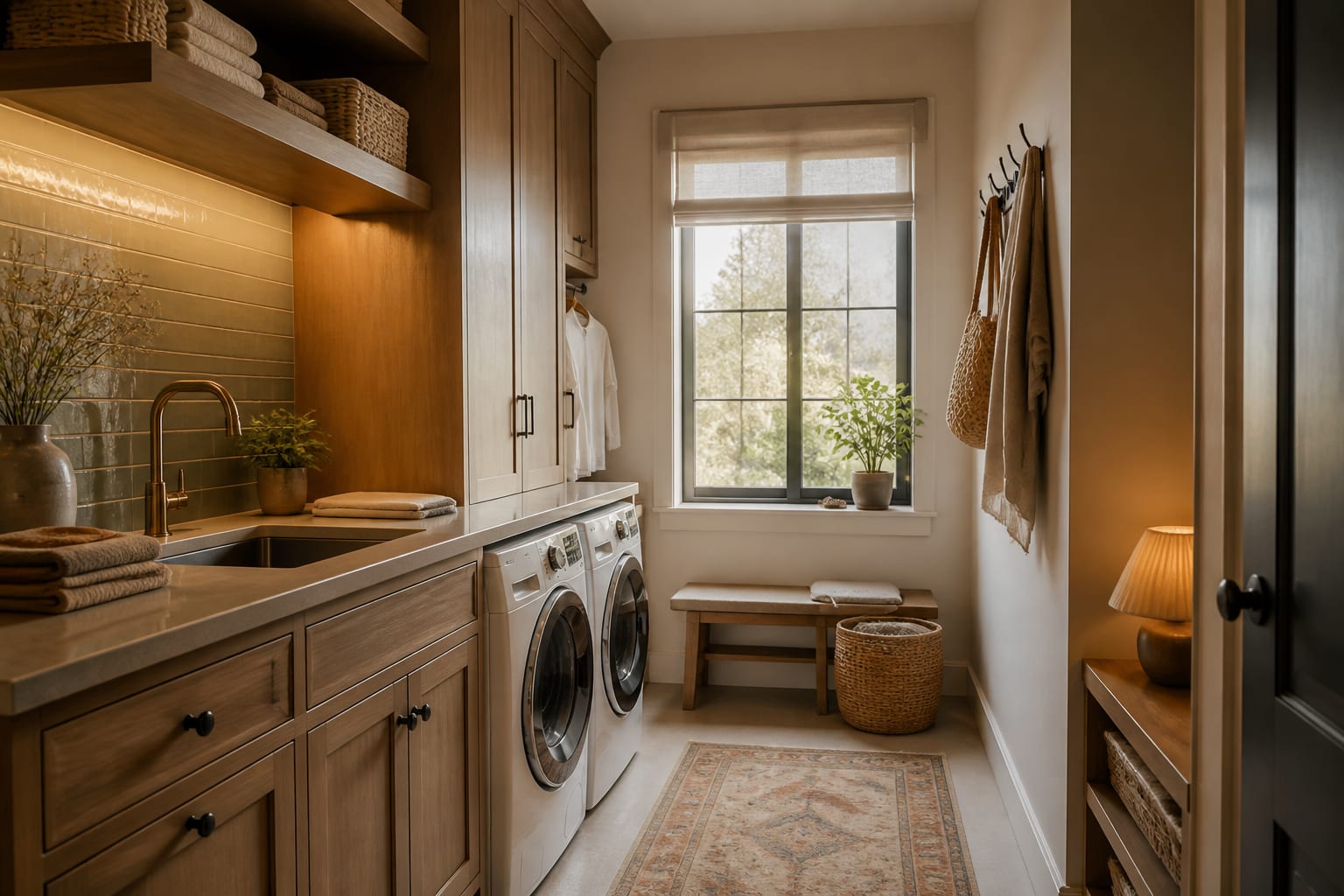
A small laundry space is rarely about square footage and almost always about going vertical and using every surface. The instinct to leave the area bare because it feels cramped is exactly backward, since the walls, door, and the gap beside the machines hold more capacity than the floor ever could. Stack the machines, build storage upward, and add a fold-away counter, and a closet-sized nook handles the same loads as a full room. This guide covers the highest-impact moves for tight laundry spaces, the measurements that make them fit, and the mistakes that waste the little room you have.
Stack and Choose the Right Machines
The single biggest space gain in a small laundry area is stacking the washer and dryer. A side-by-side pair eats roughly 54 inches of floor width, while a stacked set occupies a single 27- to 30-inch footprint and rises vertically instead. That reclaimed width becomes room for a tall storage cabinet, a folding station, or simply the clearance a tight space desperately needs.
When square footage is truly scarce, the machines themselves can shrink. Compact units run about 24 inches wide rather than the standard 27, and an all-in-one washer-dryer combo handles both jobs in a single appliance, ideal for a closet or apartment where stacking is not possible. These smaller machines hold less per load, so weigh capacity against the space you save before committing.
Front-loading machines are almost always the right call in a small room, because they stack and because their flat tops double as a surface when you are not running a folding counter above them. Measure carefully before buying: account for the door swing, which can need 20 inches or more of clearance in front, plus a few inches behind for hoses and venting. A stacked or compact setup planned around exact measurements is what lets a laundry area collapse from a dedicated room into a closet or a tucked-away nook without giving up any real function. Get the machine choice right first, because everything else in the layout builds around the footprint they leave behind.
See also our guide to Laundry Room Ideas for more on small laundry room ideas.
Build Storage Upward and Into Gaps
In a small laundry space, the walls and the gaps are where the storage lives, since the floor is fully committed to the machines. The wall above the units is prime territory. Cabinets or open shelves mounted there, climbing toward an 8-foot ceiling, hold detergent, supplies, and baskets in space that would otherwise sit empty. Keep the lowest shelf about 18 inches above the machine tops so you have clearance to load and lift the lids.
The slim gap beside or between the machines is the cleverest catch. A pull-out cabinet as narrow as 6 inches slides into that void and holds tall detergent bottles, a broom, and an ironing board upright. On casters, it rolls out fully and tucks back flush, turning dead space into one of the most useful storage spots in the room.
Don't forget the door and the back wall. An over-the-door rack adds tiered shelving or pockets for supplies, and a row of hooks holds the drying rack, lint brush, and laundry bags off every flat surface. A tension rod stretched between two walls, or a wall-mounted retractable line, creates hanging space for air-dry items without a single square inch of floor. Vertical dividers on a shelf keep folded items from toppling in the limited depth. The governing idea is that a small laundry room has far more vertical and recessed space than it appears, and filling the walls, the door, and the narrow gaps is what lets a tiny footprint store everything a full-size room would.
For a related angle on small laundry room ideas, read Laundry Room Color Ideas.
Fold-Away Surfaces and Drying in Inches
Folding and drying are the steps that seem impossible in a tight laundry space, but both fold away when they are not in use. A wall-mounted drop-leaf counter is the hero here. Mounted at a comfortable 36 inches high, it provides a real folding surface and then collapses against the wall to just a couple of inches deep, vanishing entirely between loads. A pull-out shelf built into a cabinet does the same job from inside the cabinetry.
If even a drop-leaf is too much, a slim rolling cart serves as a mobile folding table and supply station that you wheel out when needed and store in a corner otherwise. A countertop spanning a stacked machine setup, where the depth allows, gives a fixed surface without sacrificing the freed-up width.
Drying works the same way, leaning on solutions that disappear. A wall-mounted accordion rack folds flat against the wall and extends about 24 inches when you need to hang sweaters and delicates. A retractable clothesline pulls across the room and reels back in afterward. A ceiling-mounted pulley rack lifts wet items into the unused airspace overhead, completely clearing the floor. A single rod with a few good hangers handles shirts straight from the wash. The trick in a small space is choosing features that occupy zero footprint when idle and expand only for the minutes you actually use them. That collapsibility is what lets a closet-sized laundry area perform every function of a full room without ever feeling crowded between loads.
Light, Color, and Smart Finishing Choices
A small laundry space lives or dies on how open it feels, and light and color do most of that work. A cramped, dim closet feels like a punishment, so generous lighting is essential. Add an LED fixture or a strip under the upper cabinets so the folding surface and machine controls stay bright, and choose a clean light around 3500K that helps you spot stains without feeling harsh in such a tight room.
Color can visually expand a small space. Light, reflective tones on the walls and cabinetry bounce light and push the boundaries outward, making the area read larger than its actual dimensions. A glossy or satin finish reflects more light than a flat one, which helps in a windowless nook. If you want personality, confine a bold color or pattern to a single accent, like the back wall or a tiled niche, so it adds interest without closing the space in.
Smart finishing choices keep a tight room feeling intentional rather than crammed. Sliding or pocket doors on the laundry closet save the floor space a swinging door would steal. Matching baskets and labeled containers calm the visual clutter that makes a small space feel chaotic. A mirror on the door or an adjacent wall bounces light and adds depth. Choosing durable, wipeable surfaces, like a quartz-look counter and a water-resistant floor, means the room stays sharp despite the splashes a laundry area invites. In a small footprint every finish choice is amplified, so leaning on light colors, reflective surfaces, and space-saving doors turns a claustrophobic closet into a tidy, efficient corner that works harder than its size suggests.
Here are the common mistakes to avoid: - Treating the floor as the only storage instead of building cabinets up the wall - Buying side-by-side machines when stacking would free 30 inches of valuable floor width - Leaving the slim gap beside the machines empty rather than adding a pull-out cabinet - Choosing a swinging door that steals floor space a sliding or pocket door would save - Skipping fold-away surfaces and ending up with nowhere to fold or hang clothes - Using dark, flat paint that makes a windowless laundry nook feel smaller and dimmer
Bring the look home with Re-Design
Fitting a full laundry setup into a closet takes precise planning, and mistakes are costly once cabinets are installed. With Re-Design you upload a photo of your nook and preview stacked machines, upper cabinets, a drop-leaf counter, and a bright paint color in your real space before you buy. Re-Design lets you test whether everything fits and which light color opens the room up, so you commit to the layout that works in the inches you have.
Frequently Asked Questions
What is the smallest space a laundry room can fit in?
A stacked washer and dryer fits in a footprint as small as 30 inches wide and about 32 inches deep, which is roughly a standard closet. Add 20 inches or so of clearance in front for the door swing. An all-in-one combo unit shrinks it further, fitting setups where even stacking is not possible, like an apartment closet.
How do I add storage to a tiny laundry room?
Build upward and into the gaps, since the floor is taken by machines. Mount cabinets or shelves above the units toward the 8-foot ceiling, and slot a pull-out cabinet as narrow as 6 inches into the gap beside them. Then use the door for an over-the-door rack and the walls for hooks and a retractable drying line.
Should I stack my washer and dryer in a small room?
Almost always, yes. Stacking front-loaders turns a 54-inch side-by-side footprint into a single 30-inch column, freeing roughly two feet of width for a storage cabinet or folding zone. Just confirm the units are stackable, leave clearance for the door swing and venting, and make sure the upper machine sits at a height you can comfortably reach.