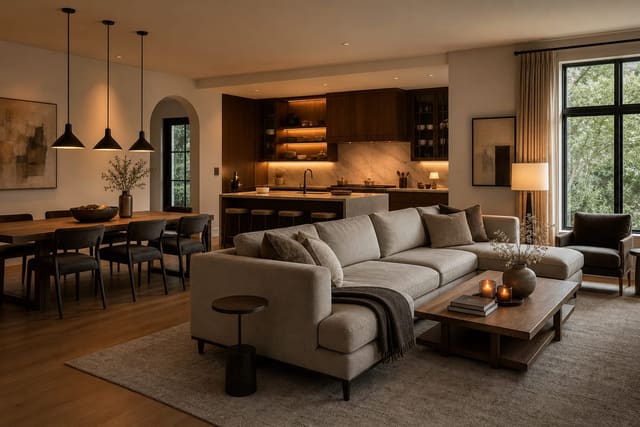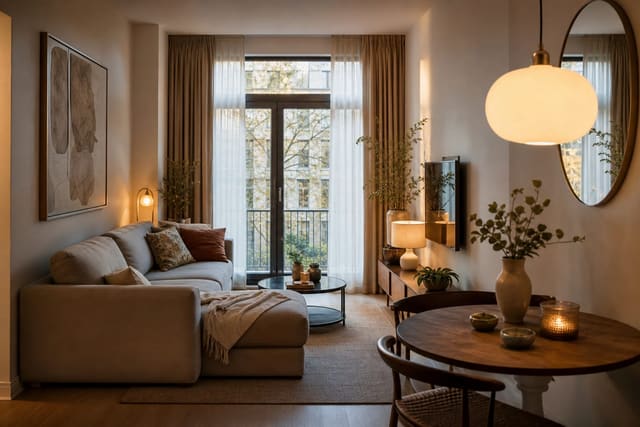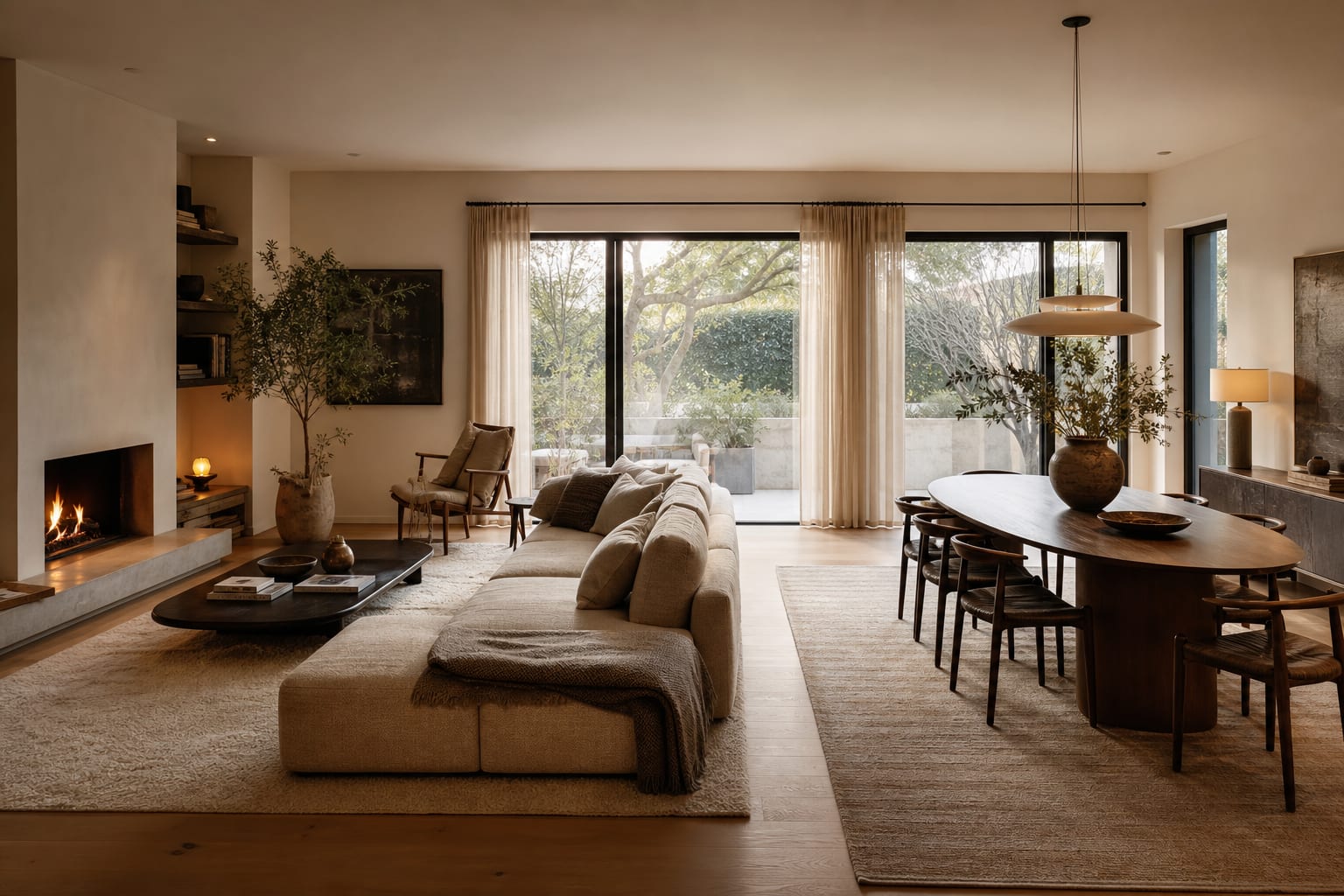
Living dining room combo furniture works when the sofa back faces the dining table with 30 to 36 inches of walk-through clearance, the table stays under 72 inches in a sub-15-foot run, and one rug anchors each zone instead of two competing rectangles. Scale matters more than style: mix eras and finishes freely, but keep height, visual weight, and breathing room consistent across both areas.
What makes living and dining furniture belong in one open room?
Match the visual weight of seating and dining pieces, keep circulation clear, and repeat materials, rugs, and lighting so two zones read as one room. Most combo problems aren't ugly furniture, they're pieces speaking different scales: a chunky roll-arm sofa beside a skinny glass table, or a delicate sofa next to a heavy 84-inch farmhouse table.
Scale rules to set before buying:
- Keep the main walkway between zones at least 30 inches wide, 36 inches if it leads to a kitchen or hallway.
- Match seat heights loosely: sofa seats run 17-19 inches, dining chairs around 18 inches. A low lounge next to a tall formal table splits the room by posture.
- Repeat one material across zones — oak chairs with an oak coffee table, black metal legs with a black floor lamp, woven seats with a jute rug.
If the space feels like a hallway with furniture pushed against both walls, read zoning an open plan room without walls before adding another accent chair.
The furniture scale decision that controls the whole combo
The dining table is the scale anchor because its dimensions and clearances are fixed. A sofa can look fine at several sizes; a table that blocks chair pullback announces the mistake at every meal.
In a small open room, a 36-48 inch round table often beats a rectangle because chairs can slide around it without creating sharp corners in the walking path. A 42-inch round table suits four people; six people need a 60-inch rectangle or 54-inch round table, which many apartments don't actually have room for.
Leave 36 inches from the table edge to a wall, console, or sofa back for chair pullback. Thirty inches is tolerable in a tight rental only if chair backs are slim and the route isn't the main path. If the table sits close to the living area, choose armless or compact upholstered chairs no wider than about 20 inches.
The sofa shouldn't dominate the table. A 78-90 inch sofa is usually more useful than a large sectional; if you want a chaise, keep its long side out of the dining route. Legs showing 5-7 inches of air under the sofa read lighter beside a dining set than a blocky base flush to the floor.
Rugs expose scale mistakes fast. Size the living rug so at least the front legs of sofa and chairs sit on it — 8x10 rather than 5x7 in most combos. A dining rug should extend about 24 inches beyond the table on all sides so chairs stay on it when pulled back. If two rugs would nearly touch, skip the dining rug and use lighting to define the table instead.
Test this on your own room photo with ReDesign before finalizing the layout, keeping the room structure, daylight, ceiling line, and main path visible.
How do you connect the zones without matching everything?
Connection comes from rhythm, not duplication. Pick one dominant line: if the sofa is low and horizontal, keep the dining table simple rather than pairing it with an ornate pedestal. If dining chairs curve, repeat that curve in the coffee table, mirror, or pendant. Balance a visually heavy table with lighter open-base chairs or a slim media cabinet on the living side.
Lighting separates zones without splitting the room. Hang a pendant 30 to 36 inches above the tabletop, centered on the table rather than the ceiling grid. In the living area, use lamps around 2700K so seating feels warmer and lower. Two light heights plus a repeated metal finish keep the room layered but connected.
Storage needs the same discipline: a sideboard near the dining table should usually run 30-34 inches high so it doesn't tower over the sofa. If the table is squeezed into the living room, the guidance in choosing a dining table for a small living room applies directly — smaller diameter, cleaner chair backs, no oversized seating.
Common living-dining combo mistakes to avoid
- Buying the biggest sofa that fits on paper. Choose seating shape after drawing the dining chair pullback zone, not before.
- Letting the dining set look more formal than the living area. A glossy table and crystal fixture beside a relaxed slipcovered sofa feels disjointed; control contrast through one element, not all of them.
- Using tiny rugs because the room is shared. Two postage-stamp rugs make both zones nervous — use one generous living rug, one correctly sized dining rug, or no dining rug at all.
- Ignoring the backs of furniture. Sofa backs, dining chair frames, and sideboards are often visible from the entry; choose finished profiles you like from behind.
- Trying to solve scale with color alone. Paint and pillows won't fix a table that's too long or chairs that can't pull out. Color connects zones; dimensions decide whether the room works.
Use AI design to preview the combo before you buy
Open rooms are hard to judge from isolated product photos. A modest-looking sofa online can dominate the dining table; a small showroom table can become the perfect pivot once seen beside your actual rug and windows.
Upload a photo from a corner showing the living area, dining wall, windows, and main walking route. Leave real constraints in frame — pet bed, bar stools, the table you're replacing. A cleared-out room gives you a prettier fantasy, not a better plan.
Test three controlled versions: a rectangular table with sofa and two chairs, a round table with the same seating, and a lighter sofa with the table unchanged. Keep wall color and flooring consistent so you're judging furniture scale, not a full style makeover.
When using AI open plan kitchen living previews, prompt for concrete constraints: 36-inch dining clearance, 30-inch minimum walkway, 8x10 living rug, dining pendant 30-36 inches above the table, and a sofa that doesn't block the kitchen path.
The winning version looks calm before it looks styled — you should be able to pull out a dining chair, sit on the sofa, and know where each zone begins without a sign. For the broader workflow, use the AI design complete guide as the parent checklist, then return here for scale, light, and layout specifics.
Frequently Asked Questions
How big should the rug be in a living-dining combo?
Use one 8x10 or 9x12 rug under the seating zone and skip a rug under the table, or use one large rug extending 24 inches past pulled-out dining chairs. Two competing rectangles usually crowd the open floor.
What sofa size works in an open living-dining plan?
Pick a sofa whose back length is 70-85% of the open wall it faces, and avoid sectionals deeper than 38 inches in rooms under 15 feet wide. Deeper sectionals push the dining table too close to the wall.
How much space should sit between sofa back and dining table?
Leave 30 to 36 inches of walk-through clearance between the sofa back and dining chairs at full pull-out. Less than 30 inches makes the chair-pull and the walkway fight for the same space.
Should the dining table or coffee table be heavier visually?
The dining table is the larger object and should anchor the room; keep the coffee table low-profile — oval or round, mid-tone — so it doesn't compete visually with the dining set.
Where should the TV go in a living-dining combo?
Hang the TV perpendicular to the dining table on the longest solid wall. Never place it opposite the table, since the screen becomes the visual focus of dinner and dilutes both zones.
> Try this: Ready to see this on your own room? Open ReDesign and run the preview before you buy, paint, drill, or move furniture.
Three transformations to try
1. 8x10 rug under seating only, 72-inch dining set on bare floor 2. One 10x14 rug under both zones with a 30-inch sofa-back path 3. L-shaped sectional with round 54-inch dining table on a tight floor