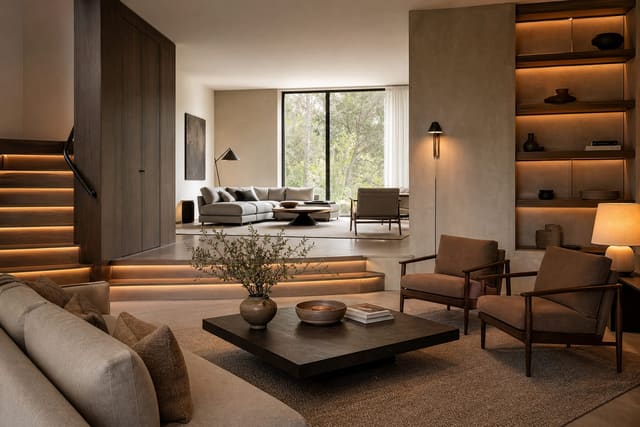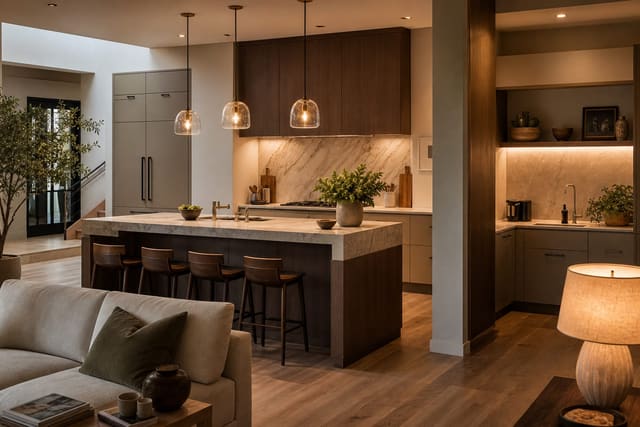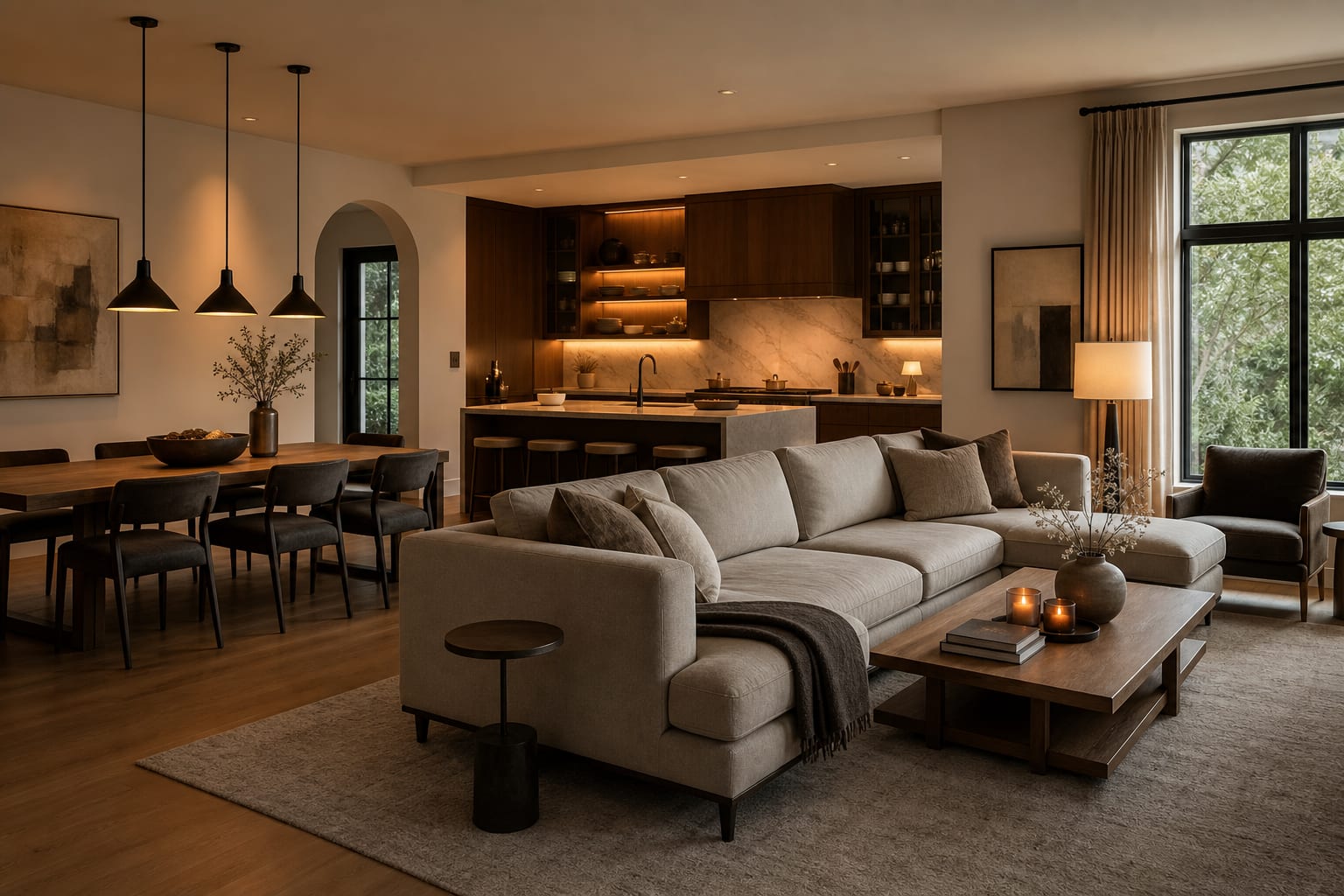
You zone an open plan living dining kitchen by giving each area its own rug, its own light source (pendant, recessed, or sconce), and furniture oriented toward a different focal point. No walls needed: the sofa back, rug edge, and ceiling fixture do the dividing so the eye reads three rooms inside one footprint.
What divides an open-plan space without building walls?
Furniture backs, rugs, lighting, ceiling cues, and storage divide an open-plan space without walls. The goal isn't faking three rooms; it's making one room behave with more manners.
Start with circulation. Keep main walking paths around 36 inches wide where people carry plates or groceries, and allow 30 inches for calmer secondary routes. Around a dining table, plan roughly 24 inches for a chair to pull out and closer to 36 inches if someone must walk behind it during dinner.
Rugs are the easiest visual boundary, but only when large enough to hold the furniture group. An 8 by 10 foot rug works for a modest sofa and two chairs; go 9 by 12 if the seating floats mid-room. Front legs of the sofa and chairs should land on the rug so the group reads as one island, not furniture drifting near the kitchen.
The dining area needs its own cue, especially between kitchen and sofa. A pendant hung 30 to 36 inches above the tabletop, a wall sconce, or a shallow cabinet behind the table makes eating feel deliberate. If the table keeps sliding into the living room, see how to fit a dining table into a small living room.
Which furniture boundary should lead the layout?
The strongest boundary is usually the sofa back, not the rug. A sofa facing away from the kitchen tells the living area where to stop while keeping the cook connected. Choose a back height around 30 to 34 inches if it sits mid-plan; taller backs become a visual wall, and very low backs give too little separation.
A console behind the sofa sharpens that boundary. Keep it 10 to 14 inches deep so it holds lamps and trays without stealing the walkway. Deeper than that, it starts acting like a second table with worse chairs.
Position the dining table as the bridge between kitchen and living zone: kitchen side for serving, living side for conversation. In a narrow room, a rectangular table parallel to the longest wall usually behaves better than a round table pushing chairs into the path.
Scale trips up most open plans. A huge sectional beside a tiny dining table makes eating feel temporary; a bulky dining set beside a delicate sofa makes the living area look underfed. Compare the room against living and dining furniture scale rules before buying either.
Test this on your own room photo with ReDesign - keep the doorway, walls, windows, main furniture, and fixed features visible so the preview solves the room you actually have.
Which open plan zoning ideas earn their footprint?
Change light before you change flooring. Give each zone its own source: under-cabinet lighting for the kitchen, a pendant or sconce for dining, lamps around the sofa. Keep living and dining bulbs warm, roughly 2700K to 3000K, so the room doesn't feel like a kitchen showroom after dark.
Let the kitchen boundary be practical. An island, peninsula, or counter edge already creates a zone if stools, dishwasher doors, and walkway clearances behave. Allow about 24 inches of width per stool and keep stools out of the main route between sink, fridge, and table.
Use ceiling or wall changes sparingly. A dropped ceiling over the kitchen, beams over the dining table, or one accent wall behind the sofa helps, but too many surface changes chop the room up. One architectural cue per zone is enough.
Storage can divide space when it solves a real mess. A sideboard or open-backed shelving unit between dining and living works if it stays under about 42 inches or stays visually porous. A tall cabinet in the middle blocks daylight and turns the kitchen into the back room.
Color should connect the zones while allowing small shifts. Use one wall color throughout if the space is busy, then vary texture through wood, upholstery, tile, and metal. For contrast, repeat at least one finish across all three areas: black window frames and chair legs, or oak cabinets and an oak coffee table.
Common open plan zoning mistakes
- Buying the rug after the sofa. The rug is the floor plan label for the living zone, not an accessory. Choose its size while planning the sofa and coffee table, and keep the coffee table 14 to 18 inches from the sofa edge.
- Floating every piece without an anchor. At least one zone needs a strong edge - a sofa back, island face, sideboard, or pendant-lit table - or the eye has no reason to understand where one activity ends.
- Matching everything too closely. The zones should speak the same language, not wear the same outfit. Repeat tones and materials, then let each zone keep one distinct texture: woven rug, upholstered chairs, satin cabinet fronts.
- Letting the TV control the plan. The sofa can face the media wall, but the dining table still needs light, art, or storage nearby or it will collect laptops instead of dinners.
- Ignoring sound. Hard floors, stone counters, and tall ceilings send kitchen noise straight into the living zone. Add lined drapery, an upholstered sofa, a rug pad, or fabric dining chairs to soften it.
Use AI design to preview your open plan before you commit
A floor plan shows dimensions; a room preview shows whether the sofa back feels graceful, the dining table looks stranded, or the island stools crowd the main path.
Upload one photo from the kitchen looking toward the living area, one from the sofa looking back, and one wide angle from the entry. Keep the dining table, island, windows, and doorways visible - crop out the awkward path and the preview will ignore the exact problem you need to fix.
Run specific zoning tests: one version with a floating sofa, 9 by 12 rug, console behind the sofa, pendant over a 42 inch round table, warm kitchen task lighting, and a clear 36 inch walkway. Run another with the sofa rotated, a rectangular table parallel to the island, and two low bookcases as a divider.
Check the boring details first: does the dining chair still pull out, does the rug hold the seating group, does the sofa back block the view? Those answers matter more than exact chair fabric.
For a more targeted upload-and-preview loop, use AI open plan kitchen living design once you've narrowed to two or three directions. AI can't verify clearances, electrical boxes, or product dimensions, but it can show whether your plan needs stronger furniture edges, better light separation, or fewer competing focal points before money is spent.
After the preview, tape the zones in the real room - sofa back, rug edge, table diameter, chair pullout, console depth, stool line. Walk sink to table, table to sofa, sofa to hallway while carrying something. If the taped layout feels calm, the open plan is ready for furniture.
Frequently Asked Questions
How do I zone an open plan without walls?
Use rugs, ceiling fixtures, and furniture orientation as the three zoning tools. Each zone gets its own rug, its own ceiling moment, and its own focal point, so the eye reads separate zones even without walls.
What rug strategy works for open-plan zoning?
Use different rugs per zone in the same color family but different texture - wool for living, jute for dining, a runner for the kitchen. Identical rugs across zones blur the boundaries; related-but-distinct rugs define them.
How do I define a dining zone in an open plan?
Center one pendant over the table at 28 to 32 inches above the surface, and use a rug 24 inches larger than the table on every side. The lighting moment plus rug perimeter define the zone without any wall.
Where should the sofa go in an open-plan layout?
Float it away from the wall, facing the focal point (fireplace, TV, or window), with the sofa back creating a soft boundary to the zone behind it. Pushed against the wall, the living zone bleeds into the rest of the space.
Can I use half-walls or columns to help zone an open plan?
Yes if the architecture already has them. Adding new half-walls or columns after construction often costs $5,000 to $15,000 and reads as renovation debt - rugs and lighting do most of the zoning work at a fraction of the cost.
> Try this: Ready to see this on your own room? Open ReDesign and run the preview.
Three transformations to try
1. Three zones with matched-family different-texture rugs 2. Dining pendant plus living surface fixture per zone 3. Sofa floating with focal-point orientation