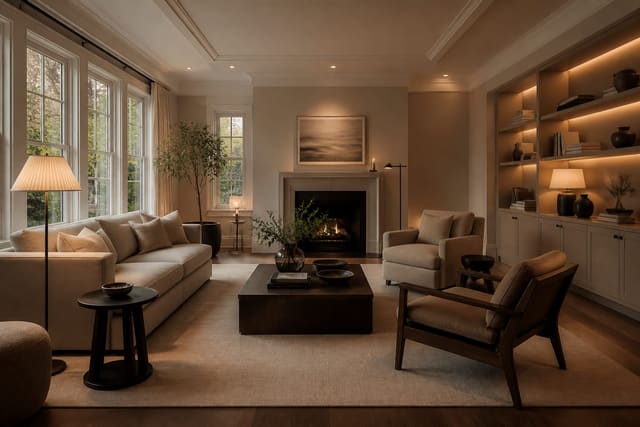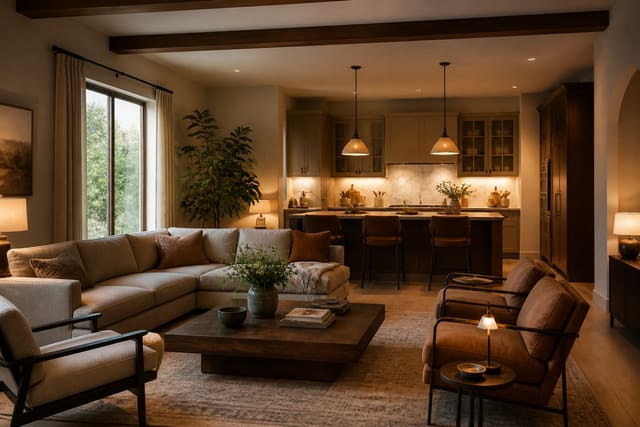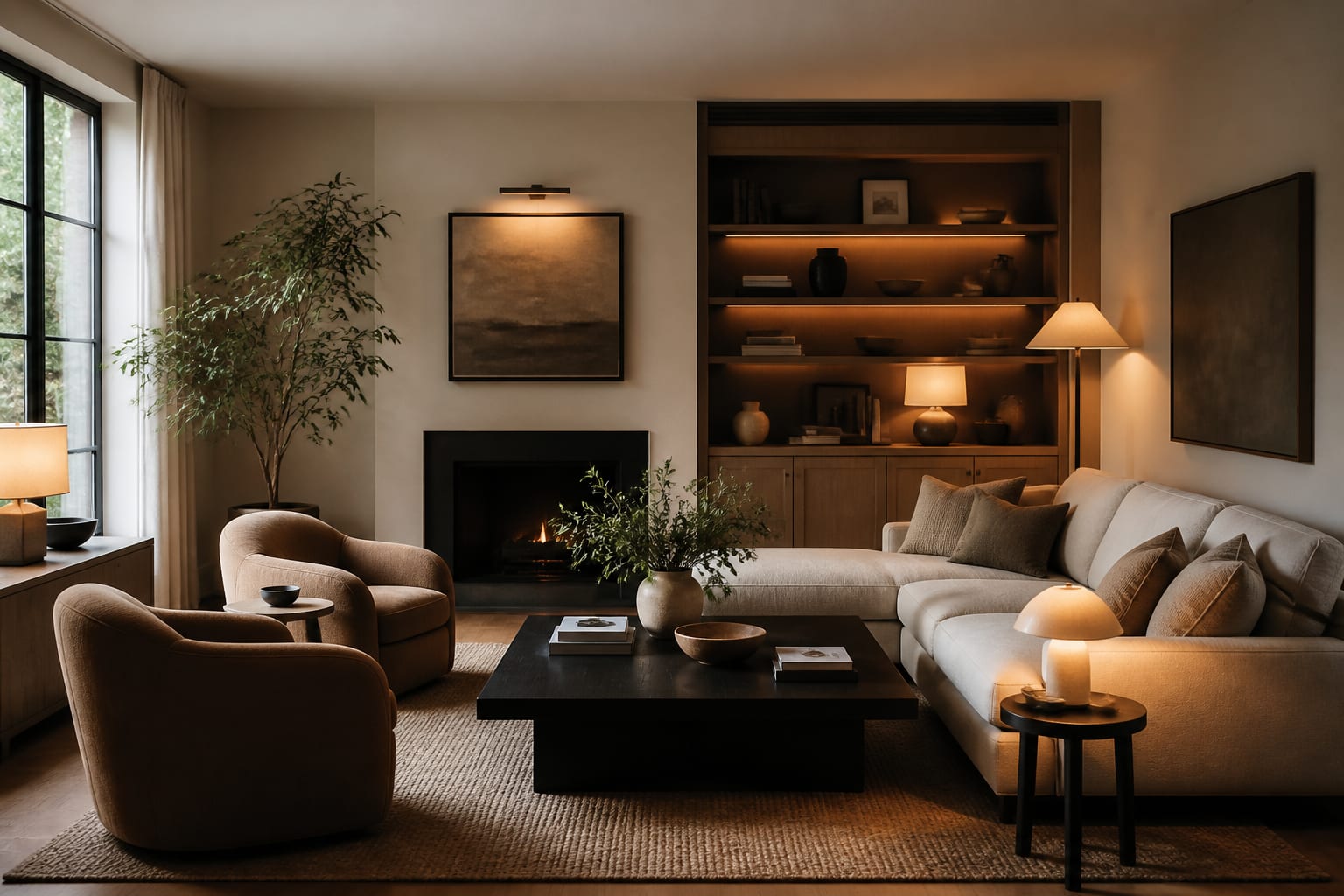
The single overhead light in the middle of the ceiling is the worst thing in most living rooms. It flattens the space, drops hard shadows, and leaves the corners dim while glaring down on everyone's faces. A living room needs to flex from movie-dark to bright-enough-to-read, and one fixture on one switch can never do that. The answer is layering: ambient light to fill the room, task light where you actually do things, and accent light to add depth. Build all three on dimmers and the same room serves a quiet evening, a board game, and a dinner party without you touching a bulb.
What are the three layers of living room light?
The ambient layer is your base. It fills the room with a soft, general glow so nothing is in darkness, and it should come from several spread-out sources rather than one ceiling fixture. Recessed downlights on a dimmer, a few table lamps, or a torchiere bouncing off the ceiling all build ambient light. The goal is even fill with no single bright glare and no dim corners, the foundation the other layers sit on top of.
The task layer puts light exactly where you do something specific: a reading lamp beside the armchair, a floor lamp over the sofa corner where you knit or scroll, a small lamp on a desk in the corner. Task light is brighter and more focused than ambient, and it should sit close to the activity so you are not straining. The accent layer is the finishing touch, the light that adds depth and mood: a picture light over art, LED tape under a floating shelf, a lamp grazing a textured wall. Accent light has little practical function and enormous atmospheric payoff, and it is what makes a room feel designed rather than merely lit. How you arrange these layers depends heavily on the living room layout, since the furniture plan dictates where lamps can land and which corners need their own source.
How much light does a living room actually need?
Start with a target of roughly 20 lumens per square foot for general ambient light, then add task and accent on top. A 200-square-foot living room therefore wants around 4,000 lumens of ambient output, but the key is spreading that across five to eight sources rather than cramming it into one. A single 4,000-lumen ceiling fixture would be punishing; the same total split among recessed lights, two table lamps, and a floor lamp feels balanced and warm. More sources at lower individual brightness always beats one bright fixture.
Color temperature ties it all together. Use 2700K bulbs across the entire living room for the warm, lamplight glow that makes an evening space feel relaxed, and resist the urge to mix in cooler 4000K bulbs, which read cold and clinical in a room meant for unwinding. Aim for bulbs with a CRI of 90 or higher so skin tones and your sofa fabric render true. Above all, put every layer on a dimmer. A dimmer is the cheapest way to make a room flexible, letting the same fixtures deliver bright light for cleaning at 100 percent and a soft 20 percent glow for a film. Expect to spend about $25 per dimmer switch, and it is the highest-return upgrade in the room. In an open-plan living and kitchen space, separate dimmers for the seating zone and the cooking zone let you keep the kitchen bright while the living area stays soft.
Where should the fixtures go?
Start by mapping where people sit and what they do there, then light those spots. Every seating position wants a task light within reach, which usually means a table lamp at each end of the sofa and a floor lamp beside the main chair. Table lamps read best when the bottom of the shade sits around eye level for a seated person, roughly 58 to 64 inches from the floor, so the bulb is hidden and the light falls on the page rather than in your eyes. A floor lamp for reading should put its shade just above and behind your shoulder.
For the ambient base, distribute recessed lights about 6 to 8 feet apart across the ceiling, or rely on lamps and a torchiere if you cannot add recessed cans. Accent fixtures go wherever you want to draw the eye: a picture light centered on art, LED tape under shelving, a small lamp set on a bookshelf. A pendant or chandelier can anchor a conversation area, hung with its bottom about 7 feet off the floor so it lights the zone without blocking sightlines across the room.
Common living room lighting mistakes to avoid
Most dim, flat-feeling living rooms share the same fixable errors: - Relying on a single overhead fixture, which flattens the room, shadows faces, and leaves the corners dark. - Skipping dimmers, so the room is stuck at one brightness and never shifts for movies or conversation. - Mixing color temperatures, putting a 2700K lamp beside a 4000K downlight, so the light reads uneven and cold. - Hanging table-lamp shades too high or too low, so the bare bulb glares instead of hiding above seated eye level. - Forgetting task light, leaving people to read or work in dim ambient glow that strains the eyes. - Under-lighting the corners, which makes even a large room feel small and cave-like after dark.
See your lighting plan in Re-Design
Layered lighting is hard to picture from a written plan, because the magic is in how the sources combine in your specific room. Upload a photo of your living room into Re-Design and preview the three layers at once: add table lamps at the sofa ends, a floor lamp by the chair, accent light on the art, and watch the flat single-bulb look turn into a room with depth. You can re-design the same space with a warm 2700K scheme versus a cooler one, or test a pendant over the seating area against recessed cans, all before buying a fixture. That preview shows you exactly where each source needs to land so the finished room feels both bright enough and genuinely inviting.
Frequently Asked Questions
What are the three layers of living room lighting?
The three layers are ambient, task, and accent. Ambient light fills the room with a soft general glow from several spread-out sources. Task light is brighter and focused where you read, work, or play. Accent light adds depth and mood through picture lights, LED tape, or a lamp grazing a wall. Building all three, each on its own dimmer, is what makes a living room flexible and inviting.
How many lumens does a living room need?
Aim for about 20 lumens per square foot of ambient light, so a 200-square-foot room needs roughly 4,000 lumens. The important part is spreading that total across five to eight sources rather than one fixture, since many softer sources feel far better than a single bright one. Add task and accent light on top of that ambient base for the spots where you need it.
What color temperature is best for a living room?
Use 2700K bulbs throughout for the warm, relaxed glow a living room wants after dark, and keep every fixture at that same temperature so the light reads consistent. Avoid cooler 4000K bulbs, which feel cold and clinical in a space meant for unwinding. Choose bulbs with a CRI of 90 or higher so skin and fabric colors render accurately.
Do I need dimmers on living room lights?
Yes, dimmers are the single best upgrade for living room lighting. They let the same fixtures deliver bright light for cleaning and a soft glow for a film, so one room handles every mood without swapping bulbs. At around $25 per switch, dimmers are inexpensive, and putting each lighting layer on its own dimmer gives you full control over the atmosphere.