The old knock on Murphy beds was that they looked like furniture hiding a secret, and the secret was always obvious. That is no longer true, and clinging to the stereotype costs you the single best way to make one room do two jobs. A modern fold-away bed, framed by built-in cabinetry and finished like real millwork, disappears so cleanly that guests cannot tell the home office, den, or playroom doubles as a bedroom. The trick is to stop thinking of it as a bed you hide and start thinking of it as a wall of built-ins that happens to fold down. Design the cabinet, not just the mattress.
Get the dimensions right before anything else
A Murphy bed lives or dies on clearances, so measure before you fall for a finish. A vertical queen cabinet, the most common type, stands about 83 inches tall closed and projects 16 to 18 inches from the wall, less than a typical sofa's depth. When it folds down, the mattress and frame swing into the room and need roughly 60 inches of clear floor in front, so plan a path and keep that landing zone free of rugs that bunch or furniture you would have to drag aside every night. A horizontal queen, which folds from the side, sits lower and wider and suits a room with an 8-foot ceiling or a long stretch of short wall.
Mattress depth is the spec people miss. Most cabinets are built for a mattress no thicker than 10 to 12 inches, and a plush 14-inch model can stop the bed from closing flush or latching. Buy the mattress to fit the cabinet, not the other way around. Wall mounting matters too: the cabinet must anchor into studs or a properly rated cleat, because the lift mechanism transfers real force to the wall every time the bed moves. Get these numbers settled and the rest is styling.
Build it into a wall, not a standalone box
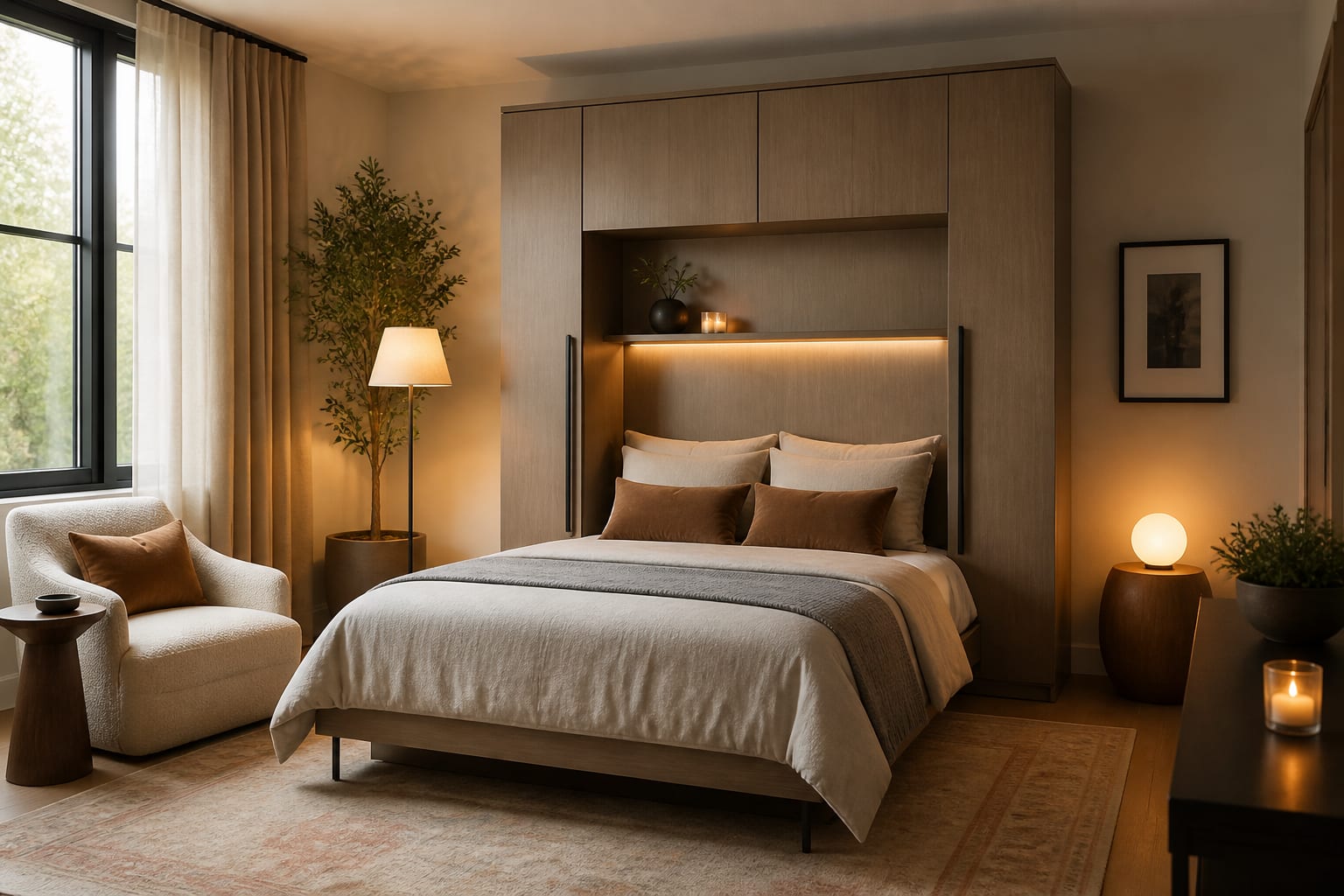
A Murphy bed sitting alone on a blank wall always looks like what it is. Surround it and it vanishes. The strongest move is to flank the bed cabinet with floor-to-ceiling bookcases or cabinets in the same finish, so the bed front becomes one panel in a continuous wall of millwork. Run a 12-inch-deep shelf or a fixed header across the top to tie the units together and hide the gap where the cabinet meets the ceiling. When the bed is up, the eye reads a built-in library; when it is down, the shelves still frame it like a headboard.
Desk-style units take this further for a home office. Some horizontal Murphy cabinets include a fold-down desk that stays level when you lower the bed, so the laptop and lamp do not need clearing first, a genuinely clever bit of engineering for a room that works all day and sleeps at night. Matching the cabinetry color to the room's existing trim, the way you would coordinate a fitted master bedroom wardrobe wall, is what sells the built-in look. A contrasting cabinet announces itself; a matched one disappears.
Light it and dress it like a real bed
The fastest way to break the illusion is to leave the folded-down bed unlit and unstyled, glowing only from the overhead. Build lighting into the cabinet. LED strips along the inside edges of the flanking shelves, or a pair of slim reading lights mounted to the cabinet face at about 48 inches, give the bed the same bedside glow a permanent headboard would. Wire them to a switch within arm's reach of the pillow, since there is no nightstand lamp to reach for.
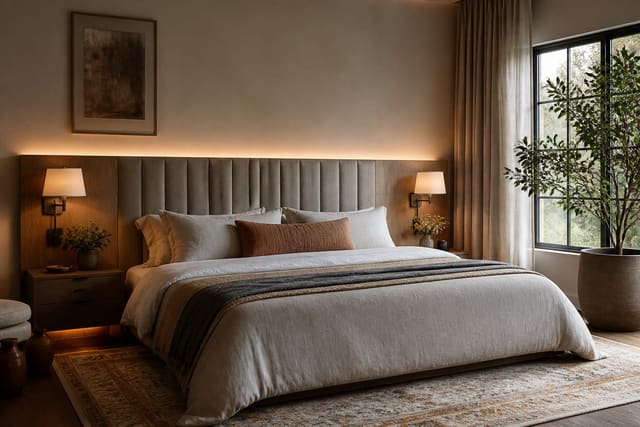
Dress the made bed so it looks intentional, not stowed. A fitted sheet plus a coverlet that tucks cleanly lets the bed fold up without a pile of loose bedding catching in the mechanism, and a couple of pillows on a strap or shelf keeps them from tumbling out. The face of the cabinet is a design surface too: a slatted wood front, a painted shaker panel, or an upholstered insert all read as deliberate. The same attention you would give a headboard belongs on that cabinet face, because when the bed is up, that panel is the largest thing on the wall.
Murphy bed ideas worth copying
With the mechanics handled, here are concrete configurations that work: - A queen vertical cabinet flanked by two 18-inch bookcases, unified by a 12-inch header shelf, so the wall reads as a built-in library. - A horizontal twin or full with an integrated fold-down desk for a true office-by-day, guest-room-by-night setup. - A bunk-style double Murphy for a kids' room or vacation rental, stacking two fold-away beds in one cabinet. - An upholstered cabinet face in performance velvet that doubles as a soft, padded wall when the bed is up. - A slatted white-oak front with hidden push-latch hardware so there are no visible handles to break the clean line. - A unit with side cabinets holding a pull-out bench or ottoman, giving the room seating that tucks away too. - A Murphy cabinet painted the same deep color as the room's walls so it recedes completely into the architecture.
Preview your wall in Re-Design first
A Murphy bed is a built-in, which means it is expensive to get wrong and nearly impossible to picture from a catalog. Upload a photo of the room into Re-Design and the app shows the wall as a finished cabinet system, both with the bed tucked up and folded down, using your actual ceiling height and wall width. You can test a matched-trim cabinet against a bold contrasting one, see whether flanking bookcases fit your space, and confirm the fold-down landing zone leaves room to walk before a single panel is built. Seeing the dual-purpose wall rendered in your own room is the difference between hoping it works and knowing it does.
Frequently Asked Questions
How much space does a Murphy bed need?
A vertical queen cabinet stands about 83 inches tall and projects 16 to 18 inches from the wall when closed, less than a typical sofa's depth. When it folds down it needs roughly 60 inches of clear floor in front, so keep that landing zone free of rugs and furniture. A horizontal unit sits lower and wider, which makes it the better pick for rooms with 8-foot ceilings or a long stretch of short wall.
Do Murphy beds work with thick mattresses?
Usually only up to a point. Most cabinets are engineered for a mattress 10 to 12 inches thick, and a plush 14-inch model can keep the bed from closing flush or latching properly. Buy the mattress to fit the cabinet's stated limit rather than forcing a thicker one in. The lift mechanism is also tuned to a weight range, so an overweight mattress can make the bed harder to raise and shorten the hardware's life.
How do I make a Murphy bed look like a built-in?
Flank the cabinet with floor-to-ceiling bookcases or matching cabinets in the same finish, then tie them together with a header shelf across the top so the bed front becomes one panel in a continuous wall. Match the cabinetry color to the room's existing trim so it recedes, build lighting into the surround, and finish the cabinet face with a slatted, shaker, or upholstered panel so it reads as designed millwork.