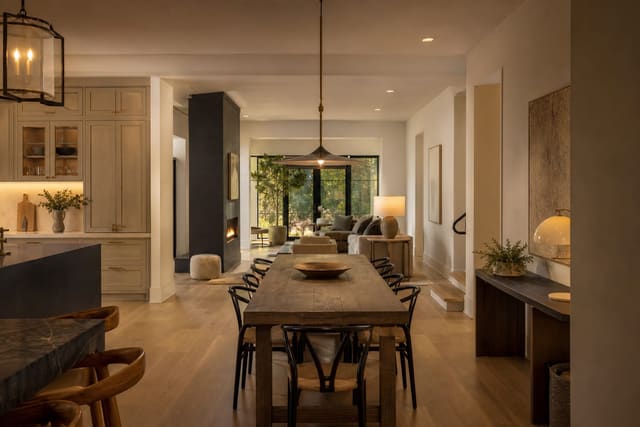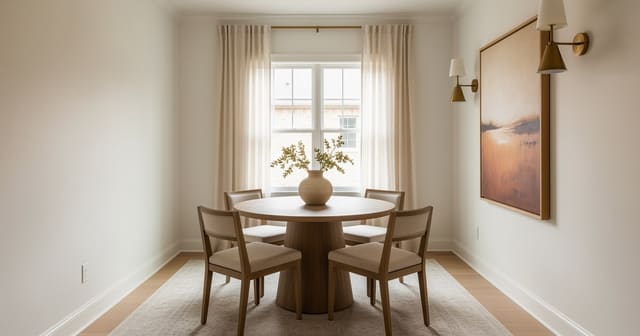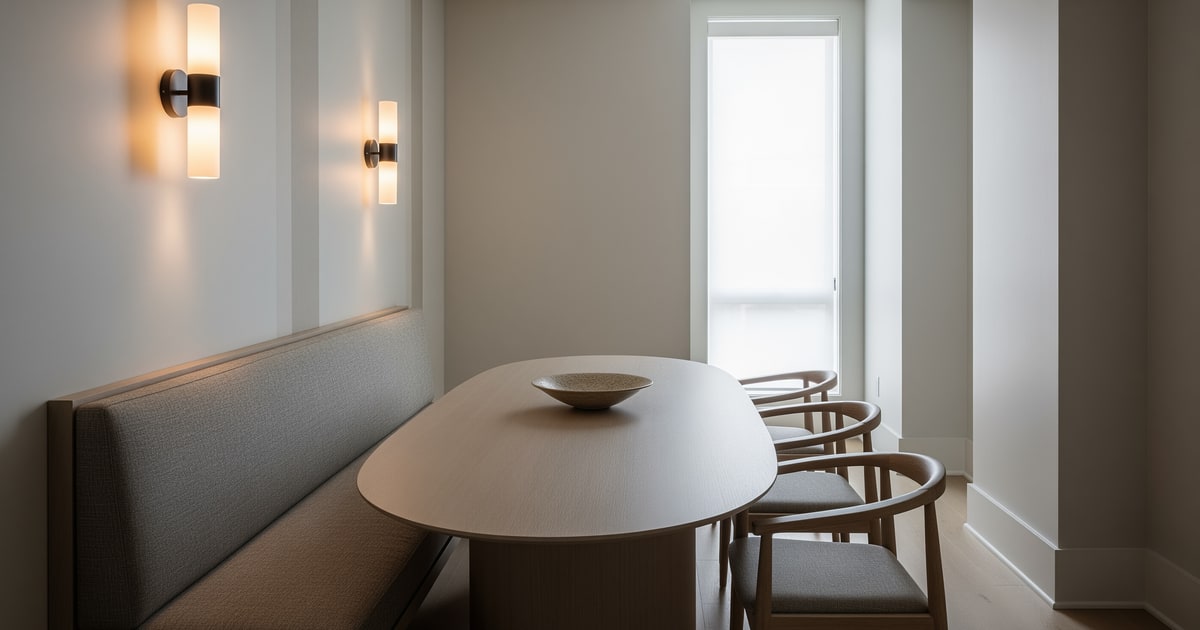
A narrow galley dining room earns its scale when the table runs lengthwise centered between two doorways, seating drops to bench plus chairs on one long side only, and the opposite wall becomes a 12 to 16-inch deep sideboard or built-in for serving. A narrow dining room fails when it pretends to be a square dining room. The standard table centered under a chandelier leaves bruised hips, blocked chairs, and a room people avoid except on holidays. The better move is to design it like a galley: one clean traffic lane, one dominant table line, shallow storage, and lighting that stretches the room instead of squeezing it. The result can feel intentional, not compromised.
How do you furnish a long narrow dining room?
Furnish a long narrow dining room with a slim rectangular or oval table, bench seating on the tight side, armless chairs on the open side, at least 36" of clear circulation where people walk, and wall-mounted lighting instead of bulky floor pieces. The goal is to keep one side visually and physically lighter so the room has a lane.
The layouts that work in a galley dining room
- Table parallel to the long wall. This is the default for a reason. It follows the room's shape and keeps circulation predictable.
- Bench on the wall side, chairs on the open side. A bench needs less pull-out depth than chairs. If the wall side is tight, a bench or banquette can recover 10" to 18" of usable width.
- Oval table instead of sharp rectangle. An oval keeps seating capacity but softens the corners that people clip in narrow rooms.
- One shallow storage piece only. A 12" to 15" deep sideboard, wall-mounted shelf, or picture ledge works. A standard 20" deep buffet usually steals too much of the walking lane.
Test this on your own room photo with ReDesign before you choose the final direction; keep the doorway, walls, windows, main furniture, lighting, and awkward fixed features visible so the preview solves the room you actually have.
Table, bench, and clearance specs
For rooms under 9' wide, start with a 32" to 36" wide table. Wider tables feel generous in a showroom and punishing in a galley dining room. Leave 36" minimum from table edge to the walking wall; 42" is better if people pass behind seated diners. A built-in or freestanding bench should be 18" deep and about 18" high. If you use chairs on both sides, pick armless chairs under 20" wide and avoid thick upholstered backs.
Lighting and wall moves that stretch the room
Use a linear pendant or two small pendants centered over the table line, not a wide chandelier that fights the narrow footprint. Add a pair of plug-in or hardwired sconces at 60" to 66" on the long wall to create rhythm. Keep wall color warm and continuous from end to end; a dark short wall can work only if the room already has good daylight. A long mirror can help, but only if it reflects the table, sconces, or a window rather than another blank wall.
A galley dining room needs furniture that respects the long axis. Keep the table 30 to 34 inches wide when circulation is tight, and leave 30 inches from table edge to wall for a minimum seated pull-out. If people need to pass behind chairs, push for 36 inches on that side or use a bench that tucks fully under the table. A 14 to 16 inch deep bench along one wall can save enough space to make the room work, especially with a pedestal or trestle table that avoids corner legs. The tighter table math from small dining room ideas applies here, but the narrow room also needs length managed visually.
Lighting should run with the table, not fight it. A linear pendant about one-half to two-thirds the table length pulls the eye down the center, while two small pendants can work over a longer table if they are evenly spaced. Hang the fixture 30 to 34 inches above the tabletop and keep bulbs warm so the room feels like dining, not a corridor. Wall moves matter too: one long piece of art, shallow picture ledges, or a continuous banquette back will look calmer than a scatter of small frames. Owners can add a banquette and shift the ceiling box; renters can use a plug-in linear pendant and a washable runner. If the room mostly fails after sunset, start with the dim dining room lighting fix before changing the table.
The rug decision is binary in a narrow dining room. Either use a rug large enough that every chair remains on it when pulled out, or skip the rug and let continuous flooring lengthen the room. A too-small rug catches chair legs and draws a rectangle around the problem. If you need softness, use an indoor-outdoor flatweave with a low contrast border, not a thick pile that makes chairs harder to move.
Storage should move up or get shallow. A 10 to 12 inch picture ledge, wall-mounted cabinet, or narrow sideboard can hold serving pieces without stealing chair clearance. Standard 18 to 20 inch deep buffets belong only at the end of the room or in a recess. If the room needs closed storage, choose doors over drawers so no one has to stand in the traffic lane with a drawer open.
Finish rhythm matters because the eye travels down the long walls. Repeat one material three times: wood table, wood picture frame, wood bench; or black chair legs, black sconce arms, black art frames. That repetition makes the room feel composed without adding bulk. Avoid alternating every chair, frame, and fixture finish, which turns a narrow plan into visual noise.
End walls deserve attention. A strong piece of art, a shallow cabinet, or a softly lit plant at the far end gives the eye a destination and makes the length feel chosen. Leaving the end blank makes the room feel like a passage. If the end wall has a window, keep treatments simple and stack fabric outside the glass so the room borrows every inch of width it can.
Chair backs should be visually quiet. Spindles, cane, slim upholstery, or low curved backs work better than tall parsons chairs lined up like a wall. In a narrow room, every repeated chair back becomes architecture, so choose a shape you want to see six times in a row.
Common narrow dining room mistakes
- Centering everything by habit. Centering a table in a narrow room often leaves two useless skinny lanes instead of one comfortable lane.
- Using bulky host chairs. Upholstered end chairs make the room look formal and narrower at the same time.
- Standard-depth storage. A full buffet can eat the exact clearance the chairs need.
- One wide chandelier. The fixture spreads visually across the narrow width and makes the ceiling feel lower.
- Tiny rug under the table. If a rug cannot extend at least 24" beyond every table edge, skip it and let continuous flooring make the room feel longer.
- Buying standard-depth storage for a skinny room. A beautiful buffet can steal the exact 6 inches the chairs need, turning every dinner into a shuffle.
- Choosing a wide table to make the room feel generous. In a galley plan, generosity comes from circulation, not tabletop width.
Use AI design to test the galley layout before buying
Narrow dining rooms are hard to solve on graph paper because a few inches changes everything. Upload a photo to Re-Design and preview a wall-side bench, an oval table, a linear pendant, and shallow storage before ordering furniture. Seeing the walking lane in your actual room is the fastest way to stop guessing.
Frequently Asked Questions
How wide does a narrow dining room need to be?
Plan for 9 to 10 feet minimum to fit a 36-inch table with chairs on both sides; an 8-foot-wide room works only when one side becomes a bench against the wall. Use the room photo to compare the visible layout and fixed constraints before committing, because door swings, windows, outlets, storage reach, circulation, and existing furniture decide whether the idea survives daily use.
Should chairs sit on both sides of a narrow dining table?
Bench on one long side and chairs on the other reads designed and increases seat count; chairs on both sides require 30 inches of clearance behind each, which most narrow rooms cannot give. Keep the preview honest by leaving the problem area visible in the frame, then compare one conservative version against one bolder version before you buy lighting, paint, furniture, or storage.
What shape table works best in a narrow dining room?
Rectangular tables 36 to 40 inches wide and 60 to 84 inches long match the room geometry; round tables waste corners and read awkward in a corridor-shaped space. Check the result against ordinary movement first: drawer clearance, chair pullout, walkway width, glare, switch access, and sightlines matter more than a perfect catalog angle.
Where does the sideboard go in a narrow dining room?
Against the long wall opposite the bench seating, 12 to 16 inches deep so it does not steal walkway; deeper sideboards force chairs to crowd the table edge. Use the image to narrow priorities and measurements before ordering anything custom; final purchases still need real dimensions, outlet locations, installation limits, and product clearances.
How do I light a narrow galley dining room?
Use a linear pendant or two matching pendants centered on the table length, not a round chandelier; round fixtures fight the long geometry and read off-center from the doorways. If the preview invents architecture or hides the awkward feature you need solved, rerun it with stricter instructions so the result remains tied to your actual room.
> Try this: Ready to see this on your own room? Open ReDesign and run the preview.
Three transformations to try
1. Bench-plus-chairs galley dining layout 2. Linear pendant centered on rectangular table 3. Shallow sideboard against long wall opposite bench