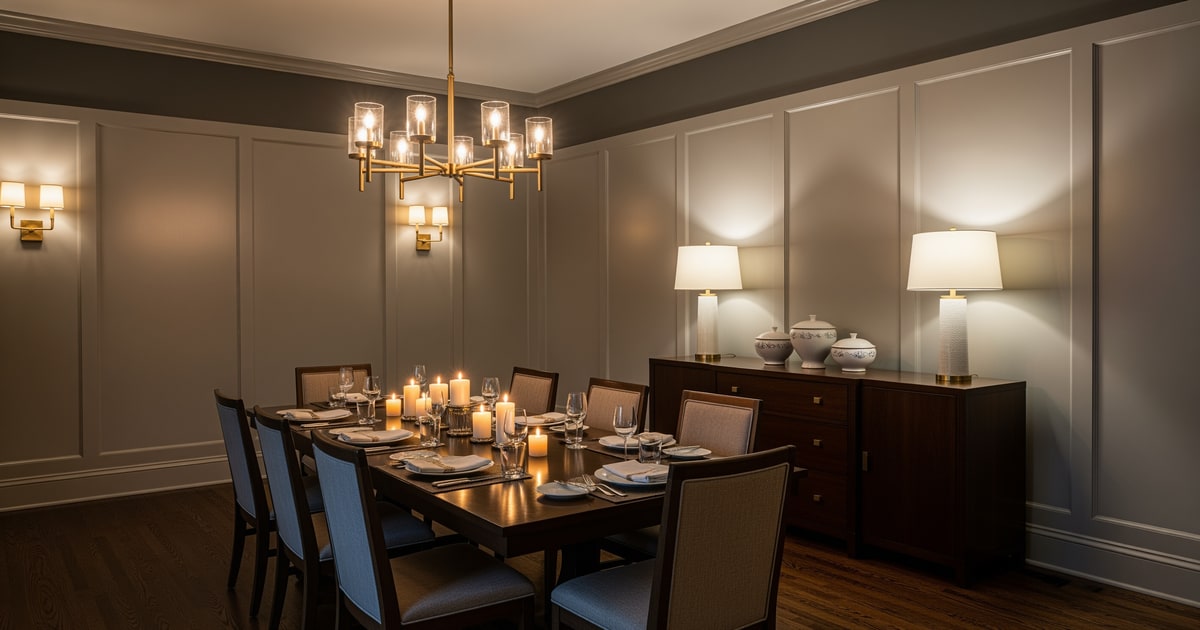
A dim dining room fixes when the lighting stops relying on the chandelier alone — adding two flanking sconces or buffet lamps on the sideboard wall, a single warm 2700K floor lamp in a corner, and dimmers on every fixture so light layers from candle dim through full bright depending on the meal. A dim dining room is almost always a single-fixture problem. One chandelier hung too high, on no dimmer, with cool-white bulbs, doing all the work for a room designed around long meals at close quarters. The fix isn't a bigger chandelier — it's a four-layer plan that makes the room glow at every height. Done right, the dining room becomes the room everyone gravitates toward after dinner.
How do you fix a dim dining room?
Improve lighting in a dim dining room with four layers: a chandelier or pendant hung at the right height on a dimmer, wall sconces flanking the buffet or art, a pair of buffet lamps at counter height, and candles on the table itself. All at 2700K. The single biggest mistake is treating the chandelier as the only light source — chandeliers are ambient, not task, and a dining room needs multiple heights of warm light for the conversation that happens around the table.
Chandelier or pendant height (the most-missed spec)
The chandelier is the focal point, but only if it's at the right height.
- Bottom of the fixture: 30"–34" above the table top. Not from the floor — from the table. Hung too high (over 36") and it floats; hung too low (under 28") and people bump it standing up.
- Diameter: half the width of the table, minimum. A 36"-wide chandelier over a 72" table is too small; aim for 36"–48" for that table.
- Dimmable on a wall dimmer, not a chain pull. Non-dimming chandeliers are a design crime in any dining room.
- Style match: chandelier sets the tone for the room. Modern minimalist needs a clean architectural form; traditional rooms need crystal or candle-style; coastal rooms need woven or rope.
- 2700K bulbs only. If the chandelier uses bare candelabra bulbs (E12 socket), get the dim-to-warm version that drops to 2200K when dimmed. Magic.
Test this on your own room photo with ReDesign before you choose the final direction; keep the doorway, walls, windows, main furniture, lighting, and awkward fixed features visible so the preview solves the room you actually have.
Wall sconces flanking buffet or art
The most-forgotten layer in dining rooms. Two wall sconces on the long wall behind the buffet or flanking a piece of art double the light in the room without adding a single ceiling fixture.
- 60"–66" off the floor, centered with the buffet or the art.
- Hardwired ideal, plug-in works. A pair of plug-in sconces with cords run through baseboard cord covers is indistinguishable from hardwired once styled.
- Choose a sconce with an upward throw. Down-only sconces light only the wall; up-and-down sconces bounce light off the ceiling for ambient fill.
- Same Kelvin as the chandelier. All 2700K.
Buffet lamps (the secret weapon)
A pair of buffet lamps — tall, narrow table lamps designed for sideboards — at 26"–32" total height on either end of the buffet bring the lighting to human-eye level when seated.
- A single pair adds 10x the ambience of any one ceiling fixture upgrade.
- Low-watt LEDs (25–40W equivalent), 2700K, on the same dimmer or smart-plug as the chandelier.
- Skip the matchy-matchy lamp-and-vase set. Two identical lamps with simple silhouettes read more curated.
Candles on the table
The fourth layer is on the table itself. Real or LED, taper or pillar, the candles add point sources at the lowest height in the room — the height closest to the diners' faces.
- Two taper candles in metal candlesticks at 8"–10" tall if you want low-profile.
- Three pillar candles of varying heights in glass hurricanes for a more sculptural look.
- LED flicker candles with real wax exteriors (Luminara, Pottery Barn) read genuinely like real candles in dim light and don't require watching during dinner.
- Always dim the rest of the room to 30%–40% when candles are lit. The candles disappear if competing with bright overhead light.
Color temperature, dimming, and bulb selection
- 2700K across every fixture. Mixed Kelvin in a dining room is a worse offense than mixed Kelvin in a kitchen.
- Dim-to-warm bulbs (drop to 2200K when dimmed) for chandeliers with bare candelabra bulbs. Look for "warm dim" or "dim-to-warm" on the package. ~$8 per bulb.
- Smart bulbs on a "dinner" scene set the whole room to ~30% in one tap. A Lutron Caseta or Hue setup that runs all four layers off one button is the single most adult upgrade in a dining room.
The table light has to be sized to the table, not the room. Hang the bottom of a chandelier or pendant 30 to 34 inches above the tabletop, and choose a fixture about one-half to two-thirds the length of the table. A 72 inch table usually wants a 36 to 48 inch linear fixture or a pair of smaller pendants; a 42 inch round table can take a 20 to 28 inch drum or lantern. Use 2700K dimmable bulbs and a shade or diffuser that hides the bulb from seated eye level. If the room is long, the layout rules in narrow dining room ideas keep the fixture from emphasizing the bowling-alley effect.
The underrated product pick is the buffet lamp. A pair of 26 to 30 inch lamps on a sideboard gives faces side light, makes serving feel intentional, and lets you keep the chandelier lower without relying on it for all brightness. If there is no sideboard, use a plug-in wall sconce or picture light over art. Renters can get most of the effect with table lamps and a plug-in pendant on a swag hook; owners should add a dimmer and shift the ceiling box if it misses the table center by more than 6 inches. For truly tiny rooms, compare table shape first in small dining room ideas, then choose the fixture.
Shade material changes the whole mood. Linen, paper, opal glass, and pleated fabric diffuse light across faces; clear glass and exposed candle bulbs sparkle in photos but can make guests squint. If you love a lantern shape, choose one with frosted sleeves or use low-lumen bulbs and let buffet lamps provide the flattering layer. A dimmer is mandatory because dining rooms shift from homework to dinner to late conversation more than most people admit.
Common dim-dining-room mistakes
- Chandelier hung too high. Defaults from electricians put it at 38"–42" above the table; the right number is 30"–34".
- No dimmer. The room only has one mode.
- Cool-white bulbs. Reads like a banquet hall.
- No buffet or sconce layer. The most-skipped part of the plan.
- One giant pendant with no other light. Even at the right height and Kelvin, a single pendant flattens the long table.
- Spotlight cans in the ceiling pointed at the table. Reads like a hostage interrogation.
- Choosing sparkle over usable glow. Clear crystal and bare bulbs can look dramatic online while throwing harsh pinpoints across plates and faces.
- Centering the fixture on the room instead of the table. Diners feel the mismatch immediately, even if guests cannot name what is wrong.
Use AI design to preview the dining room glowing
Owners who have eaten under one harsh chandelier for a decade can't picture the four-layer version. AI design lets you photograph the existing dining room and preview it with the chandelier at the right height, sconces, buffet lamps, and candles — alongside the current dim version — in minutes. The preview is what unlocks the small electrical bill and the trip to Target for the lamps.
Frequently Asked Questions
Why does my dining room feel dim even with the chandelier on?
Chandeliers cast light downward onto the table center and leave the room edges in shadow; without flanking sconces, buffet lamps, or a wall fixture, the dining room walls and corners read cave-like even at full chandelier output. Use the room photo to compare the visible layout and fixed constraints before committing, because door swings, windows, outlets, storage reach, circulation, and existing furniture decide whether the idea survives daily use.
What watts does a dining room chandelier need?
Total 1,200 to 2,400 lumens for an 8x10ft dining room (roughly 60 to 100W equivalent across all bulbs); below that the room reads under-lit, above it the table glares for everyone seated below. Keep the preview honest by leaving the problem area visible in the frame, then compare one conservative version against one bolder version before you buy lighting, paint, furniture, or storage.
Should I add sconces to the dining room walls?
Yes — sconces at 60in centerline on either side of a sideboard, mirror, or art piece add the layer the chandelier cannot, plus they read finished and architectural on otherwise empty walls. Check the result against ordinary movement first: drawer clearance, chair pullout, walkway width, glare, switch access, and sightlines matter more than a perfect catalog angle.
Are buffet lamps still in style?
Yes — a pair of 24 to 32in lamps on the sideboard reads classic and warm; the lamps stay off during full meals and on for candlelit second courses and after-dinner conversation. Use the image to narrow priorities and measurements before ordering anything custom; final purchases still need real dimensions, outlet locations, installation limits, and product clearances.
Should every dining room light be on a dimmer?
Yes — meals shift from prep (full bright) to seated (medium) to dessert (low) to lingering (candle); without dimmers the room locks into one mode and either glares or feels dim every time. If the preview invents architecture or hides the awkward feature you need solved, rerun it with stricter instructions so the result remains tied to your actual room.
> Try this: Ready to see this on your own room? Open ReDesign and run the preview.
Three transformations to try
1. Dining room with chandelier, flanking sconces, and buffet lamps 2. Statement chandelier with corner floor lamp 3. Multi-layer dining with candle dim setting