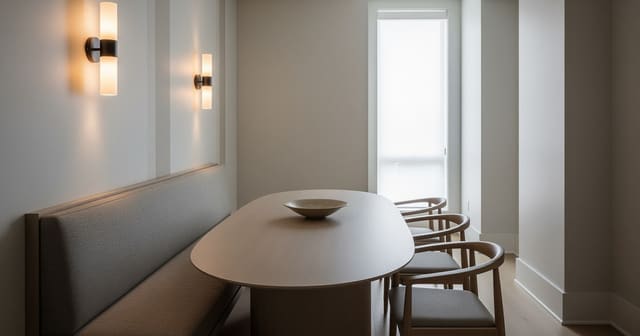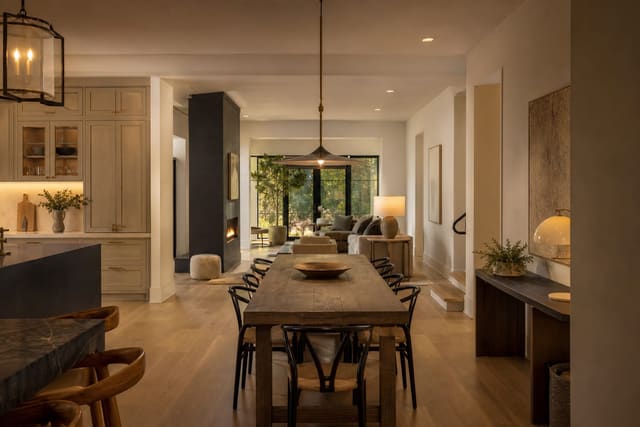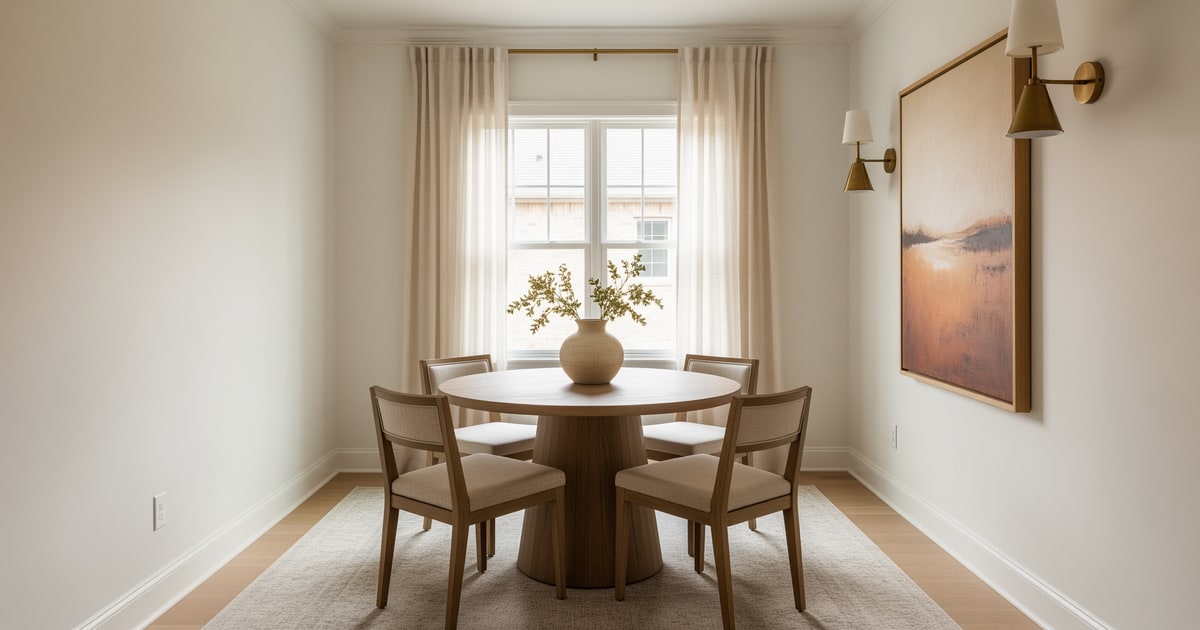
A dining room under 100 square feet seats four to six when the table is a round 42 to 48-inch (or rectangular 36 by 60-inch with bench seating on one side), the room edits to one sideboard 12 to 16 inches deep, the rug spans 8 by 10 feet to extend visually past every chair, and the lighting is one pendant centered on the table at 28 to 32 inches above the surface. A dining room under 100 square feet is not a problem — it's a constraint that forces better decisions than most larger rooms ever achieve. The mistakes are predictable: a table too big for the room, chairs that block every circulation path, a chandelier hung too low, walls painted in a dark color "for coziness" that just shrinks the room further. Fix those four things and a 9x10 dining room feels intentional and generous.
What do you do with a dining room that is too small?
Right-size the table first. A round or square table seats the same number of people as a rectangular one while freeing the corners for circulation — the corners are what make small dining rooms feel tight. Match the table diameter to the room: a 36" round table works in a room as small as 8'x8'; a 42" round table needs at least 9'x9'. Then layer light correctly and clear every unnecessary piece of furniture. Small dining rooms that work have three things: the right table, good light, and nothing extra.
Table size and shape: the single most important decision
- Round over rectangular in square or near-square rooms. A 36"–42" round table is the workhorse of the small dining room. No corners to navigate around, no head-of-table dead zones, no awkward wall proximity.
- Pedestal base only. Four-leg tables in small rooms create eight legs total between the table and four chairs. A pedestal base gives everyone more under-table legroom and makes the room feel less cluttered by 40%.
- Drop-leaf tables for the smallest rooms. A drop-leaf can seat 2 every day and expand to seat 6 for guests. Companies like Crate & Barrel, Room & Board, and IKEA all make refined versions. Not a compromise — a feature.
- Minimum clearance requirements. Leave at least 36" from the table edge to any wall for pull-out seating. 42" is comfortable; 48" is generous. Anything under 30" and the person sitting against the wall can't stand up without hitting the opposite chair.
Test this on your own room photo with ReDesign before you choose the final direction; keep the doorway, walls, windows, main furniture, lighting, and awkward fixed features visible so the preview solves the room you actually have.
Chair strategy for small dining rooms
- Armless chairs only. Arms add 4"–6" on each side of the seat footprint and prevent the chair from being pushed fully under the table. In a small room, armless chairs are not a downgrade — they're the right tool.
- Go lighter visually. Lucite or rattan chairs disappear into the room; heavy upholstered chairs with padded backs visually fill a small room to capacity even when empty.
- Benches on one or two sides. A bench along one wall or in a corner banquette configuration gains seating without the blocked-circulation problem of individual chairs. A 48" bench seats three adults comfortably.
- Stackable or foldable accent chairs for overflow. Keep two good-looking folding or stackable chairs in a closet. When a dinner party needs them, they're available; the rest of the time the room breathes.
Lighting that makes the room feel larger
- Chandelier bottom: 30"–34" above the table. In a small room this measurement is critical — too high and the fixture floats, making the room feel taller but hollow; too low and it reads cramped.
- A smaller chandelier than you think you need. A 24"–28" diameter chandelier over a 36" round table is correct and looks intentional. A chandelier wider than the table overwhelms a small room.
- Dimmer on the chandelier. Small dining rooms feel even smaller under full-brightness overhead. Running the chandelier at 50%–70% with two wall sconces or buffet lamps at the perimeter is the right setup.
- Wall sconces, not a second overhead. Two plug-in sconces at 60"–66" on the long wall double the light without adding to ceiling visual clutter.
- 2700K everything. Small dining rooms especially can't afford the clinical read of cool-white bulbs.
Paint, mirror, and finish choices that add perceived space
- Warm white walls or a warm greige. Benjamin Moore White Dove, Sherwin-Williams Accessible Beige, or Farrow & Ball Skimming Stone — all bounce light and read as larger than they are.
- One large mirror on the wall opposite the longest window or primary light source. 24"x36" minimum. Reflects the room back at itself and doubles the perceived depth.
- Match the floor color to the wall color or go lighter. A dark floor in a small dining room is a floor that visually compresses the ceiling down.
- Skip the area rug under the table if the room is under 100 sq ft. Rugs add visual layers; small rooms benefit from calm, continuous flooring.
- Extend the table to the wall as a built-in if you're willing to invest. A wall-to-wall built-in table with a bench or banquette on one side gains 8"–12" of useful surface per side that floating furniture wastes.
Table math is ruthless under 100 square feet. A 36 inch round table is the safest four-person option when the room is close to square, while a 30 by 48 inch rectangle works better in a narrow room or against a banquette. Leave 30 inches from table edge to wall for a tight but usable pull-out, and 36 inches where someone has to pass behind a seated diner. Pedestal bases beat four legs because chairs can slide around them. If the room is more galley than square, the narrow dining room guide will save you from buying a table that technically fits and still feels hostile.
The finish pick should reduce visual weight. Cane-back chairs, slim black metal frames, bentwood cafe chairs, or upholstered slipper chairs without arms all keep the room breathable. A washable wool-look rug can help define the dining area, but it has to extend about 24 inches beyond the table on every side or the chairs will catch. Renters should solve the room with furniture and plug-in light first; owners can add a built-in banquette or a wall sconce pair if the room is truly permanent. For studios, the zoning ideas in small space studio design explain how to make the dining zone feel separate without walls.
Common small-dining-room mistakes
- A table 6"–12" too large. The number-one mistake. The correct size feels too small in the store; it works in the room.
- Four large upholstered chairs. Takes the room from 10% capacity to 90% capacity while seated.
- Heavy pendant hung too high. Floats and makes the ceiling feel lower, not higher.
- Dark accent wall for "drama." Without enough light, reads as a cave.
- A sideboard or buffet on every wall. One surface at most; two leaves no room to walk.
- Four-leg table base. Switch to pedestal before anything else.
- Buying the table for the guest count you wish you hosted. A six-seat table in a four-seat room makes every normal dinner worse. Use leaves or folding backup chairs for holidays instead.
- Using armchairs because the room is formal. Arms consume pull-out clearance first, which is exactly what a tiny dining room cannot spare.
Use AI design to test your small dining room before you buy anything
The table is the biggest financial commitment and the hardest to return. AI design lets you photograph your existing small dining room and preview a 36" round pedestal table with armless chairs and wall sconces against a warm-white wall — before you order anything. The visual confirmation removes the anxiety about "will it fit" that stalls the decision for months.
Frequently Asked Questions
What size table fits a 100-square-foot dining room?
A 42 to 48-inch round seats four comfortably, six tightly; a 36 by 60-inch rectangular with bench seating on one side seats six with chairs on the other — both fit the 10 by 10 footprint with walkway. Use the room photo to compare the visible layout and fixed constraints before committing, because door swings, windows, outlets, storage reach, circulation, and existing furniture decide whether the idea survives daily use.
How much clearance does a small dining room need?
Plan for 30 to 36 inches between the table edge and walls or sideboard for pull-out and walkway; below 30 inches, chairs hit the wall and circulation fails. Keep the preview honest by leaving the problem area visible in the frame, then compare one conservative version against one bolder version before you buy lighting, paint, furniture, or storage.
Should a small dining room use a round or rectangular table?
Round in square or near-square rooms (fewer pinch points, easier to seat extras at the corners); rectangular in narrow rooms or when one side becomes bench seating against the wall. Check the result against ordinary movement first: drawer clearance, chair pullout, walkway width, glare, switch access, and sightlines matter more than a perfect catalog angle.
How big should the rug be in a small dining room?
An 8 by 10 rug centered under a 42 to 48-inch round (or 6 by 9 under a 36 by 60 rectangular) extends 24 inches past every chair leg so chairs do not catch the rug edge on pullout. Use the image to narrow priorities and measurements before ordering anything custom; final purchases still need real dimensions, outlet locations, installation limits, and product clearances.
What lighting fixture works in a small dining room?
One pendant or chandelier centered on the table, 28 to 32 inches above the surface, with two or three bulbs at 2700K on a dimmer; over-tall fixtures eat ceiling height in a small room. If the preview invents architecture or hides the awkward feature you need solved, rerun it with stricter instructions so the result remains tied to your actual room.
> Try this: Ready to see this on your own room? Open ReDesign and run the preview.
Three transformations to try
1. 48-inch round table with four chairs and pendant 2. 36 by 60 rectangular with bench against wall 3. Sideboard against long wall opposite seating