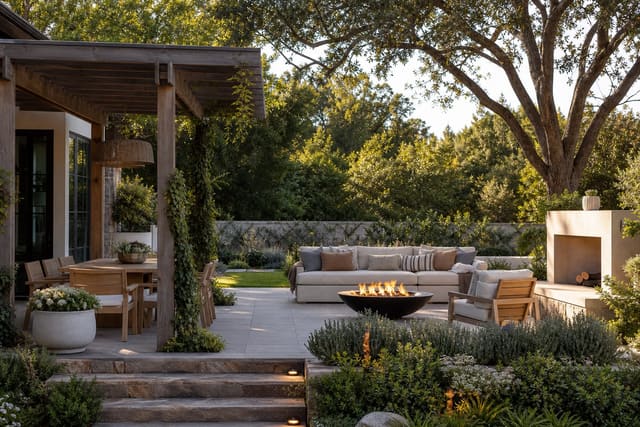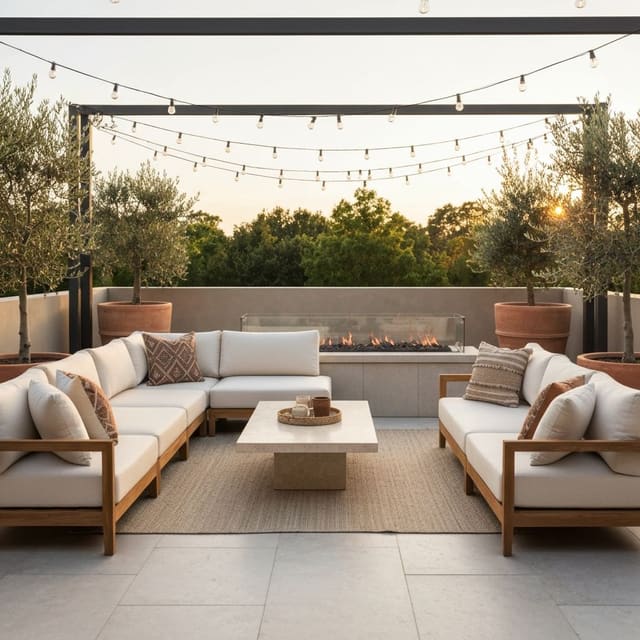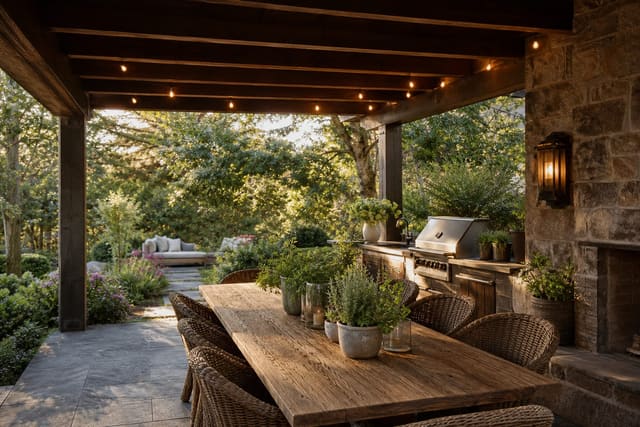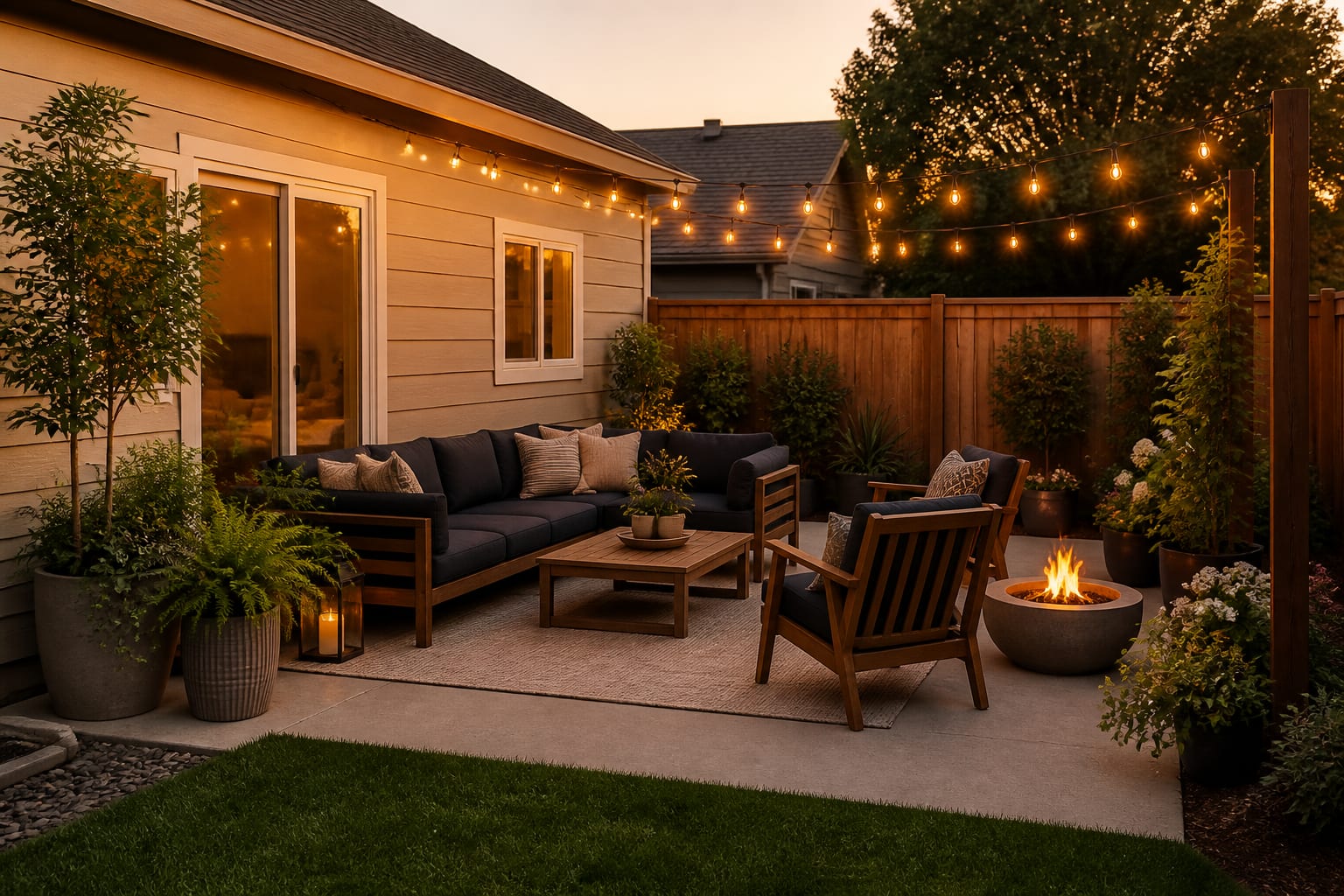
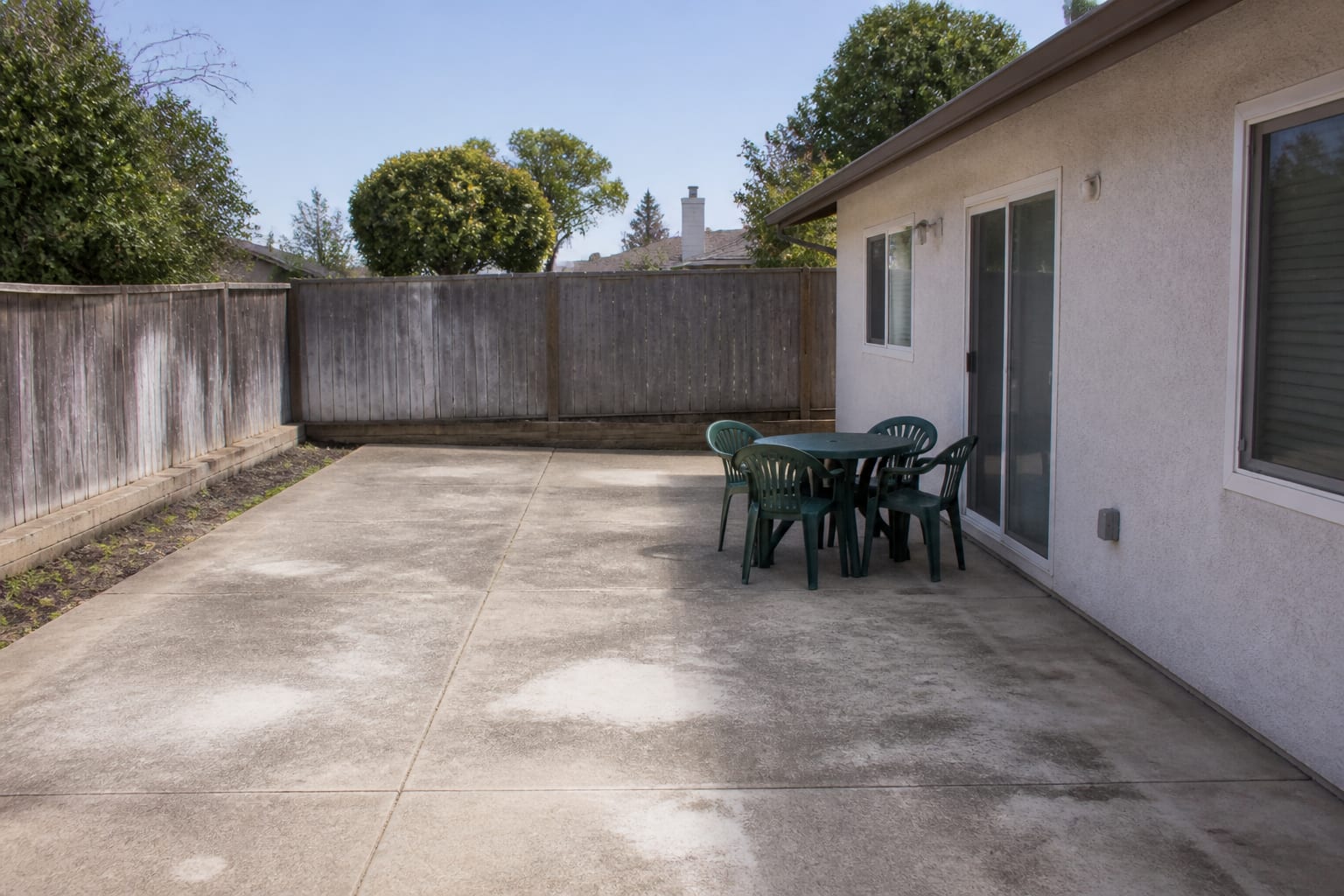
The matching four-chair patio set is the most predictable, least comfortable way to fill a backyard. My read is that those sets sell because they are easy to buy, not because anyone actually relaxes in stiff chairs arranged in a polite square nobody wants to sit in. A great outdoor seating area starts with how you want to gather, then chooses pieces to serve that, and it almost never looks like the boxed set at the garden center.
I think the real unlock is layering: mix a deep sectional with a couple of light chairs you can pull around, anchor it with a rug and a low table, and the space starts working like an outdoor living room instead of a furniture display. Get the layout and scale right and even a small slab can seat six in comfort.
Idea 1: Build a conversation zone, not a row
The first move away from the basic set is to stop lining furniture against the house. Pull seating into a loose square or L so people face each other within about 8 feet, the distance where conversation feels easy without raising your voice. A single sectional plus two pull-up chairs does this far better than four matching seats spaced evenly around the perimeter. The goal is a room-like cluster, the same logic that drives a good outdoor living room layout indoors and out.
Use these layout ideas to make a zone feel intentional:
- Anchor the group with an 8-by-10-foot outdoor rug so the seating reads as one room.
- Keep 18 inches between seats and the coffee table for legroom and drink reach.
- Leave a 30-inch walkway behind the seating so traffic does not cut through the conversation.
- Mix one heavy piece (a sectional or sofa) with two light chairs you can move.
- Add a low side table within arm's reach of every seat, roughly every 3 feet.
- Repeat one material, teak, black metal, or rope, across pieces so the mix still reads as a set.
The mix-and-match approach beats the boxed set precisely because it can grow and shift. Add a chair when guests come, pull one to the fire when it cools, and the area adapts instead of staying frozen in its showroom arrangement.
Idea 2: Built-in benches for small or awkward patios
When the slab is tight, built-in benches are the highest-capacity move you can make. A bench runs along a wall or wraps a corner and seats more people per square foot than any chair, roughly 30% more, because there is no gap between seats and no legs eating floor. An L-shaped bench in a corner turns dead space into the best seats in the yard.
Build the seat at 17 to 18 inches high, the same as an indoor sofa, and 22 to 24 inches deep so it is loungeable rather than perch-like. Top it with 4-inch quick-dry foam cushions in solution-dyed acrylic so they shrug off rain. The understructure can double as storage for cushions in the off-season, which is a real win when garage space is scarce. A built-in also frees the center of the patio for a table or a fire feature, the kind of dual-duty thinking that makes an outdoor dining area and a lounge coexist on one slab.
The payoff of a built-in is permanence in the good sense: it looks architectural, not bought, and it never blows over in a storm the way light chairs do. Soften all that hard edge with throw pillows and a side table so it reads as comfortable, not like stadium seating.
Idea 3: Anchor the area with a fire pit or low table
Every outdoor seating area needs a center of gravity, and a fire pit is the strongest one there is because it pulls people in and extends the usable season into cool evenings. Arrange seating in a loose circle 24 to 36 inches back from the pit edge: close enough for warmth, far enough to keep smoke and sparks off your shins. A 36 to 44-inch pit suits four to six seats; go larger only if the circle around it grows too.
If fire is not your thing, a generous low table does the same anchoring job. A coffee table roughly 18 inches high and at least 40 inches long gives every seat a place to set a drink and visually ties the cluster together. The scale matters: a tiny table floating in a big seating group looks lost, while a substantial one makes the whole arrangement feel deliberate.
Layer in light so the area works after sunset. Warm 2700K string lights overhead plus a lantern or two at seat height keep the zone usable once the sun drops, and they make the seating read as a destination rather than a patch of furniture you abandon at dusk. Hang the overhead run about 8 feet up so it clears heads but still pools light over the seats, and keep at least one low source at roughly 24 inches so faces stay lit and the group does not dissolve into silhouettes.
Shade is the daytime version of the same problem. A spot that bakes at noon goes unused no matter how nice the furniture is, so plan an umbrella, a sail, or a pergola over the seating zone before you buy cushions. Even a single 9-foot cantilever umbrella can rescue an exposed corner, and it makes the difference between a seating area you admire from indoors and one you actually sit in. The same anchoring and lighting principles run through my broader patio design ideas.
Use AI design to preview your outdoor seating area
The hard part of outdoor seating is scale outdoors: a sectional that feels huge in a showroom can look undersized against an open yard, and a fire-pit circle is hard to picture from a tape measure. Re-Design fixes the guesswork. Upload a photo of your patio or yard, and the AI design tool re-renders the same space as a sectional conversation zone, a built-in bench corner, or a fire-pit circle so you can judge the fit before anything is delivered.
Because you upload your real space, the previews keep your actual slab size, fence line, and house wall in frame, so the scale is honest. Try a deep sectional, then swap to an L-shaped bench, then add a fire pit and a rug, and compare which layout seats your crowd without crowding the yard, all before you haul home a single cushion.