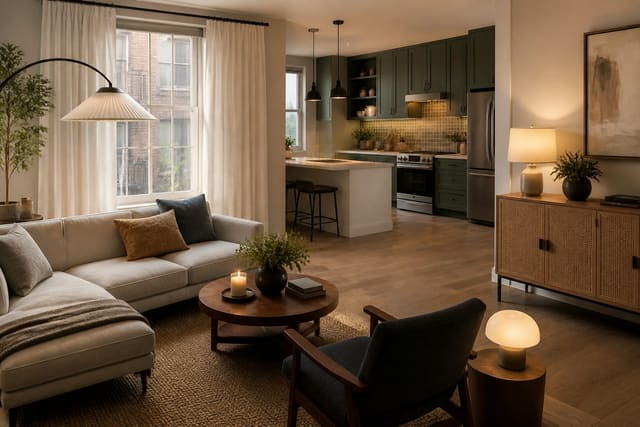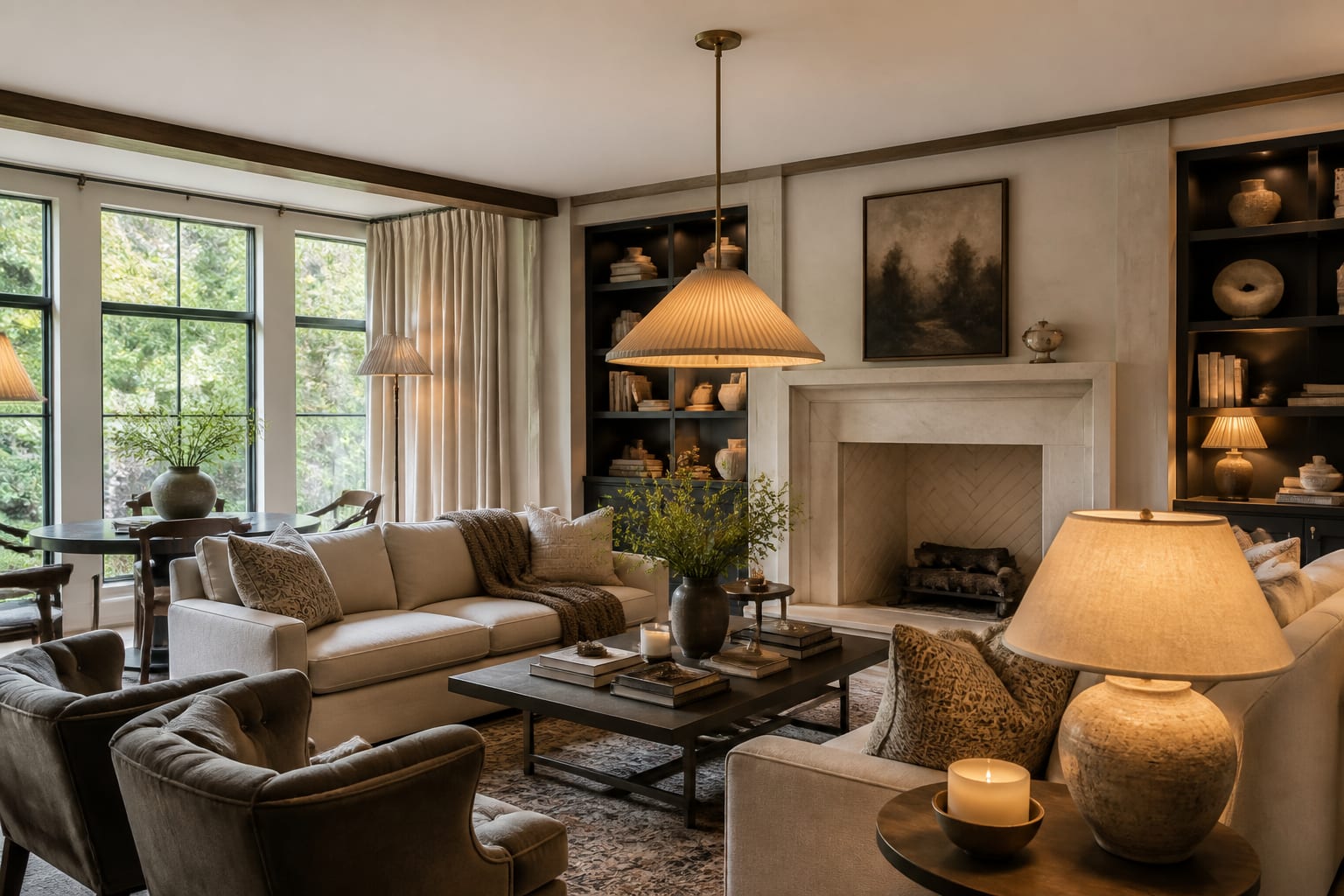
Most pendant lights are hung at the wrong height, and that single error undoes an otherwise good fixture. Too high and the pendant floats like an afterthought; too low and it blocks sightlines and bonks foreheads over an island. The right move is to treat hanging height, fixture diameter, and color temperature as one decision tied to the surface below and the people using it. A pendant over a kitchen island answers to different rules than one over a dining table or a nightstand, and getting those numbers right matters more than the fixture's style. Nail the placement and even a modest pendant reads as intentional lighting.
How high should a pendant hang?
Height is the make-or-break number, and it changes with the surface and the traffic beneath it. Over a kitchen island or a bar-height counter, hang the bottom of the pendant 30 to 36 inches above the countertop. That range clears the line of sight across the island, so people on opposite stools can see each other, while still pooling light onto the work surface. Taller cooks and 9-foot ceilings can push toward the 36-inch end; standard 8-foot ceilings usually look best near 30 to 32 inches.
Dining tables get a slightly lower hang, 28 to 34 inches above the tabletop, because no one walks through the space above a seated table. The lower fixture creates intimacy and frames the table as the room's center. For a pendant in an open walkway, a foyer, or a stairwell, the rule flips to clearance: keep the bottom of the fixture at least 7 feet off the floor so nobody walks into it, and higher in a two-story foyer where the pendant reads from the floor above. Beside a bed, hang reading pendants 24 to 30 inches above the mattress top with the cord positioned so the light falls on the page, not your eyes.
These heights also help in compact rooms, where a well-placed pendant frees the floor and nightstands; our guide to AI interior design for small spaces leans on exactly that move.
Sizing and spacing pendants correctly
A pendant that is the wrong diameter throws the whole room off, so size it with math rather than guesswork. For a single pendant lighting a room, add the room's length and width in feet, then read that sum as inches for the fixture's ideal diameter. A 12-by-14-foot room sums to 26, which points to roughly a 26-inch fixture or cluster. For a pendant over a table, aim for a fixture that is about half to two-thirds the table's width, so a 36-inch round table wants an 18- to 24-inch fixture, leaving 6 inches of clearance to each table edge.
Multiple pendants over an island follow spacing rules that keep them balanced. Center the row on the island's length and width, space the fixtures 24 to 30 inches apart on center, and hold the end pendants at least 6 inches in from the island's ends so they do not crowd the corners. Two pendants suit an island up to about 6 feet; three pendants suit a 7- to 9-foot island. For odd numbers, center the middle fixture on the island's midpoint and work outward. Matching the pendant count to the island length is what makes a kitchen look professionally lit rather than improvised.
Color temperature and bulb choices by room
The warmth of the light matters as much as the fixture, and the right Kelvin value depends on the room's job. For living rooms, dining rooms, and bedrooms, choose 2700K to 3000K, a warm white that flatters skin, wood, and food and keeps the evening mood relaxed. Over a dining table specifically, 2700K candle-warm light makes the table feel inviting and makes a meal look its best. This is the range to default to anywhere comfort outranks task precision.
Kitchen work zones can take a cooler, crisper light. Over an island where you chop and read recipes, 3000K to 3500K gives cleaner contrast without tipping into the bluish, clinical feel of 4000K and above. Whatever the temperature, prioritize a high color rendering index, ideally 90 or above, so colors look true under the light. Put pendants on a dimmer wherever you can, since the ability to drop a 3000K island light to a soft glow for evenings doubles the fixture's range. For wattage, target roughly 450 to 800 lumens per pendant over a table and more over a busy island, then dim to taste rather than living with a fixture that only runs at full blast. Renters can get most of this effect with a plug-in swag pendant and a smart bulb; our AI room design for a rental apartment guide covers no-drill lighting swaps.
Common mistakes to avoid
- Hanging a lone pendant so high that the bare bulb glares straight into sightlines across the open room.
- Picking a fixture scaled for a nightstand to float over an island that needs far more visual weight.
- Mixing warm 2700K and cool 4000K bulbs in one open plan so the light reads patchy and uneven after dark.
- Skipping a dimmer, which locks the fixture at one brightness instead of shifting from task to evening mood.
The most frequent pendant mistake is hanging too high to avoid the fear of a low fixture, which leaves the light stranded near the ceiling and the surface below underlit. Trust the 30-to-36-inch island range and the 28-to-34-inch table range; they look low on paper and correct in the room. The opposite anti-pattern, hanging a wide drum pendant low over a high-traffic island, blocks sightlines and invites collisions, so favor slimmer or higher fixtures where people move.
A second mistake is the wrong scale, a dainty 10-inch pendant marooned over a 9-foot island or an oversized fixture crowding a small table. Run the sizing math first. The third is centering pendants on the room instead of on the surface they light, which leaves the fixtures visibly off from the island or table below; always align to the furniture, not the walls. The fourth is mismatched color temperatures across one open space, where a 2700K dining pendant fights a 4000K kitchen, making the whole area feel disjointed. Keep an open floor plan within about 500K of itself. The last is skipping the dimmer, which locks you into one brightness and one mood when a single switch could have given you several.
See it first in Re-Design
Fixture scale and hanging height are nearly impossible to judge from a catalog photo, so previewing them in your own kitchen pays off fast. Upload a photo of your island, dining table, or entryway into Re-Design and re-design the ceiling with pendants at the height and diameter you are weighing, then read whether a 26-inch fixture overwhelms the table or a trio of small globes looks balanced over the island. You can test two pendants against three, swap a warm globe for a cooler linear fixture, and check the sightline across the island before you drill a single hole or call an electrician for the rough-in.
Frequently Asked Questions
How high should a pendant hang over a kitchen island?
Hang the bottom of the fixture 30 to 36 inches above the countertop. That keeps the light on the work surface while preserving sightlines across the island so seated guests can see one another. Lean toward 30 to 32 inches on 8-foot ceilings and up to 36 inches on taller ones.
What size pendant do I need?
For a single fixture lighting a room, add the room's length and width in feet and treat the sum as inches of diameter, so a 12-by-14 room suggests about a 26-inch fixture. Over a table, choose a fixture about half to two-thirds the table's width, leaving roughly 6 inches of clearance per side.
How many pendants should I hang over an island?
Match the count to the island length: two pendants for islands up to about 6 feet, three for 7- to 9-foot islands. Space them 24 to 30 inches apart on center, hold the ends at least 6 inches in from the island edges, and center the row on the island.
What color temperature is best for pendant lights?
Use 2700K to 3000K warm white in living, dining, and bedroom spaces for a relaxed, flattering glow. Step up to 3000K to 3500K over kitchen work zones for crisper task light, and keep an open floor plan within about 500K of itself so the lighting reads as one cohesive scheme.