Cover the popcorn ceiling with 1/4 in. drywall, install tongue-and-groove planking, or skim-coat over it — each avoids the asbestos exposure risk of scraping a pre-1980 textured ceiling. The best popcorn ceiling alternatives balance cost, lost headroom, and how much dust you can tolerate. Skim coating gives the cleanest modern look for $2 to $4 per sq ft but takes 3 to 5 days. Planks add warmth for $4 to $9 per sq ft and cost 5/8 in. of height. Drywall overlay is the most permanent fix at $3 to $7 per sq ft with a 1/2 in. height loss.
How do you deal with a popcorn ceiling without removing it?
The right choice depends on ceiling height, asbestos status, and whether the existing texture is sound. Measure floor to ceiling first: under 8 ft, you can't lose much height, so skim coat or beadboard wins. At 8 ft to 9 ft, drywall overlay and planks both work. Above 9 ft, tin tile and beam-and-plank become options because the room can absorb the visual weight.
Test the texture if the house predates 1980. A DIY mail-in asbestos kit runs $30 to $50 and takes 5 business days. If positive, all cover methods remain safe — you just can't scrape or sand through the texture. Planks screwed through into joists with a sealed underlayment are the contractor-preferred path; for skim coating, a sprayed bonder seals the texture first.
Check whether the popcorn is shedding by running a soft brush across a corner. Loose chunks mean the texture isn't a sound substrate — knock it down (test first) or laminate a stable underlayment before finishing. A low ceiling room design tricks audit is worth doing alongside this, since paint, lighting, and trim moves can visually raise the ceiling more than the cover itself.
Compare popcorn ceiling alternatives on cost, headroom, and disruption
Numbers reflect 2025 mid-market US averages including labor for a 200 sq ft room; DIY cuts labor roughly 60% but adds rental and learning-curve time.
| Alternative | Cost per sq ft | Height lost | DIY friendly | Best room |
|---|---|---|---|---|
| Skim coat | $2 to $4 | 0 in. | No (3-day skill) | Living, bedroom |
| 1/4 in. drywall overlay | $3 to $7 | 1/2 in. | Yes (2 people) | Any |
| Tongue-and-groove planks | $4 to $9 | 5/8 to 3/4 in. | Yes | Living, dining |
| Beadboard panels (4x8) | $3 to $6 | 1/4 in. | Yes | Bath, kitchen, porch |
| Tin tile (drop-in or nail-up) | $8 to $15 | 1/4 to 1 in. | Yes if nail-up | Kitchen, dining, foyer |
| Acoustic spray (commercial) | $1 to $2 | 0 in. | No | Basements, garages |
| Scrape and re-texture | $1 to $3 | 0 in. | Yes if no asbestos | Any (post-1980) |
Three shortcuts that work on real projects:
- Under 8 ft and under $1,000 budget: skim coat. Headroom matters more than a plank or tin upgrade.
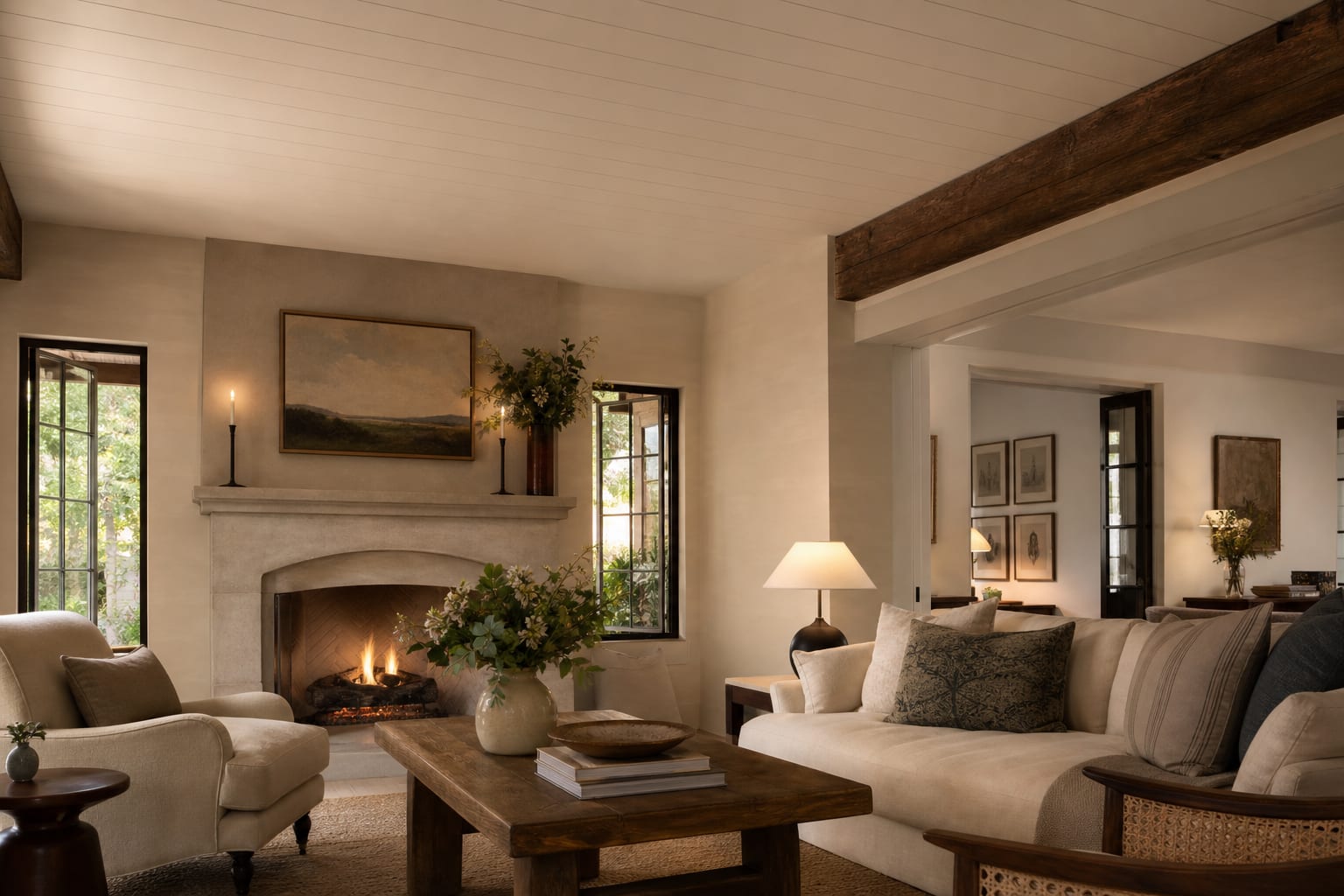
- 8 ft 6 in. or taller and want character: tongue-and-groove white planks at $4 to $9 per sq ft. The coffered ceiling diy cost breakdown extends the same logic to coffered panels later.
- Asbestos-positive and want permanence: 1/4 in. drywall overlay screwed to joists with sealed seams. It encapsulates the asbestos forever and disappears once mudded and painted.
Preview a planked or smooth ceiling on your own living room photo before committing. Seeing tin tile next to plank against your actual wall color settles the decision faster than any sample board.
Common popcorn ceiling mistakes to avoid
- Scraping an untested pre-1980 ceiling. Uncontained asbestos scraping can contaminate an entire HVAC system; the $30 to $50 test is cheap insurance.
- Skipping joist location. Stud finders read joists through popcorn texture only about 70% reliably — tap-test and confirm with a 1/8 in. pilot hole before driving screws.
- Skim coating without sealing first. Compound applied straight to popcorn pulls the texture off as it dries; use a bonder primer, then plan on 2 to 3 skim coats.
- Forgetting trim. A new ceiling plane sits below existing crown molding, so budget $4 to $8 per linear ft to reinstall it — a 200 sq ft room has about 60 ft of perimeter.
- Ignoring lighting. Recessed cans no longer sit flush after an overlay; add cans with adjustable trim rings or lean on a fake natural light any room strategy with warm 2700K wall washers.
Use AI design to preview popcorn ceiling alternatives before you commit
A skim coat and a white plank ceiling read completely differently in the same room with the same furniture. Upload a straight-on photo from one corner, showing the full ceiling and a wall down to the floor, and render a smooth skim, a white tongue-and-groove plank, and a pressed tin tile on the same angle.
Be specific: ask for a matte white skim at the existing height, a 6 in. white plank with a 5/8 in. drop, or a 12 in. pressed tin tile in antique copper. If the planks make the room feel cave-like, that's a real signal to go with skim coat instead. If tin tile makes the dining table read as a defined zone, you have a case for the bigger budget.
Frequently Asked Questions
Do all popcorn ceilings have asbestos?
No, but any popcorn ceiling installed before the 1978 US ban on asbestos in spray texture can contain it, and installations from existing inventory continued into the early 1980s. A $30 to $50 mail-in test confirms status in 5 business days. Post-1985 ceilings are essentially asbestos-free, but testing anything older is still worth it without construction records.
Can I install planks over popcorn?
Yes. Tongue-and-groove planks install directly over popcorn using furring strips or screws into the joists, leaving the texture sealed and undisturbed. Skip furring strips on texture under 1/4 in. thick and screw planks directly instead. Budget 5/8 in. to 3/4 in. of headroom loss including plank thickness.
How much ceiling height will I lose?
Height loss ranges from 0 in. for skim coat to 1/4 in. for beadboard, 1/2 in. for 1/4 in. drywall overlay, 5/8 to 3/4 in. for planks, and up to 1 in. for nail-up tin tile. In rooms already at 8 ft, anything over 1/2 in. starts feeling low. Below 7 ft 6 in. finished, stick to skim coat or beadboard.
What is the cheapest popcorn cover-up?
Scrape-and-re-texture or skim coat is cheapest at $1 to $4 per sq ft if the ceiling isn't asbestos-positive. A DIY 1/4 in. drywall overlay runs $1 to $2 per sq ft in materials plus a weekend of two-person labor. Avoid the cheapest spray-on DIY textures — they look temporary and need redoing within 5 years.
What is the best look for a rental?
Skim coat to a smooth flat ceiling for a rental. It's the most neutral, holds up best under tenant turnover, and never looks dated. Budget $400 to $800 for a 200 sq ft room professionally skim coated; faster listings and better photos typically pay that back inside 6 months.